
What Is Agency Vertical Specialization for B2B Sales
What Is Agency Vertical Specialization for B2B Sales
TL;DR:
- Agency vertical specialization focuses solely on a single industry, enabling faster onboarding and higher message relevance. Such specialization results in predictable pipeline growth, reduced costs, and higher conversion rates by leveraging industry-specific knowledge and proven playbooks. Choosing a true vertical specialist depends on sales cycle length, internal capacity, and budget, with real evidence of revenue concentration and results being key evaluation criteria.
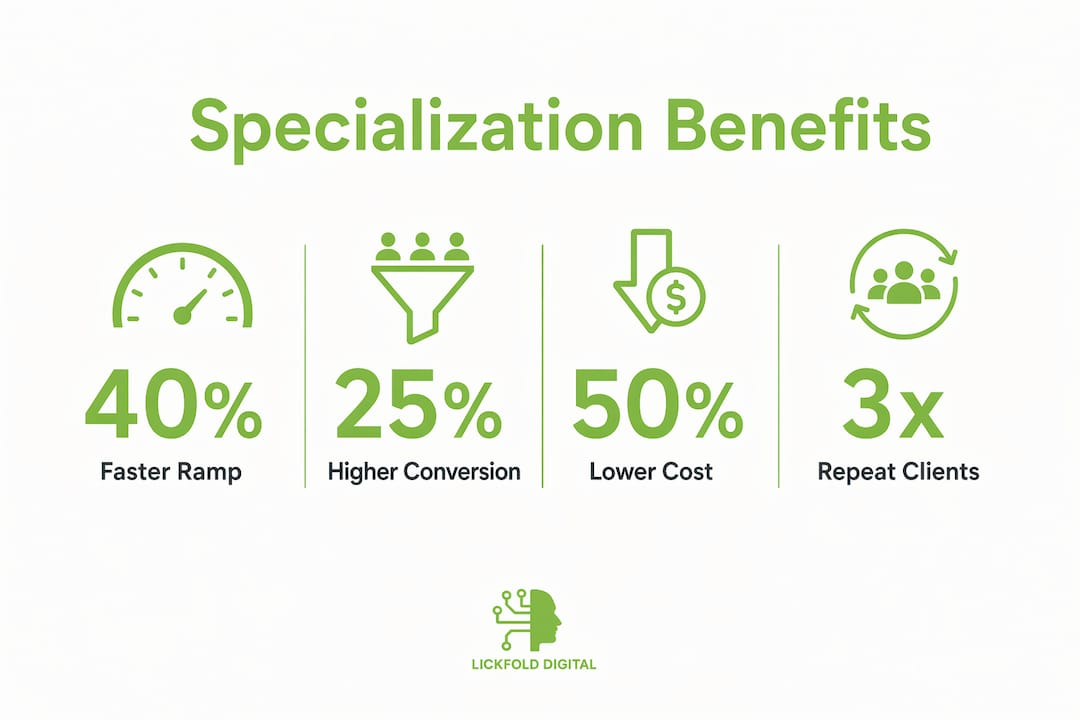
Agency vertical specialization is when an agency concentrates its strategy, playbooks, and delivery inside a single industry rather than spreading across many. For B2B buyers evaluating AI-driven outbound sales partners, that focus translates directly into three things: faster ramp time because the agency already knows your buyer committee, higher message-to-meeting conversion because messaging is calibrated to your industry’s language, and lower total cost because fewer revision cycles are needed to get outreach right.
Three reasons this matters if you’re buying AI-driven outbound sales automation:
- Faster time-to-productivity. A vertical specialist already knows your category’s buying triggers, objections, and compliance constraints. You don’t spend the first 60 days educating them.
- Higher conversion from targeted messaging. Industry-calibrated prompts and prospect models produce outreach that resonates, not generic sequences that get ignored.
- Predictable pipeline. Repeatable playbooks mean the agency runs the same proven motion for your vertical, not a custom experiment each time.
Table of Contents
- What agency vertical specialization actually means
- Why vertical specialization changes outcomes for B2B buyers
- Specialist vs. generalist: how to decide
- How to evaluate a vertical-specialist agency
- What vertical specialization looks like for AI-driven outbound sales
- How agencies build repeatable playbooks: timeline and cost
- How Lickfold Digital applies vertical specialization to AI outbound
- Key Takeaways
- Why specialists win in complex B2B outbound
- Lickfold Digital: AI outbound built on a specialist model
- Sources and further reading
What agency vertical specialization actually means
A vertical specialist concentrates strategy, demand generation, and delivery inside one industry. The agency sells category outcomes, such as a qualified SaaS pipeline or fintech meetings booked, across multiple services rather than selling a single service across every industry it can find.
Four structural components separate a real vertical specialist from a generalist with a niche landing page:
- Buyer fluency. The team knows the titles, reporting structures, and decision triggers in your category without being briefed.
- Message-market calibration. Copy, sequences, and positioning are pre-tuned to the industry’s language, not adapted from a generic template.
- Channel economics. The agency knows which channels convert in your vertical and at what cost, because they’ve run the numbers across multiple clients in the same space.
- Repeatable playbooks. Documented processes that compress setup time and reduce cost-per-test through reuse. Vertical markets also allow agencies to justify premium pricing because their tailored solutions carry measurably higher value.
The clearest framing: vertical specialization is revenue concentration plus repeatable playbooks. An agency that earns a substantial portion of its revenue from one vertical and has documented playbooks for that vertical is a specialist. An agency that lists 12 industries on its website is not.
Pro Tip: Ask any agency what portion of their active clients are in your vertical. If the answer is low, their “specialization” is a marketing claim, not an operating model.
Why vertical specialization changes outcomes for B2B buyers

Long sales cycles and complex buying committees punish generic outreach. When a deal takes many months to close and involves multiple stakeholders, every misaligned message costs real pipeline time. Specialists develop pattern recognition for buying committees, compliance constraints, and long sales cycles that generalists simply haven’t accumulated.
Buyer-facing benefits, in order of impact:
- Lower onboarding time. No industry education required. The agency arrives knowing your vernacular, your regulatory environment, and your buyer’s objections.
- Higher message-to-meeting conversion. Targeted messaging produces better conversion rates and higher retention because services feel custom-built rather than repurposed.
- Improved pipeline predictability. Proven playbooks mean you can forecast results based on prior performance in your category, not hope.
- Better channel selection. A specialist already knows whether LinkedIn sequences, cold email, or event-based outreach converts in your vertical, and at what cost.
Data from Pick an Agency’s analysis of a large number of agencies shows that most agencies offer three or fewer services, and specialists consistently maintain higher ratings in focused disciplines. That concentration isn’t accidental. It’s what makes the work better.
Specialist vs. generalist: how to decide
Choose based on your internal coordination capacity, budget, and whether your problem needs category-specific pattern recognition. That’s the short answer. Here’s how to apply it:
- You have an internal marketing lead or fractional CMO. Hire a specialist. They can coordinate vendors and translate specialist outputs into broader strategy.
- You lack internal marketing leadership. A generalist simplifies coordination. One vendor, one point of contact, fewer handoffs. When internal marketing leadership is absent, a generalist reduces friction even if it sacrifices depth.
- Your category has a 9+ month sales cycle or a multi-stakeholder buying committee. A specialist pays off. The pattern recognition they bring is worth the coordination overhead.
- Your budget is tight and your category is relatively simple. A generalist is a reasonable starting point. Specialists charge higher rates, though they often reduce total project cost through faster execution and fewer revisions.
- You’re entering a new category with no prior data. Be cautious. Specialization works best when it’s built on proven, repeatable expertise, not an aspirational niche.
Pro Tip: A hybrid model works well for mid-market B2B companies: a fractional CMO or strategic generalist handles coordination and brand, while a vertical specialist handles outbound execution. You get depth where it matters without losing coherence.
How to evaluate a vertical-specialist agency
A real specialist demonstrates repeatable results, category references, and templates that cut ramp time. Here’s what to check before signing anything.
Evaluation checklist:
- Documented playbooks with artifacts you can review before engagement
- Revenue concentration: a substantial portion of active clients—at least 40%—in your vertical
- Real case studies with named metrics (conversion rates, CAC, qualified leads per month)
- Team titles that map to your buyer committee (not just “account manager”)
- Sample outreach sequences from prior campaigns in your category
- References from clients in your vertical you can actually call
Eight interview questions worth asking:
- What percentage of your current clients are in our vertical?
- What’s your typical onboarding timeline before the first outreach goes live?
- What does your standard playbook look like for our category?
- What KPIs do you track, and how do you report them?
- What’s the average sales cycle length for clients in our space?
- Can you share anonymized results from a pilot in our vertical?
- How do you handle reply qualification before passing leads to our sales team?
- What’s your process when a campaign underperforms?
Red flags: vague case studies with no metrics, inability to name the percentage of vertical revenue, no documented playbook artifacts, and references that don’t match your category. Building authority in B2B services takes years of real client work. An agency that can’t show the receipts probably doesn’t have them.
What vertical specialization looks like for AI-driven outbound sales
A vertical specialist for AI outbound combines vertical data models, industry-specific prompts, and mapped buying committees to produce higher-quality outreach at scale. The difference from a generalist running the same tools is not the technology. It’s the training data and the targeting logic behind it.
What a true specialist builds for AI-driven outbound:
- Industry-trained AI agents that recognize relevant job titles, company signals, and buying triggers specific to the vertical
- Dedicated prospect data models built from prior campaigns in the category, reducing false positives in prospect matching
- Warm-up and deliverability infrastructure configured for the sending volumes and domain reputation requirements of the vertical’s typical campaign cadence
- Multi-touch outreach cadences with messaging calibrated to the category’s objections and decision timeline
- Human reply qualification before leads reach your sales team, so your reps only engage with genuinely warm prospects
For AI-driven outbound, the real advantage comes from vertical-trained data models and prompt libraries that lower false positives in prospect matching and increase meeting quality. Key metrics to track: time-to-first-qualified-lead, email deliverability rate, and meeting-to-opportunity conversion. A specialist should be able to give you benchmarks for all three from prior campaigns in your vertical.
How agencies build repeatable playbooks: timeline and cost
A repeatable playbook compresses setup time and reduces cost-per-test through reuse. That’s the core economic argument for specialization. Here’s what the workstream typically looks like:
| Stage | Typical Duration | What Happens |
|---|---|---|
| Discovery and ICP mapping | 1–2 weeks | Buyer committee mapping, vertical data audit, messaging brief |
| Playbook customization | 1–2 weeks | Adapting templates, building prospect lists, configuring AI agents |
| Infrastructure setup | 1 week | Domain warm-up, deliverability configuration, CRM integration |
| Pilot outreach | 3–4 weeks | First campaign wave, reply qualification, initial conversion data |
| Optimization | 2–3 weeks | Sequence tuning, list refinement, KPI review |
| Scale | Ongoing | Full cadence deployment, reporting cadence, expansion |
Cost drivers to understand before you budget:
- Data licensing for vertical-specific prospect lists
- AI model tuning and prompt library development
- Deliverability infrastructure (dedicated domains, warm-up accounts)
- Human qualification of replies before handoff to sales
Pro Tip: Never evaluate an agency on hourly rates alone. Measure total cost-to-value: a specialist charging more per hour but delivering a qualified pipeline in six weeks beats a generalist charging less who takes four months to figure out your category.
For a practical workflow that maps to these stages, the agency business development workflow guide covers how specialists structure their pipeline motions from discovery through scale.
How Lickfold Digital applies vertical specialization to AI outbound
Lickfold Digital deploys dedicated AI agents, category-specific prospect data models, and full deliverability infrastructure to reduce ramp time and improve outreach quality for B2B buyers. The model is built on repeatable playbooks, not custom experiments, which means faster time-to-first-qualified-lead and more predictable pipeline from day one.
Lickfold’s service structure maps directly to what a vertical specialist should deliver:
- AI prospecting agents trained to identify decision-makers matching a client’s ideal customer profile within a specific vertical
- Decision-maker mapping across buying committees, so outreach reaches the right titles at the right time
- Multi-touch outreach campaigns with personalized messaging, not generic sequences
- Warm-up and reputation management to protect deliverability across the campaign lifecycle
- Human qualification of replies before opportunities reach the client’s sales team
When evaluating Lickfold for your vertical, ask for sample playbook artifacts from prior campaigns in your category, anonymized pilot results showing deliverability and conversion metrics, and reference calls with clients in a similar space. A specialist that can’t provide those three things isn’t operating as a specialist. Lickfold’s approach to landing enterprise clients follows the same pattern recognition model described throughout this article.
Key Takeaways
Agency vertical specialization delivers faster ramp, higher conversion, and more predictable pipeline when the agency’s playbooks are built on real revenue concentration in your category, not a marketing claim.
| Point | Details |
|---|---|
| Definition | Vertical specialization is revenue concentration plus repeatable playbooks inside a single industry. |
| When to choose a specialist | Choose a specialist when your sales cycle exceeds 9 months or your buying committee has multiple stakeholders. |
| Evaluation standard | Require proof: a substantial portion of vertical revenue share—at least 40%—plus documented playbooks and named case-study metrics. |
| AI outbound advantage | Vertical-trained data models and prompt libraries reduce false positives and increase meeting quality. |
| Lickfold | Lickfold deploys dedicated AI agents, decision-maker mapping, and human reply qualification as a repeatable specialist model for B2B outbound. |
Why specialists win in complex B2B outbound
Specialists win when buyers need faster time-to-productivity and industry-calibrated messaging. That’s my position, and the data from 47,000 agencies backs it up.
What most articles miss is the compounding effect. A specialist’s second client in a vertical is cheaper to onboard than the first. Their third is cheaper still. By the time they’ve run ten campaigns in your category, their playbook is a tested asset, not a hypothesis. That’s the real moat, and it’s why revenue concentration matters more than any claim on a website.
That said, specialization has limits. If you’re entering a genuinely new category with no established buying patterns, a specialist’s playbook may be built on assumptions that don’t transfer. And if your budget is tight enough that you can’t afford the coordination overhead of managing a specialist alongside internal resources, a generalist is the honest answer. Specialization is a multiplier on existing pattern recognition. When that pattern recognition doesn’t exist yet, you’re paying for aspiration, not expertise.
For AI-driven outbound specifically, the risk of hiring a generalist is higher than in most categories. The margin between a well-trained AI agent and a poorly-trained one shows up immediately in deliverability rates and prospect quality. That’s not a gap you want to close through trial and error on your own pipeline.
Lickfold Digital: AI outbound built on a specialist model
If you’ve read this far, you already know what to look for in a specialist. Lickfold delivers exactly that for B2B outbound: dedicated AI agents trained to your vertical, full deliverability infrastructure, decision-maker mapping, and human qualification before any lead touches your sales team. No generic sequences, no six-month ramp to figure out your category.
The difference is a proven playbook, not a promise. When you reach out, come prepared with your ideal customer profile, your current outbound metrics (or lack of them), and a sense of the verticals you’re targeting. That’s all Lickfold needs to scope a pilot conversation.
Start that conversation here and see what a specialist model looks like applied to your pipeline.
Sources and further reading
- The Starr Conspiracy: Vertical-Specialist B2B Marketing Agency — defines the operating model and revenue concentration framing used throughout this article
- Pick an Agency: Do Specialist Agencies Beat Generalists? — source for the 47,000-agency dataset, specialist ratings data, and cost-to-value analysis
- Quantopia: Vertical Markets Explained — supports buyer-facing benefits including conversion lift and retention
- Investopedia: Vertical Markets — industry-standard definition and pricing implications
- The Go Network: Agency Specialisation — source for the “specialize in what you already have” principle
- Six Point Strategy: Vertical vs. Horizontal Expertise — supports AI outbound pattern recognition and buying committee mapping
- Lickfold: Building authority in B2B services — how specialists build proof points over time
- Lickfold: Agency business development workflow — practical workflow mapping to specialist pilot timelines
- Lickfold: How agencies land enterprise clients — go-to-market motions for long-cycle B2B sales
- MOGHQ: Business intake and operations — practical framework for operationalizing specialist playbooks and demand generation