
The Role of Positioning in Agency Sales Success
The Role of Positioning in Agency Sales Success
TL;DR:
- Effective agency positioning focuses on defining a clear niche, client problem, and operational choices.
- It shifts sales from price competition to diagnosing client issues, leading to higher close rates and premium pricing.
Positioning in agency sales is the strategic decision about who you serve, what specific problem you solve, and why a prospect should choose you over every other option. That single decision shapes your close rates, your pricing power, and the quality of every sales conversation you have. Agencies with clear, tight positioning command 30% or more in price premiums and close deals with a fraction of the prospect volume that generalist agencies require. The role of positioning in agency sales is not a branding exercise. It is the operating foundation your entire sales process runs on.
How positioning transforms your sales process and outcomes
Positioning changes the fundamental dynamic of a sales conversation. Without it, you are a vendor competing on price. With it, you are a specialist diagnosing a problem, and that shift changes everything.

The framework that captures this best is the Doctor Frame. A doctor does not walk into an exam room and pitch their services. They ask questions, assess symptoms, and prescribe a solution. That posture is only credible when the doctor has a clear specialty. The same logic applies to agency sales. The Doctor Frame sales posture requires a clearly defined specialty. Without one, you default to the Vendor Frame, where the conversation collapses to price and timeline.
The sales outcomes from tight positioning are concrete and measurable:
- Higher close rates. Positioned agencies close more deals per pitch because prospects arrive pre-qualified and already aligned with the agency’s specialty.
- Shorter sales cycles. Prospects make faster decisions when the agency’s value is specific and clear, not generic.
- Pricing premiums. Specialist agencies achieve 30% or more in price premiums over generalist competitors because they are selling expertise, not capacity.
- Better lead quality. Clear positioning filters out poor-fit prospects before they reach a senior sales conversation.
- Pipeline predictability. When positioning is tight, prospects self-qualify before calls, which reduces wasted meetings and speeds up decision-making.
The math is stark. A positioned agency closing 5 high-fit deals at a 50% close rate generates the same revenue as a generalist agency grinding through 50 low-quality prospects. That is a 90% reduction in required prospect volume.
Pro Tip: Use a 15-minute triage call before any full discovery meeting. This single gate protects senior sales time and disqualifies poor-fit prospects before they consume hours of pipeline attention.
What true agency positioning entails beyond messaging
Most agencies treat positioning as a tagline problem. They rewrite their homepage headline, update their LinkedIn bio, and call it done. That is not positioning. That is messaging. The difference matters enormously in sales.
True positioning is an operational decision. It dictates:
- Who you accept as a client and, more critically, who you refuse.
- What problems you own and which ones you refer out.
- How you price your work, because specialists price on value, not hours.
- Who you hire, because your team’s expertise must match your declared specialty.
- Which projects you take on, even when a lucrative off-positioning deal lands in your inbox.
Positioning requires operating decisions about who to serve, what problems to own, and what work to refuse. Messaging flows from those choices, not the other way around.
The failure mode most agencies fall into is what practitioners call the “So That” gap. An agency declares a positioning statement but does not change any of its actual business decisions. The positioning sits on the website while the sales team pitches anyone who calls. The result is inconsistent messaging, confused prospects, and stalled deals.
“Positioning is a way of running the business. It must align sales, delivery, hiring, pricing, and marketing to be authentic and effective. The operational gap between declared positioning and agency behavior leads to lost sales.”
Agencies with beautiful branding but weak operational positioning struggle to close because prospects sense the inconsistency. A prospect who reads “we specialize in SaaS onboarding” on your website and then hears a generic pitch about your full-service capabilities will not trust your specialty claim. Authentic positioning shows up in every touchpoint, from the first email to the final proposal.
Effective tactics for positioning an agency to optimize sales strategy
Building positioning that actually improves sales requires specific choices, not general intentions. The following framework gives you a practical path from vague to specific.
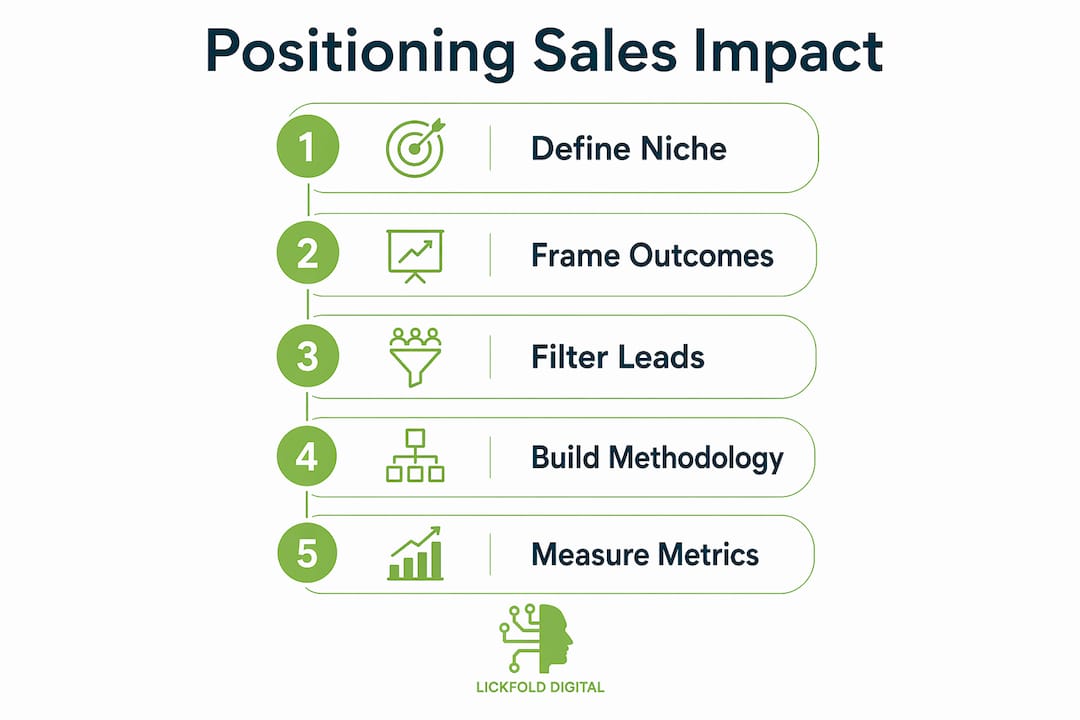
Define your niche with buyer-level specificity
Generic niches do not work. “We serve B2B companies” is not a niche. Effective positioning names the buyer with specific business challenges, not broad categories. A strong niche statement names the industry, the company size, the role of the buyer, and the specific problem they face. For example: “We help Series A SaaS companies reduce onboarding churn in the first 90 days.”
Frame your value around client outcomes, not deliverables
Selling “React app development” is a deliverable. Selling “a solution to onboarding churn for SaaS companies” is an outcome. Articulating positioning in client problem terms shifts the buyer’s mindset from vendor selection to expert engagement. That shift enables value-based pricing and removes price as the primary decision factor.
Build a repeatable sales methodology
Your sales process should reflect your positioning. Every discovery call, proposal, and follow-up should reinforce your specialty. Proposals centered on client outcomes and fit, not service lists and hourly rates, close faster and at higher values.
Use positioning to filter, not just attract
Positioning is as much about saying no as saying yes. Agencies that consistently refuse projects outside their positioning maintain higher margins and better sales focus. Every off-positioning deal you accept dilutes your specialty claim and weakens your next sales conversation.
The table below summarizes the core elements of effective agency positioning and what each looks like in practice.
| Positioning element | Weak version | Strong version |
|---|---|---|
| Target buyer | “B2B companies” | “Series A SaaS founders with churn problems” |
| Problem owned | “Digital marketing” | “Reducing onboarding drop-off in the first 90 days” |
| Differentiation | “We’re a full-service agency” | “We use a proprietary 5-step onboarding audit” |
| Pricing model | Hourly rates | Outcome-based retainers |
| Sales filter | Accept all inbound | Triage call to disqualify poor fits |
Pro Tip: When writing your positioning statement, test it with the “So That” filter. “We do X so that our clients achieve Y.” If you cannot complete that sentence with a specific, measurable outcome, your positioning is not tight enough yet.
Understanding your ideal client profile is the foundation of every element in this table. Without that clarity, every other tactic is guesswork.
How do you measure the impact of positioning on sales performance?
Positioning’s effect on sales shows up in your funnel metrics before it shows up in your revenue. The key is knowing which numbers to watch.
Industry benchmarks for 2026 recommend that high-performing agencies target 6–10 discovery calls, 4–6 proposals, and 2–3 closes per month. Those ratios assume stage gates like triage calls to disqualify poor-fit prospects early. If your funnel looks dramatically different, your positioning may be the cause.
The metrics most directly tied to positioning strength are:
- Close rate per proposal. A positioned agency closes a higher percentage of proposals because proposals only go to qualified, high-fit prospects.
- Average deal size. Positioning enables value-based pricing, which lifts deal size without requiring more volume.
- Lead volume needed to close one deal. Tight positioning reduces this number significantly. A 90% reduction in required prospect volume is achievable with specialist positioning.
- Sales cycle length. Misaligned positioning shows up as prolonged sales cycles where prospects stall, ask for more options, or go silent.
Misalignment between positioning and sales behavior is visible in the data. Stalled deals, frequent price objections, and low proposal-to-close ratios all signal that your positioning is not doing its job. The fix is rarely more outreach. It is sharper positioning.
Pro Tip: Run a quarterly win/loss analysis. For every deal you lost, ask whether the prospect was inside or outside your defined positioning. If most losses are off-positioning prospects, your qualification process needs tightening, not your pitch.
AI-driven prospecting, like the approach Lickfold uses, amplifies this effect. When your positioning is tight, AI agents can identify and engage decision-makers who match your ideal client profile with far greater accuracy. The result is a pipeline filled with prospects who already fit, which makes every sales conversation more productive. Agencies using AI for prospecting report measurable gains in sales efficiency when their positioning gives the system a precise target to work from.
Key Takeaways
Positioning is the single most powerful lever agency leaders control for improving sales efficiency, pricing power, and close rates.
| Point | Details |
|---|---|
| Positioning drives pricing power | Specialist agencies command 30% or more in price premiums over generalist competitors. |
| Doctor Frame changes sales dynamics | Diagnosing client problems instead of pitching services shifts power away from price competition. |
| Operational alignment is non-negotiable | Positioning must change hiring, pricing, and project intake decisions to be credible in sales. |
| Niche specificity improves lead quality | Naming a specific buyer and problem attracts higher-quality prospects and enables self-qualification. |
| Funnel metrics reveal positioning gaps | Stalled cycles and low close rates signal misalignment between positioning and sales behavior. |
Why positioning is the agency’s most underused sales asset
Most agency leaders I have worked with treat positioning as something they will “get to eventually.” They focus on hiring more salespeople, running more outreach, and building better decks. Then they wonder why their close rates stay flat and their deals keep stalling on price.
The uncomfortable truth is that more sales activity on top of weak positioning just produces more of the same result. You get busier, not better. The Doctor Frame changed how I think about this entirely. When an agency has a genuine specialty, the sales conversation stops being a pitch and starts being a consultation. The prospect is no longer evaluating you against three other agencies. They are deciding whether their problem is serious enough to act on. That is a fundamentally different and far more winnable conversation.
The discipline of saying no is where most agencies fail. Turning down a $40,000 project because it falls outside your positioning feels painful in the moment. But every yes to an off-positioning deal is a quiet vote against your own specialty claim. It muddies your case studies, confuses your referral network, and weakens the next sales conversation you have with a high-fit prospect.
Start by auditing your last 10 deals. How many were inside your declared positioning? How many were exceptions? The answer will tell you more about the health of your sales process than any conversion metric. Operationalize your positioning fully, and the sales results follow. There is no shortcut around that sequence.
— Duarte
How Lickfold helps agencies sell from a position of strength
Positioning tells you who to target. Lickfold makes sure you actually reach them.

Lickfold’s AI-driven prospecting system identifies decision-makers who match your ideal client profile and executes personalized outreach at scale. When your positioning is tight, Lickfold’s AI agents have a precise target to work from, which means every outreach campaign produces higher-quality conversations, not just more volume. The system handles infrastructure, warm-up, reputation management, and human qualification of replies before opportunities reach your sales team. If you are ready to put your positioning to work in the market, reach out to Lickfold and see how a dedicated outbound system can fill your pipeline with the right prospects.
FAQ
What is the role of positioning in agency sales?
Positioning defines who the agency serves, what specific problem it solves, and why prospects should choose it. That clarity improves close rates, pricing power, and lead quality across the entire sales process.
How does the Doctor Frame improve agency sales conversations?
The Doctor Frame shifts the agency from pitching services to diagnosing client problems, which removes price as the primary decision factor. This posture requires a clearly defined specialty to be credible.
Why do agencies with good positioning still struggle to close deals?
The “So That” gap causes this. Agencies declare a positioning statement but do not change their operational decisions around hiring, pricing, or project intake, which creates inconsistency that prospects detect during sales conversations.
What metrics show whether agency positioning is working?
Close rate per proposal, average deal size, and sales cycle length are the clearest indicators. Stalled deals and frequent price objections signal that positioning is not filtering prospects effectively before they reach the sales stage.
How specific does agency positioning need to be?
Positioning must name a specific buyer, industry, company size, and problem to be effective. Broad categories like “B2B companies” do not create the authority or self-qualification effect that drives dedicated sales growth for agencies.