
The Role of Infrastructure Setup in Sales Growth
The Role of Infrastructure Setup in Sales Growth
TL;DR:
- Sales infrastructure encompasses systems, processes, and tools that make sales execution predictable and scalable. Strong infrastructure enables accurate forecasting, faster onboarding, and improved deal quality by embedding guardrails in CRM, automation, and outbound deliverability. Investing in documented processes and continuous audits ensures sustainable growth and frees reps from unnecessary manual work.
Most sales leaders believe their biggest lever is hiring better reps or refining the pitch. The role of infrastructure setup in sales tells a completely different story. Your reps can be talented, motivated, and well-coached, yet still produce erratic results if the systems underneath them are broken. Infrastructure is what transforms a group of individual performers into a predictable revenue machine. Get it right, and you can forecast within a tight range, onboard new hires in weeks instead of months, and scale without adding headcount proportionally.
Table of Contents
- Key takeaways
- The role of infrastructure setup in sales
- Why infrastructure impact on sales is bigger than most leaders think
- Weak setups vs. optimized infrastructure
- How to build effective sales infrastructure
- My take on what most leaders get wrong
- How Lickfold builds your outbound sales infrastructure
- FAQ
Key takeaways
| Point | Details |
|---|---|
| Infrastructure drives predictability | Strong sales ops infrastructure lets you forecast revenue within ±10% six weeks out. |
| CRM quality determines data quality | Clean, customized CRM layouts reduce friction and directly improve pipeline visibility for managers. |
| Documented processes beat tribal knowledge | Storing your sales process as written systems, not in people’s heads, is what makes scaling possible. |
| Outbound infrastructure needs dedicated setup | Dedicated warm-up accounts, sequencing tools, and reputation management are non-negotiable for outbound deliverability. |
| Infrastructure reduces ramp time | A properly built sales setup can cut rep ramp time from six months down to as little as eight weeks. |
The role of infrastructure setup in sales
Ask most sales leaders what their infrastructure includes, and they’ll mention their CRM. That’s where the list usually stops. But what is infrastructure setup in sales, really? It’s the full collection of systems, processes, tools, and documented workflows that make sales execution repeatable regardless of who’s on the team.
A proper sales infrastructure includes:
- CRM configuration: Stage definitions, required fields, pipeline views, and deal hygiene rules that reflect how your buyers actually move through a decision process
- Sales process documentation: Written playbooks, qualification frameworks, objection handling guides, and stage-exit criteria that reps can follow independently
- Enablement tools: Demo libraries, proposal templates, battlecards, and product walkthroughs positioned close to the sales workflow so reps use them in context
- Automation and sequencing: Tools that handle follow-up cadences, lead routing, activity logging, and pipeline stage advancement without manual intervention
- Reporting and analytics: Dashboards that give sales managers real-time visibility into pipeline health, conversion rates by stage, and individual rep performance
- Outbound-specific setup: For teams running outbound prospecting, this means dedicated sending domains, warmed email accounts, and sender reputation management
What is infrastructure setup for outbound sales specifically? It adds a technical layer on top of standard sales systems. Deliverability, domain health, and sequencing logic are not afterthoughts. They are the foundation that determines whether your outreach actually reaches an inbox or disappears into spam.
Modern sales infrastructure acts as a passive coach, embedding pricing rules, product eligibility logic, and approval gates directly into quoting and CRM tools. Reps get guardrails without needing a manager in the room.
Why infrastructure impact on sales is bigger than most leaders think
The business case for investing in sales infrastructure is not theoretical. The numbers are specific and sobering.
Companies with strong sales ops infrastructure can achieve revenue prediction within ±10% accuracy six weeks out. That kind of forecasting precision changes how you plan hiring, marketing spend, and capacity. Without it, you’re guessing.
Rep ramp time is another place where infrastructure pays for itself fast. A well-designed sales setup can reduce ramp time from six months to eight weeks, dramatically cutting the cost of every new hire and reducing the revenue gap during onboarding. That difference alone often justifies the entire infrastructure investment.

The benefits of sales infrastructure also show up in deal quality. When revenue infrastructure prevents reps from selling undeliverable deals, you protect margin and reputation simultaneously. Rogue selling, where individual reps improvise discounts or promise capabilities outside scope, becomes structurally impossible instead of a management problem.
Scalability is the third pillar. Without documented systems, every growth phase requires you to hire in proportion to revenue targets. With solid infrastructure, you can build a scalable pipeline without adding headcount linearly. The system carries the logic that used to live in your most experienced rep’s head.
Pro Tip: Before buying any new sales tool, audit your current CRM for completeness. Typical CRM audits reveal 40 to 60 percent of deals missing at least one critical field, which poisons your forecast before any new technology touches it.
Weak setups vs. optimized infrastructure
Most teams don’t know their infrastructure is broken until a scaling attempt exposes it. Here’s what the gap actually looks like:
| Characteristic | Weak infrastructure | Optimized infrastructure |
|---|---|---|
| Sales process | Stored in top rep’s memory | Documented playbooks with stage-exit criteria |
| CRM usage | Inconsistent, incomplete data | Required fields enforced, audited regularly |
| Forecasting | Based on gut feel and pipeline value | Stage-weighted, data-driven, ±10% accuracy |
| Onboarding speed | 4 to 6 months to full productivity | 6 to 8 weeks with structured enablement |
| Outbound setup | Shared domain, no warm-up | Dedicated sending domains, reputation monitoring |
| Deal quality | Rogue discounting, unprofitable wins | Pricing guardrails embedded in quoting tools |
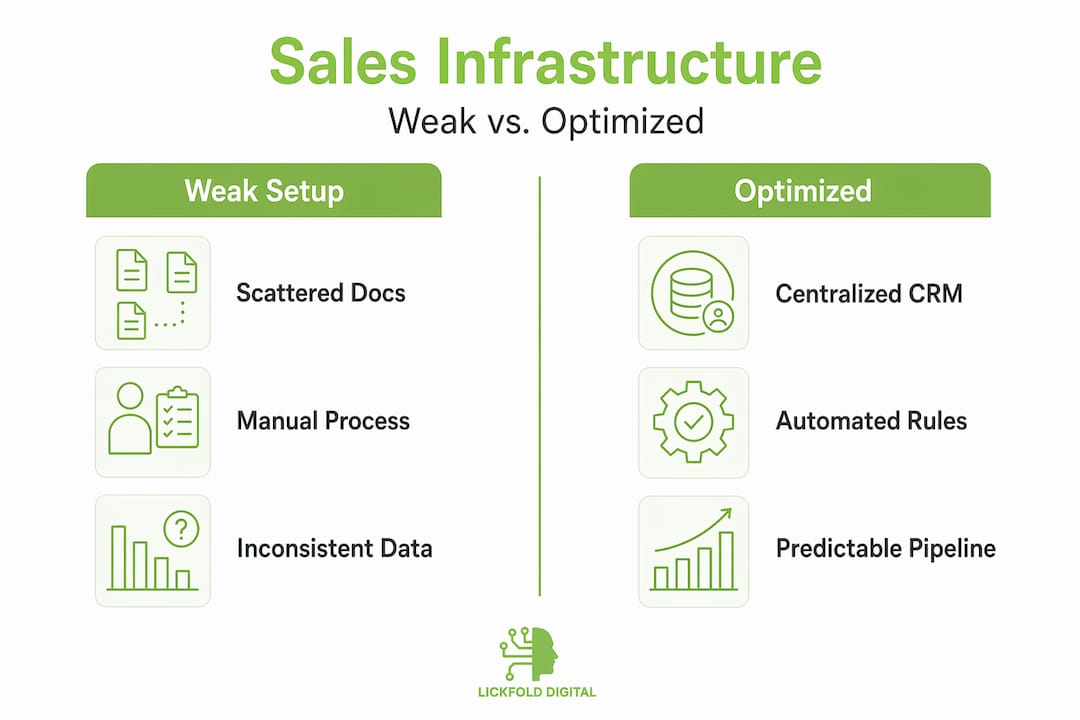
The root cause of most weak setups is the same across industries. Most sales leaders fail to scale because they treat their sales process as tribal knowledge rather than a documented system. When your best rep leaves, the process leaves with them.
Typical consequences include:
- Inaccurate pipeline forecasts that make planning unreliable
- New reps taking months longer to close their first deal because there is no clear path to follow
- Managers spending coaching time on process basics instead of deal strategy
- AI sales tools that underperform because the underlying data they rely on is incomplete
The optimized version is not about adding more tools. It’s about creating a system where the right behavior is the easiest behavior.
How to build effective sales infrastructure
Building effective sales infrastructure is a sequenced process, not a one-time event. Here is a practical approach:
-
Document your process before automating it. Write down every stage in your pipeline, what a rep must accomplish to advance a deal, and what disqualifies a prospect. If you can’t write it down, you can’t systematize it. Use a step-by-step framework to structure your pipeline stages before touching any tool.
-
Audit and clean your CRM. Remove fields reps never fill out. Enforce required fields at stage transitions. Customizing CRM page layouts by removing unnecessary fields improves data entry speed by about 20 percent. A leaner CRM gets higher adoption.
-
Build your enablement library close to the workflow. Embedding demo infrastructure as close to the sales workflow as possible maximizes adoption and demo quality. Reps should not have to leave their CRM or email to find the resource they need.
-
Standardize your demos and proposals. When you standardize demo infrastructure, junior reps can produce demos 80 percent as effective as senior reps with far less prep time. Consistency beats individual brilliance at scale.
-
Set up outbound-specific technical infrastructure. For outbound teams, this means dedicated sending domains, properly warmed accounts, DNS records configured correctly, and sequencing logic that respects reply behavior. Using AI workflow automation for follow-up cadences reduces manual workload and keeps sequences running without gaps.
-
Build dashboards before you need them. Define your pipeline KPIs, set up conversion rate tracking by stage, and create a weekly review cadence before you start scaling. Managers who track pipeline predictability using analytics spot problems weeks earlier than those who rely on rep self-reporting.
-
Audit continuously. CRM configuration is not a one-time setup. It requires ongoing audits to maintain data integrity for forecasting and analytics. Schedule a quarterly review of field completion rates, stage conversion rates, and pipeline age.
Pro Tip: Start with the minimum viable process: three to five pipeline stages with clear exit criteria and five to ten required CRM fields. You can always add complexity later. Starting with too much structure kills adoption before the infrastructure has a chance to prove its value.
My take on what most leaders get wrong
I’ve watched a lot of sales scaling attempts fall apart, and the pattern is almost always the same. Leadership invests in headcount first, tools second, and infrastructure last. Or never.
What I’ve learned is that infrastructure doesn’t restrict good reps. It frees them. When pricing logic is embedded in the quoting tool, a rep doesn’t have to chase down an approval email before sending a proposal. When the demo library is one click away in the CRM, they prep in ten minutes instead of an hour. The system handles the cognitive load that was quietly burning their time and attention.
The leaders who resist infrastructure investment usually frame it as bureaucracy. In my experience, that framing comes from never having seen a properly built system in action. They’ve only seen bloated, poorly configured CRMs that slow everyone down. That’s not infrastructure. That’s technical debt dressed up as process.
The most underrated return on infrastructure investment is what happens to your second and third hires. The first exceptional rep you hired figured it out through raw talent. The next ten need a system. If you’re serious about growth, you build the system before you need it, not after the wheels come off.
Outbound sales infrastructure specifically deserves more leadership attention than it gets. Deliverability, sender reputation, and sequencing logic are not IT problems. They are revenue problems. When your emails land in spam, your pipeline stops, full stop.
— Duarte
How Lickfold builds your outbound sales infrastructure

If building and maintaining a complete outbound sales infrastructure sounds like a full-time project on top of running your pipeline, you’re not wrong. Lickfold handles the entire infrastructure layer for B2B sales teams: dedicated warm-up accounts, domain and sender reputation management, AI-driven prospect research, and personalized multi-touch sequencing that runs continuously without manual input.
The result is a predictable pipeline of qualified opportunities delivered directly to your sales team, with human qualification applied before any lead reaches a rep. If you want to see what a properly built outbound setup looks like for your market, reach out to the Lickfold team for a no-obligation assessment.
FAQ
What is infrastructure setup in sales?
Sales infrastructure setup refers to the systems, tools, processes, and documentation that support repeatable sales execution. It includes CRM configuration, sales process playbooks, enablement tools, automation, reporting dashboards, and for outbound teams, technical email delivery setup.
Why does infrastructure matter for outbound sales specifically?
Outbound sales infrastructure includes dedicated sending domains, warmed email accounts, and sender reputation management. Without this technical layer, outreach emails land in spam rather than inboxes, making the entire outbound program ineffective regardless of messaging quality.
How does sales infrastructure improve forecasting accuracy?
Companies with strong sales ops infrastructure can achieve revenue prediction within ±10% accuracy six weeks out. This is only possible when CRM data is clean, pipeline stages have clear exit criteria, and conversion rates by stage are tracked consistently.
What is a basic outbound sales infrastructure list?
A foundational outbound infrastructure list includes dedicated sending domains, warmed email accounts, a CRM with pipeline stages configured, an outreach sequencing tool, a prospect research process, and reporting that tracks reply rates and pipeline conversion by channel.
How long does it take to see results from better sales infrastructure?
The timeline depends on current gaps, but a well-designed infrastructure can reduce rep ramp time from six months to eight weeks and improve forecasting accuracy within the first full quarter of consistent use.