
90 Day SGE Playbook for B2B: Answer First, Cluster First
90 Day SGE Playbook for B2B: Answer First, Cluster First
SGE optimization means restructuring content so Google’s AI Overviews can extract, verify, and cite it, rather than just ranking it. The single highest-impact move is publishing an answer-first paragraph within the first 80 words of any target page and pairing it with FAQPage schema. Prioritize informational how-to and comparison pages first. Those trigger AI Overviews far more often than transactional or navigational queries, which makes them your fastest path to a citation.
TL;DR:
- Structural clarity, including headers, lists, and schema, significantly improves the chances of your content being selected for AI summaries.
- Content should be answer-focused within the first 80 words, with standalone, question-led H2 sections supporting self-contained facts and data points.
- Building a deep domain with a pillar page and supporting cluster pages, linked cohesively, enhances long-term AI citation chances across related queries.
- Implementing specific schema like FAQPage, HowTo, and Article schema, along with accurate structured data, is essential for effective AI extraction and trust.
- Regularly measuring AI citation frequency, impressions, and conducting experiments over 90 days helps optimize content for evolving AI-driven search features.
Table of Contents
- What Is SGE and How Does Google Choose Sources for AI Overviews?
- Traditional Ranking vs. SGE Citation: What Changes and What Doesn’t
- How Do You Structure Content So SGE Can Extract It?
- Technical SEO and Structured Data Requirements for SGE
- Building Topical Authority: Clusters, Author Signals, and Citations
- Measuring SGE Visibility: Metrics, Tools, and Experiments
- Your 90-Day SGE Optimization Roadmap
- How Voice Search and Conversational AI Are Reshaping SGE
- Beyond FAQ Schema: Other Ways to Win AI-Generated Snippets
- Handling Different User Intents Within a Single SGE Response
- The Real Risks: Over-Optimization and Cannibalization
- What’s Next for SGE and AI-Driven Search
- Author Perspective: Duarte on SGE Optimization for B2B Content Programs
- Get Help Implementing Your SGE Roadmap
- Sources
What Is SGE and How Does Google Choose Sources for AI Overviews?
Google’s Search Generative Experience builds its AI Overview by pulling extractable passages from several sources at once, not by crowning a single winner the way traditional ranking does. It stitches together sentences, definitions, and data points that answer the query cleanly, then attributes them to the pages they came from. That’s a fundamentally different selection process than the ten blue links model most SEO strategy was built around.
A large share of search queries are now touched by AI-generated search features, which means treating SGE as a side project rather than a core channel is no longer defensible for teams that depend on organic visibility. The queries most likely to trigger an AI Overview share a shape: they ask what something is, how to do something, why something happens, or how two options compare. Straightforward navigational searches (“company name login”) and hard transactional ones rarely get the AI treatment.
What determines whether your page gets pulled into that synthesis, specifically?
- Structural clarity — Are headings, lists, and schema doing the organizational work a crawler would otherwise have to guess at?
Domain depth deserves more attention than most SEO checklists give it. A single excellent page ranking on its own merit is a traditional-SEO win. SGE tends to reward the site that has clearly built out the whole topic, because that breadth signals the kind of authority a generative system can lean on without double-checking.
Traditional Ranking vs. SGE Citation: What Changes and What Doesn’t
Ranking #1 and getting cited in an AI Overview are two different games with overlapping rules. You can hold the top organic position and still get skipped by the AI summary if your content isn’t structured for extraction, and you can get cited from a page ranking sixth if that page answers the query more cleanly than the pages above it.
Here’s where the two systems diverge and where they still agree:
- E-E-A-T becomes a gate, not a ranking factor. Traditional SEO treats experience, expertise, authority, and trust as one signal among many. For SGE, weak E-E-A-T can disqualify a page from citation entirely, regardless of its backlink profile.
- Author and brand identity carry more weight. Content with a named author, a visible bio, and consistent bylines across a domain reads as more citable than anonymous corporate copy.
- Links, speed, and structure still matter, but for a different reason. They used to signal authority directly. Now they mostly function as prerequisites that let the AI’s crawler reach and parse your content quickly enough to extract it.
- Position on the page stops mattering as much as position in the sentence. SGE doesn’t care if your best line sits in paragraph one or paragraph nine, as long as that line is self-contained and answerable on its own.
None of this makes traditional SEO fundamentals optional. Crawlability, page speed, and mobile usability remain baseline requirements for both classic rankings and AI-driven summaries. SGE doesn’t replace those fundamentals. It adds an extraction and trust layer on top of them.
How Do You Structure Content So SGE Can Extract It?
This is where most SGE optimization advice gets vague. The tactics below are specific enough to implement this week.
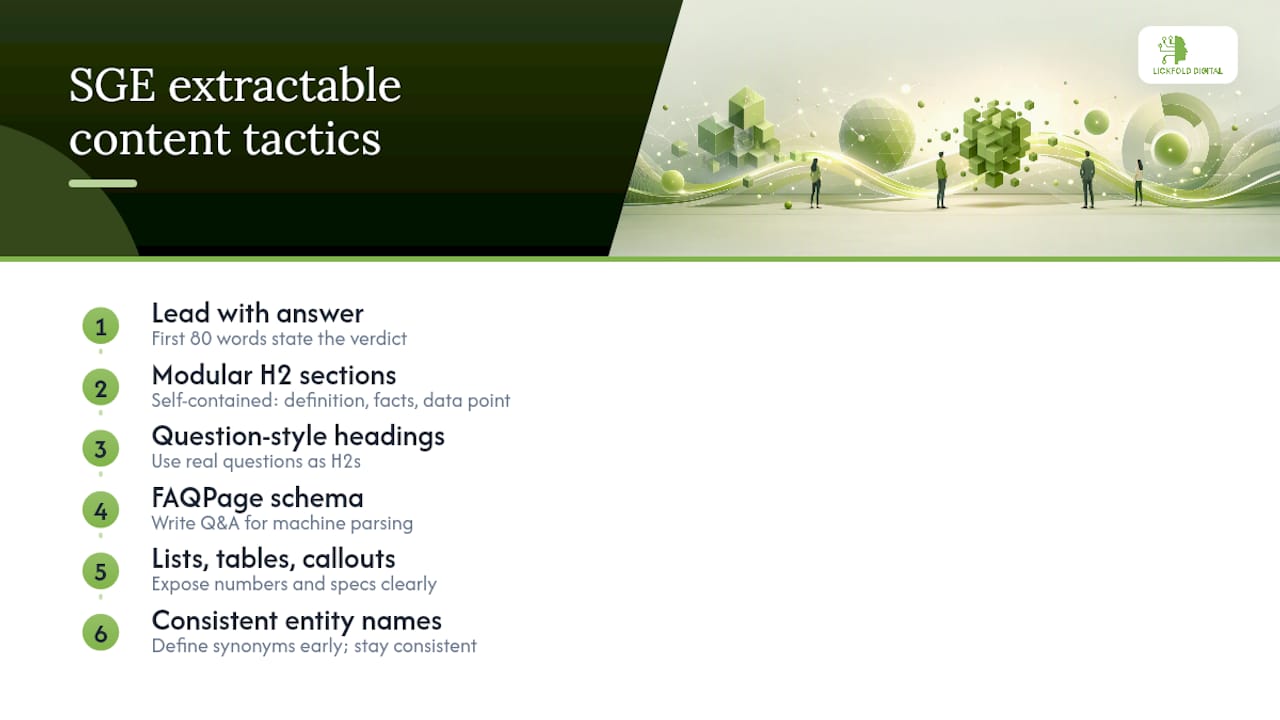
1. Write the first 80 words like the answer, not the introduction. Readers and AI systems both skim the opening for the verdict. If your first paragraph is scene-setting, throat-clearing, or backstory, you’ve handed the AI nothing to extract. State the direct answer, the number, or the recommendation in sentence one, then use the rest of the paragraph to add the qualifier or scope that keeps it honest.
2. Build modular H2 sections that work as standalone answer units. Each section should be able to survive being lifted out of the article entirely. That means a one-line definition, two or three supporting facts, and ideally one concrete data point or example, packed into a section that doesn’t depend on the paragraph before it for context. This mirrors the way SGE rewards content built as self-contained blocks rather than a single flowing argument.
3. Use question-led H2 headings wherever a real question exists. “How Does SGE Cluster Pillar Content?” extracts more cleanly than “Understanding Pillar Content Strategy” because it mirrors how people actually phrase queries and how the AI matches intent to passages.
4. Add FAQPage schema, and write the Q&A pairs for machine parsing, not just for SEO checkboxes. Keep each answer to two or three sentences, lead with the direct response, and avoid burying the actual answer under a rhetorical setup. Pages with well-built FAQ sections show up in AI Overviews more often than comparable pages without them, according to SGE optimization research from 2025.
5. Use lists, tables, and callouts for anything factual. Numbers, steps, comparisons, and specifications are exactly what generative systems like to lift verbatim. A dense paragraph burying a statistic is far less citable than the same statistic in a labeled callout or table row.
6. Keep entity names and synonyms consistent across the page and the domain. If you call it “SGE” in one section and “Search Generative Experience” in another without ever connecting the two explicitly, you’re making the AI’s entity-matching job harder than it needs to be. Say both, at least once, early.
Pro Tip: Pull up any target query in an incognito window and read exactly which sources the current AI Overview cites. That list tells you which angles your competitors covered that you haven’t. Building those missing angles into your own cluster is faster than guessing at the algorithm.
Structured formatting isn’t cosmetic here. Clear headings, FAQ schema, and list-based facts directly increase how extractable your content is, which is the entire game for SGE visibility. Every tactic above exists to serve that one goal: make it easy for a machine to lift a correct, complete answer out of your page without misquoting you.
Technical SEO and Structured Data Requirements for SGE
None of the on-page writing work matters if the AI can’t crawl, render, and parse your page in the first place. Technical SEO isn’t a separate workstream from SGE optimization. It’s the floor everything else stands on.
Start with the basics that traditional SEO already demanded:
- Confirm your sitemap is current and submitted, and that robots.txt isn’t blocking sections you want indexed.
- Explicitly allow AI crawlers and bots where your platform lets you set that policy, rather than leaving it to default.
- Treat page speed and mobile usability as non-negotiable baseline signals, not nice-to-haves. SEO fundamentals like crawlability, speed, and mobile friendliness remain required prerequisites for visibility in both classic search and AI summaries.
- Request indexing manually through URL inspection immediately after publishing or refreshing a page, instead of waiting for the next crawl cycle.
Then layer in the structured data that actually helps an AI system verify what it’s looking at:
- Article schema to establish publish date, author, and publisher identity.
- FAQPage schema for any Q&A content, formatted so each question maps to one clean answer.
- HowTo schema for step-by-step content, which gives the AI a pre-parsed sequence to cite directly.
- Organization schema to anchor your brand identity and reduce ambiguity about who’s behind the content.
- Author schema tied to a real bio page, not a generic “Staff Writer” placeholder.
Structured data beyond basic Organization markup, specifically FAQPage, HowTo, and Article schema, materially improves how well AI systems can extract and trust your content. That’s not a minor technical footnote. It’s one of the clearest levers available for SGE cluster management, because schema does the trust-verification work that would otherwise require the AI to infer context from prose alone.
Once the markup is live, run it through Google’s Rich Results Test or Schema.org’s validator, and check that what the schema claims matches what’s visible on the page. Mismatched structured data (a FAQPage schema advertising answers that don’t appear in the visible text) is a fast way to get flagged or ignored rather than cited. Keep a recurring audit on the calendar. Sites change templates, plugins update, and schema silently breaks more often than most teams realize.
Building Topical Authority: Clusters, Author Signals, and Citations
Domain-level depth beats page-level polish for SGE visibility, and the data backs that up directly. Topical clusters built around a pillar page with multiple supporting cluster pages produce more durable AI citations than optimizing a single standalone page in isolation. SGE cluster management, in other words, isn’t a nice architectural preference. It’s the structural difference between a page that gets cited once and a domain that gets cited repeatedly across dozens of related queries.
The practical shape of this: one pillar page covering the core topic broadly, supported by six to ten cluster pages that each go deep on a specific subtopic, all linked together in a clear hub-and-spoke pattern. Each cluster page should link back to the pillar and sideways to at least two or three siblings. That internal linking model does double duty. It helps search engines understand topical boundaries, and it gives readers (and AI crawlers) an obvious path to the rest of your coverage.
Author consistency matters more than most teams budget for. Clear E-E-A-T signals, including author bios and reputable citations, increase the odds that content gets featured in an AI Overview. That means:
- The same named author (or a small, consistent roster) writing across a cluster, not a rotating cast of ghostwritten “Team” bylines.
- A real author bio page, linked from every article, that establishes relevant expertise.
- Case studies and outcome data that give the AI something concrete to verify against, rather than just claims.
Pro Tip: Set a refresh cadence and actually keep it. Evergreen pillar and cluster pages should get a substantive update every three to six months. Fast-moving trend topics need refreshes far sooner, sometimes monthly, because AI systems appear to weight freshness noticeably in what they choose to cite.
Earning mentions and citations from reputable third-party sources adds another layer of external validation that a domain-only cluster can’t generate on its own. If a respected industry publication cites your case study or your data, that’s a trust signal no amount of internal linking can replicate. Case studies with real, measurable outcomes, like documented outreach results, tend to earn exactly that kind of external pickup because they give other writers something concrete to reference.
Measuring SGE Visibility: Metrics, Tools, and Experiments
Most teams have no idea whether their SGE optimization work is doing anything, because they’re still measuring with tools built for a ten-blue-links world. AI citations, AI impressions, and extraction accuracy need their own tracking layer.
- Track AI citation frequency separately from organic rank. Note which queries pull your domain into an AI Overview and which don’t, even when you rank well organically for both.
- Watch AI-driven impressions and click-through rate as a distinct metric, since a citation with zero click-through is a visibility win but not yet a traffic win. Monitoring AI-specific metrics is necessary to know whether an SGE-focused change actually moved anything.
- Run manual incognito checks on your priority queries weekly, since AI Overview citations shift faster and less predictably than organic rankings do.
- Test answer-first rewrites against a control group of unchanged pages and compare citation rates after four to six weeks.
- A/B the addition of FAQ schema on a subset of comparable pages to isolate its actual lift.
- Expand a cluster by two or three pages and monitor whether citation frequency rises across the whole pillar, not just the new pages, since cluster effects tend to be domain-wide rather than page-isolated.
Interpreting these results takes patience most teams don’t budget for. A single week of flat results doesn’t mean the tactic failed. Give each experiment a full cycle before you decide whether to scale it or scrap it, and always change one variable at a time. Stacking five tactics onto one page at once tells you nothing about which one actually worked.
Your 90-Day SGE Optimization Roadmap
Turning all of this into action means sequencing it, not attempting everything simultaneously.
- Days 1 to 7: Rewrite the opening paragraph on your top 10 highest-traffic informational pages to lead with the answer. Add FAQPage schema to any page with existing Q&A content. Submit every changed URL for manual indexing.
- Days 8 to 30: Map your existing content into pillar and cluster groupings. Identify gaps where a pillar topic has no supporting cluster pages, and outline the six to ten pieces needed to fill it.
- Days 30 to 60: Implement structured data sitewide, not just on flagship pages. Build or update author bio pages and make bylines consistent across every cluster you’ve mapped.
- Days 60 to 90: Begin outreach to earn third-party citations and mentions. Publish at least one detailed case study per pillar topic. Run your first round of answer-first-rewrite and FAQ-schema experiments and record the results.
| Phase | Primary Focus | Suggested Owner | Key KPI |
|---|---|---|---|
| Days 1 to 7 | Answer-first rewrites, FAQ schema, indexing | SEO lead | Pages reindexed, schema validated |
| Days 8 to 30 | Cluster mapping and content gap outline | Content strategist | Cluster pages scoped |
| Days 30 to 60 | Sitewide schema, author page builds | Technical SEO + editorial | Schema coverage percent |
| Days 60 to 90 | Outreach, case studies, experiments launched | Marketing + SEO lead | AI citations tracked, experiments running |
Assign a single owner to each phase before you start. SGE resource allocation tends to stall when “everyone” owns the roadmap and no one owns the deadline.
How Voice Search and Conversational AI Are Reshaping SGE
Voice queries and conversational AI assistants push search behavior toward longer, more natural-language questions, and SGE optimization has to account for that shift directly. Someone typing “best CRM for small teams” and someone asking a voice assistant “what’s the best CRM if I’ve got a small sales team” are functionally asking the same question, but the second phrasing is closer to how conversational AI parses intent.
This matters for SGE because Google’s generative systems are trained to handle exactly that kind of loose, spoken phrasing, and they reward content written in a similarly natural register. Overly keyword-stuffed, robotic copy actually performs worse here than plain, conversational writing that happens to answer the question completely.
Practically, that means writing your H2 headings and FAQ pairs the way a person would actually ask, not the way a keyword tool suggests. “How do I optimize for SGE” beats “SGE optimization methods” as a heading, even though the second one looks more like traditional SEO copy. It also means anticipating follow-up questions. Conversational sessions often chain a broad question with a narrower follow-up, so a cluster page that answers both the initial query and its likely follow-up in adjacent sections has a real advantage.
The practical overlap between voice search optimization and SGE optimization is large enough that most of the answer-first, question-led tactics already covered here serve both without extra work.
Beyond FAQ Schema: Other Ways to Win AI-Generated Snippets
FAQ schema gets most of the attention in SGE guides, but it’s far from the only lever for AI-generated snippets. Definition-style sentences, formatted as a clean, standalone claim early in a section, get extracted just as often as formal Q&A pairs, especially for “what is” and “why does” queries that never touch a FAQ block at all.
Comparison tables are another underused format. When a query implies “X versus Y,” a tightly built comparison table with a handful of clear rows often gets pulled into the AI Overview wholesale, because a table is already structured the way the AI wants to present the answer.
Step-by-step numbered lists paired with HowTo schema work similarly for process queries. Definitional callouts, the kind that isolate a single sentence in bold or in a highlighted block, act as a signal to both readers and crawlers that “this is the core fact here.” And glossary-style sections, where a term gets defined in one tight sentence before the surrounding explanation continues, consistently perform well for the same reason FAQ pairs do: they’re pre-chunked for extraction.
The common thread across all of these formats is the same principle behind FAQ schema itself. Isolate the fact, make it stand alone, and don’t force the AI to untangle it from three sentences of context it doesn’t need.
Handling Different User Intents Within a Single SGE Response
A single query can carry several intents at once, and SGE responses often reflect that by pulling from multiple angles rather than answering one narrow interpretation. Someone searching “SGE optimization” might want a definition, a how-to guide, or a comparison against traditional SEO, all in the same search session.
The practical fix is writing pages that acknowledge and answer more than one interpretation without sprawling into an unfocused mess. A strong pillar page opens with the direct definition, moves into the practical how-to guidance, and includes a section explicitly contrasting the topic against the reader’s likely alternative framing (in this case, traditional SEO). That structure lets the AI Overview pull whichever slice matches the specific phrasing of the query that triggered it, from the same page.
This is also where SGE job scheduling for your content calendar matters. Rather than publishing one page per narrow keyword variant, which risks the cannibalization problem covered next, build one authoritative page that deliberately covers the two or three most common intent variations side by side. It’s more efficient to write and far more resilient across the range of ways people actually phrase the question.
The Real Risks: Over-Optimization and Cannibalization
Chasing SGE citations too aggressively creates problems that are easy to miss until they’ve already cost you traffic.
Over-optimization is the first trap. Cramming every H2 into rigid question format, stuffing FAQ schema onto pages where it doesn’t fit the content naturally, and stripping out narrative nuance in favor of robotic, chunked answer units can make content read as hollow or manipulative, both to human readers and increasingly to the systems evaluating quality. The goal is extractability without sacrificing the actual usefulness of the page for a person who lands on it and reads the whole thing.
Content cannibalization is the second, quieter risk. In the rush to build pillar-and-cluster architecture, it’s common to end up with three or four pages all answering close variants of the same question, competing against each other for the same AI citation instead of covering distinct ground. If it does, expand that page instead of creating a competitor to it on your own domain.
A third, less obvious risk: schema that doesn’t match visible content. If your FAQPage markup claims answers that aren’t actually readable on the page, that’s a mismatch that erodes trust with both search engines and site visitors. Keep structured data honest, or skip it.
What’s Next for SGE and AI-Driven Search
AI Overviews are still expanding into query types they didn’t touch a year ago, and that expansion shows no sign of slowing. Expect broader coverage of commercial and comparison queries, categories that were historically left to traditional results and shopping features, as Google grows more confident in the accuracy of generative summaries for higher-stakes searches.
Multimodal inputs are the next real shift. Image-based and video-based queries feeding into AI Overviews will reward content that pairs its written answer with genuinely useful visual or video supplements, not stock photography bolted on for decoration. Personalization is also likely to deepen, with AI Overviews increasingly shaped by a searcher’s history and context rather than returning one identical summary to everyone who types the same words.
The way to prepare for all of this isn’t to chase each individual feature as it rolls out. It’s to keep doing the foundational work covered here: build genuinely deep topical clusters, keep author and brand signals consistent, structure content so machines can extract it cleanly, and measure what’s actually happening rather than guessing. Every one of SGE’s likely next moves rewards exactly that foundation. None of it rewards a site that only ever optimized for the AI Overview format that existed a year before.
Author Perspective: Duarte on SGE Optimization for B2B Content Programs
The mistake I see most often in B2B content programs is treating SGE optimization as a copywriting problem when it’s really an information architecture problem. Teams rewrite a handful of hero pages to be more “answer-first,” see no citation lift, and conclude the tactic doesn’t work. What actually happened is they optimized one page inside a domain that has no topical depth around it, which is precisely the setup SGE optimization research says it underperforms.
B2B content has a structural advantage here that gets underused: real case studies, real outcome data, and named subject-matter authors who can carry a byline across a whole cluster. That’s exactly the kind of E-E-A-T signal generative systems weight heavily, and most B2B teams sit on it without structuring it for extraction. If you’re running outreach and content in tandem, the AI agent workflows that surface real buyer questions are also your best source of new cluster topics. You’re already collecting the exact language your market uses to ask these questions.
— Duarte
Get Help Implementing Your SGE Roadmap
A unified AI infrastructure built for outbound prospecting can also drive structured, cluster-based content production and measurement, without hiring a separate content team to run it. Instead of choosing between a slow internal rewrite project and an expensive agency retainer, you get a system that builds the pillar-and-cluster architecture, keeps author signals consistent across every page, and tracks AI citation performance as one connected pipeline.

That matters because the roadmap outlined above (answer-first rewrites, structured data, cluster expansion, citation outreach) takes real, sustained effort to execute well, and most in-house teams are already stretched across demand generation and sales enablement. This approach pairs AI-driven content creation with market research and outreach infrastructure used for prospecting, so the case studies and outcome data cluster pages need are generated as a byproduct of the outbound work already happening, not a separate research project. For teams building AI-driven prospecting programs alongside their content strategy, that overlap saves real time.
Book a free session to walk through where your current content sits against this roadmap and what a managed rollout would look like for your domain.
Sources
For validating schema and testing your own pages, keep these on hand:
- Optimizing for Google SGE: A Step By Step Guide for Content Creators
- How to Rank in SGE Without Guessing the Algorithm
- How to optimize for Google’s SGE
- SEO basics: Beginner’s guide to SEO success
- Topical authority and AI search guidance