
The Market Expansion Checklist Every Growth Leader Needs
The Market Expansion Checklist Every Growth Leader Needs
A focused market expansion checklist cuts time-to-revenue and sharpens go/no-go decisions before you commit real capital. Here is the condensed version you can print and pin to the wall.
Core Pillars Checklist
- Strategy & goals: SMART objectives defined, entry mode selected, market scorecard completed
- Market research: TAM/SAM/SOM sized, buyer segments mapped, competitor gaps identified
- Legal & compliance: Business registrations filed, IP protected, export/import rules confirmed
- Financial plan: Budget line items set, runway calculated, breakeven timeline modeled
- Localization: Legal copy adapted, payments localized, UX tested with local users
- Channels & payments: Distribution model chosen, local payment providers integrated
- Marketing & GTM: 90-day pilot plan written, messaging tested, CAC target set
- Operations: Fulfillment, returns, and customer support SLAs confirmed
- Team & partners: Local hires or contractors identified, vendor scorecard completed
- Pilot & KPIs: Go/no-go criteria written, measurement dashboard live
- Risks & exit: Top five risks logged, contingency responses documented, exit triggers defined
Start here: Complete the market scorecard (Section 2) before anything else. It takes two hours and prevents six months of misdirected effort.
Pro Tip: Assign a single owner to each pillar above before the kickoff meeting. Checklists without owners become decoration.
Key Takeaways
A complete market expansion checklist requires strategy, research, legal compliance, financial modeling, localization, and a structured pilot before any full-scale commitment.
| Point | Details |
|---|---|
| Score markets before committing | Use a five-dimension scorecard (demand, access, regulation, cost, time-to-revenue) to rank candidates objectively. |
| Budget for learning, not just execution | Include a 15–20% contingency reserve; most teams underestimate year-one costs by 30–50%. |
| Write go/no-go criteria before launch | Define CAC, pipeline, and compliance thresholds in advance so the pilot decision stays objective. |
| Local relationships drive time-to-revenue | Stakeholder networks and local partners accelerate ramp faster than marketing spend alone. |
| Lickfold accelerates B2B pilot pipelines | AI-driven outbound prospecting builds qualified meeting pipelines in new markets from day one of a pilot. |
Table of Contents
- What does a strong market expansion checklist start with?
- How do you research and size a new market before committing?
- What legal and regulatory steps can block your launch?
- How do you build a financial plan that survives contact with a new market?
- What does product-market fit localization actually require?
- Which distribution channels and payment options fit your new market?
- What does a 90-day pilot marketing plan look like?
- Is your operation ready to support a new market launch?
- How do you build the local team and partner network you need?
- How do you run a pilot launch that actually validates your assumptions?
- Which KPIs should you track, and how often?
- What risks can kill an expansion, and how do you plan for them?
- How does automated outbound prospecting accelerate B2B market entry?
- What most expansion plans get wrong (and what to prioritize instead)
- Lickfold cuts the time from market entry plan to first qualified meeting
- Sources
What does a strong market expansion checklist start with?
The answer is strategy, not tactics. Market expansion is the process of selling proven products into new markets. The BDA framework identifies five entry modes with distinct risk profiles: direct entry, channel partnerships, licensing or franchising, acquisition, and co-entry joint ventures. Choosing the wrong mode wastes more money than almost any other early mistake.
Setting SMART goals and scoring candidate markets
Before selecting a market, write down what success looks like in numbers. A SMART goal for expansion sounds like: “Generate significant net new revenue from the Southeast U.S. market within an appropriate timeframe at a competitive customer acquisition cost.” Vague goals like “grow our presence” produce vague decisions.
Score each candidate market across five dimensions: demand (search volume, industry growth rate), access (existing relationships, distribution infrastructure), regulation (licensing burden, data law complexity), cost (entry cost, ongoing overhead), and time-to-revenue (sales cycle length, partner availability). Rate each dimension 1–5 and total the scores. The highest-scoring market gets the pilot budget.

Entry mode mapped to risk and resources
| Entry mode | Resource requirement | Risk level | Best when |
|---|---|---|---|
| Direct entry | High | High | Strong brand, large budget |
| Channel partners | Medium | Medium | Local relationships exist |
| Licensing / franchising | Low | Low-medium | Proven playbook, IP protected |
| Acquisition | Very high | High | Speed is the priority |
| Co-entry / JV | Medium | Medium | Shared risk, local expertise needed |
Pro Tip: If your market scorecard produces a tie between two candidates, default to the one where you already have at least one warm relationship. Localized stakeholder networks are the single biggest driver of faster time-to-revenue, and they cannot be bought quickly.
How do you research and size a new market before committing?
Size the opportunity before you spend a dollar on execution. The three-layer model works like this: TAM (total addressable market) is everyone who could theoretically buy; SAM (serviceable addressable market) is the slice you can realistically reach given your channels and geography; SOM (serviceable obtainable market) is what you can capture in years one and two given your resources and competitive position.
The SOM figure is what goes into your financial model.
Primary and secondary research approaches
- Secondary research: U.S. Census Bureau data, Bureau of Labor Statistics industry reports, Google Trends for demand signals, and trade association publications
- Primary research: 10–15 buyer interviews, a short survey (Typeform or Google Forms) to 50–100 prospects, and a lightweight paid search test to measure click-through intent
- Competitor analysis: Map the top five competitors on a 2x2 grid of price vs. feature depth. Identify the positioning gap where your product fits and where pricing benchmarks sit
Accuracast’s international market entry checklist recommends assigning priority ratings (Critical, High, Medium) to each research task so resource-limited teams sequence activity correctly. Market research and strategy items are rated Critical; social and community setup is Medium. That distinction matters when you have a 60-day pre-launch window.
Using AI-powered market research tools to generate target lists and surface buyer intent signals can cut the secondary research phase from weeks to days.
Pro Tip: Validate qualitative signals against hard behavioral data. If five buyers say they “would definitely buy,” run a $500 paid search test to see if they actually click. Stated intent and purchase intent diverge more than most founders expect.
| Research method | Cost | Speed | Signal quality |
|---|---|---|---|
| Buyer interviews (10–15) | Low | Medium | High |
| Paid search test | Low-medium | Fast | High |
| Industry reports (IBISWorld) | Medium | Fast | Medium |
| Trade association surveys | Low | Slow | Medium |
What legal and regulatory steps can block your launch?
Regulatory gaps are the most common cause of delayed launches, and they are almost always preventable. The U.S. Chamber of Commerce identifies legal compliance as a core pillar of any expansion budget, alongside financial health and supply chain readiness.
U.S. domestic expansion checklist
- Register the business entity in the new state (most states require foreign entity qualification if you are doing business there)
- Confirm sales tax nexus rules under the post-South Dakota v. Wayfair economic nexus standard (typically $100,000 in sales or 200 transactions per state)
- Check state-specific professional licensing requirements for your industry
- Review employment law differences for any new hires (minimum wage, non-compete enforceability, paid leave mandates)
- File trademark registrations with the USPTO before entering a new market, not after
International expansion checklist
- Confirm export control classification (EAR99 vs. controlled items under the Export Administration Regulations)
- Research import tariffs and customs duties using the U.S. International Trade Commission’s HTS database
- Register the business locally per the target country’s foreign investment rules
- Map data privacy obligations (GDPR for EU, PIPL for China, LGPD for Brazil) and confirm your data flows comply
- Review advertising restrictions, especially for regulated categories (financial services, health, alcohol)
IP protection in new markets
Register trademarks in each target jurisdiction before launch. The Madrid Protocol lets U.S. companies file internationally through a single USPTO application covering 130+ member countries. For patents, the Patent Cooperation Treaty (PCT) provides an 18-month window to decide which national phases to pursue. Monitor for infringement using Google Alerts, watch services from firms like Corsearch, and document your enforcement actions from day one.
Pro Tip: Use contract templates from the International Chamber of Commerce (ICC) as a starting point for distributor and reseller agreements. They are jurisdiction-neutral and widely recognized, which shortens negotiation time with local partners.
How do you build a financial plan that survives contact with a new market?
The Phrase market expansion guide is direct on this: forecast sales for the first years post-entry and estimate expenses to determine runway and breakeven timing.
Core budget line items
- Market research and validation: buyer interviews, paid test campaigns, industry reports
- Legal and compliance: entity registration, IP filings, local counsel retainer
- Staffing: local sales rep or contractor, customer success coverage, part-time PR
- Marketing and GTM: launch campaign, content localization, paid media tests
- Technical infrastructure: hosting, CDN, payment gateway integration, consent management
- Inventory and fulfillment: safety stock, warehousing deposit, returns processing
- Contingency reserve: 15–20% of total budget held back for unplanned regulatory or operational costs
Runway and breakeven estimation
Divide your total expansion budget by your monthly burn rate in the new market to get runway in months. The conservative scenario sets your minimum required runway. If you cannot fund the conservative scenario to breakeven, the market is not ready for full commitment.
Pricing decision tree
Start with your home-market price. Adjust downward for local purchasing power parity if entering a lower-income market. Check whether the resulting price is competitive against local alternatives. If the math does not work at a profitable margin, either the channel model needs to change or the market needs to wait.
Pro Tip: Reserve a contingency fund of a reasonable portion of your total expansion budget to account for regulatory delays, currency moves, and partner renegotiations that commonly impact expansions. Teams that do not reserve for them end up pulling resources from marketing or staffing, which compounds the delay.
What does product-market fit localization actually require?
HubSpot’s market development research frames market development as a lower-risk path precisely because you are testing an existing product in a new context rather than building something new. The risk is not the product; it is the fit assumptions.
Localization triage: what to do first
Must localize before launch:
- Legal copy (terms of service, privacy policy, refund policy) in the local language
- Payment methods (local cards, digital wallets, bank transfer options)
- Currency display and tax calculation
- Core UX labels and error messages
Can wait until traction is confirmed:
- Full creative campaign translation
- Localized case studies and testimonials
- Deep feature adaptation for local workflows
Run small adaptation tests before committing to full localization. A/B test localized landing page copy against your English version using a geo-targeted paid campaign. Toggle localized pricing on a subset of visitors. These tests cost a few hundred dollars and reveal whether the adaptation actually moves conversion rates.
For vendor selection, evaluate translation vendors on three criteria: native-speaker review (not just machine translation), subject-matter familiarity with your industry, and turnaround time for iterative updates. Platforms like Phrase or Lokalise handle string management well for software products; for marketing copy, a human reviewer is non-negotiable.
Pro Tip: Watch for false positives from superficial localization. If your localized page gets high traffic but low time-on-page and high bounce rates, the translation is technically correct but culturally off. The metric to watch is engagement depth, not just conversion rate.
Which distribution channels and payment options fit your new market?
Channel choice is a function of buyer behavior, not preference. The Shopify market development guide emphasizes selecting channels based on where buyers already shop and how they prefer to pay, not where you find it easiest to sell.
Channel options and when to use each
- Direct-to-consumer (DTC): Best when your brand is strong enough to drive traffic independently and margins support the CAC. Requires investment in local SEO and paid media.
- Marketplaces (Amazon, regional equivalents): Fast to launch, lower margin. Good for demand validation before building DTC infrastructure.
- Distributors and resellers: Slower to set up but leverage existing buyer relationships. Typical for industrial, B2B, and regulated categories.
- Channel partnerships: Co-selling arrangements with complementary businesses. Lower cost, slower ramp, requires careful incentive alignment.
Payments checklist
- Integrate at least one locally dominant payment method (ACH for U.S. B2B, Stripe or Braintree for card processing, PayPal for SMB buyers)
- Confirm chargeback dispute processes and reserve requirements with your payment processor
- Set up multi-currency invoicing if selling internationally
- Confirm sales tax or VAT collection obligations per market
- Review PCI-DSS compliance requirements for any new payment infrastructure
Pro Tip: For international expansion, start with a local payments partner who already has relationships with regional banks and regulators. The setup time for a new merchant account in a foreign market can run 6–12 weeks. Starting that process on day one of your pilot planning saves a common launch-day crisis.
What does a 90-day pilot marketing plan look like?
A 90-day pilot is not a full campaign. It is a structured experiment designed to answer three questions: Does our message resonate? Which channel delivers the lowest CAC? What conversion rate can we sustain?
Week-by-week priorities
Weeks 1–4 (Awareness): Run two to three message variants on LinkedIn (for B2B) or Meta (for B2C) targeting your defined buyer persona in the new market. Budget $1,500–$3,000 for paid tests. Track click-through rate and cost per click as early signals.
Weeks 5–8 (Lead capture): Drive traffic to a localized landing page with a single conversion action (demo request, content download, free trial). Measure cost per lead and lead quality (job title, company size, intent signals).
Weeks 9–12 (Conversion experiments): Run two pricing or offer variants. Measure trial-to-paid conversion rate and CAC. Compare against your home-market benchmarks.
Launchmetrics recommends benchmarking local visibility before launch and selecting influencer tiers or channels that actually drive traction in the specific market. Replicating a global campaign without local benchmarking is one of the most consistent ways to burn pilot budget without learning anything.
Pro Tip: For B2B pilots, micro-influencers in the 5,000–50,000 follower range on LinkedIn often outperform broad paid campaigns for awareness in a new market. They have tighter audience relationships and lower CPMs. Test one or two before scaling paid spend.
For visibility strategy in new markets, an online visibility checklist can help you sequence local SEO, paid, and social channel setup in the right order.
Is your operation ready to support a new market launch?
Operational readiness is the section most expansion plans skip until something breaks. The U.S. Chamber of Commerce’s small business expansion framework lists supply chain and infrastructure readiness as a core pillar alongside legal compliance and financial health.
Operations readiness checklist
- Confirm fulfillment lead times for the new geography (domestic: 2–5 days standard; international: factor customs clearance)
- Set minimum inventory buffer (typically 4–6 weeks of projected demand for physical products)
- Define local returns policy and reverse logistics process before launch, not after
- Confirm customer support coverage hours match the new market’s time zone
- Document SLAs for order fulfillment, customer response time, and escalation paths
Technical infrastructure checklist
- Host or cache content on a CDN node close to the new market (Cloudflare, AWS CloudFront)
- Implement cross-domain tracking if running separate regional domains
- Deploy a consent management platform (OneTrust, Cookiebot) if the target market has privacy law requirements
- Test page load speed from the target geography before launch (target under 2.5 seconds)
- Confirm your CRM and marketing automation tools support the new market’s data residency requirements
Pro Tip: Write a one-page operational incident playbook before launch day. It should cover three scenarios: a fulfillment failure, a payment processing outage, and a customer complaint that goes public on social media. Teams that have the playbook handle incidents in hours; teams that do not handle them in days, with brand damage attached.
How do you build the local team and partner network you need?
The Pipedrive expansion strategies guide is clear that scalable infrastructure and leadership are prerequisites for any expansion mode. The question is not whether you need local access; it is how to get it fastest at the lowest risk.
Hire vs. contract vs. partner
- Hire: Local sales lead (if the market justifies a full-time role within 6 months), customer success manager for enterprise accounts
- Contract: Legal counsel (local firm on retainer), PR and communications, technical localization
- Partner: Resellers or distributors for channel coverage, local agencies for paid media, industry associations for credibility
Vendor scorecard for selection
Score each vendor on: relevant market experience (0–3), references from comparable clients (0–3), pricing transparency (0–2), and responsiveness during the sales process (0–2). A vendor scoring below 6 out of 10 should not make the shortlist regardless of price.
For partner agreements, structure the first engagement as a 90-day pilot with defined deliverables and a mutual exit clause. This limits your exposure while proving whether the partner can actually deliver local access.
Pro Tip: Short pilot contracts with local partners serve two purposes: they limit financial risk, and they reveal operational fit faster than any due diligence process. A partner who resists a 90-day pilot with clear KPIs is telling you something important about how they operate.
How do you run a pilot launch that actually validates your assumptions?
The pilot is not a soft launch. It is a controlled experiment with a defined measurement window and a written go/no-go decision rule. Shopify’s market development framework emphasizes that budgeting, prioritization, and implementation sequencing must precede the launch, not follow it.
Pilot timeline with milestones
- Days 1–14 (Setup): Finalize legal registrations, activate payment gateway, confirm fulfillment partner, brief local sales or partner
- Days 15–30 (Soft launch): Go live with localized landing page, activate paid test campaigns, begin outbound prospecting sequence
- Days 31–60 (Measurement window): Track weekly KPIs, run two message or offer variants, collect buyer feedback
- Days 61–90 (Decision point): Compare actuals against go/no-go criteria, present findings to leadership, make scale/pause/exit decision
Go/no-go criteria (write these before launch)
- Go: CAC is within 150% of home-market benchmark, at least three qualified opportunities in pipeline, no unresolved compliance issues
- Pause: CAC exceeds 200% of benchmark but demand signals are strong; revisit channel or pricing
- Exit: No qualified pipeline after 60 days of active outbound, or a regulatory barrier with no clear resolution path
Pro Tip: The most common pilot failure is extending the measurement window because results are ambiguous. Set a hard decision date before you launch. Ambiguous results after 90 days usually mean the market needs a different approach, not more time.
Launch-day administrative checklist
- Payment processing confirmed live with a test transaction
- Customer support queue monitored and staffed
- Analytics tracking verified (conversion events firing correctly)
- Legal disclosures live on all customer-facing pages
- Escalation contacts for fulfillment, legal, and technical issues documented
Which KPIs should you track, and how often?
The reporting cadence is as important as the KPIs themselves. Daily dashboards create noise; monthly reviews create lag. The right cadence depends on the stage.
| Cadence | Metrics | Owner |
|---|---|---|
| Daily | Ad spend, leads generated, fulfillment exceptions | Marketing ops / ops manager |
| Weekly | CAC, conversion rate, pipeline value, support ticket volume | Growth lead |
| Monthly | Revenue vs. forecast, breakeven progress, NPS or CSAT, churn | GM / founder |
Decision rules for scaling or pausing
- Scale: Three consecutive weeks where CAC is at or below target and pipeline conversion rate is stable
- Pivot: CAC trending up for two consecutive weeks; test a new channel or message before cutting spend
- Pause: Pipeline conversion drops below 50% of target for four weeks; investigate product-market fit or pricing
- Exit: Revenue at month three is below 30% of conservative forecast and no clear corrective lever exists
Instrument your dashboard to minimize data lag. Use UTM parameters on every campaign link, set up real-time conversion alerts in Google Analytics 4 or your CRM, and confirm attribution models before launch so you are not debugging tracking errors during the measurement window. For AI-assisted search visibility tracking, tools that monitor AI-driven search signals can surface early demand shifts that standard analytics miss.
What risks can kill an expansion, and how do you plan for them?
Every expansion carries a short list of high-probability failure modes. Identifying them before launch and writing a one-page response for each is the difference between a recoverable setback and a full retreat.
Top risks and monitoring triggers
- Regulatory delay: Trigger is any licensing or registration process that exceeds its estimated timeline by 30 days. Response: engage local counsel immediately, prepare a contingency launch date.
- Partner failure: Trigger is a partner missing two consecutive KPI milestones. Response: activate backup partner from shortlist, begin direct channel setup in parallel.
- Supply disruption: Trigger is inventory buffer dropping below two weeks of projected demand. Response: activate secondary supplier, communicate lead time changes to customers proactively.
- Cannibalization: Trigger is home-market revenue declining more than 5% in the quarter following new-market launch. Response: run geographic overlap analysis, adjust pricing or channel boundaries.
- Cash runway shortfall: Trigger is monthly burn exceeding budget by 20% for two consecutive months. Response: pause discretionary spend, revisit breakeven timeline, present options to board.
Exit strategy checklist
- Define the revenue and pipeline thresholds that trigger an exit review (write these before launch)
- Identify contractual exit clauses in all partner and vendor agreements
- Document inventory repatriation or liquidation options
- Confirm employee or contractor notice periods and severance obligations in the target jurisdiction
- Prepare a customer communication plan for service wind-down
Pro Tip: Treat the exit strategy as a risk management tool, not a pessimistic scenario. Teams that write exit criteria before launch make better go/no-go decisions during the pilot because they are not emotionally attached to sunk costs.
How does automated outbound prospecting accelerate B2B market entry?
For B2B companies, the fastest way to validate demand in a new market is to put your value proposition in front of qualified decision-makers and measure response rates. Organic inbound takes months to build; a structured outbound sequence can generate qualified conversations in weeks.
Outbound playbook for a pilot market
- Build a target list: Define your ideal customer profile (ICP) for the new market: industry, company size, geography, and decision-maker title. Use LinkedIn Sales Navigator, Apollo.io, or AI-assisted prospecting tools to generate an initial list of 200–500 contacts.
- Sequence the outreach: A three-touch sequence over 10–14 days (initial email, follow-up with a specific insight, final short-form ask) outperforms single-touch campaigns. Personalize the first line of each email to the recipient’s specific context.
- Qualify responses: Not every reply is a qualified opportunity. Human qualification of responses (reviewing intent signals, company fit, and timing) before passing to sales prevents pipeline inflation.
- Measure the funnel: Track reply rate, meeting booked rate, and qualified opportunity rate. A healthy B2B outbound sequence in a new market typically produces a meeting rate of 2–5% of contacts reached.
Automating the B2B prospecting process with AI agents that handle list building, sequencing, and warm-up infrastructure can compress what used to take a three-person SDR team into a single automated workflow.
Key tool selection criteria: dedicated warm-up email accounts (to protect sender reputation), human qualification of replies before CRM entry, deliverability monitoring, and compliance with CAN-SPAM and GDPR where applicable.
Pro Tip: Pair automated outreach with a local partner introduction where possible. An email from a recognized local name in the subject line or a warm introduction from a mutual connection increases reply rates significantly. Use automation for volume; use local relationships for the highest-value accounts.
What most expansion plans get wrong (and what to prioritize instead)
Three mistakes appear in almost every expansion that stalls or fails. They are not exotic; they are structural.
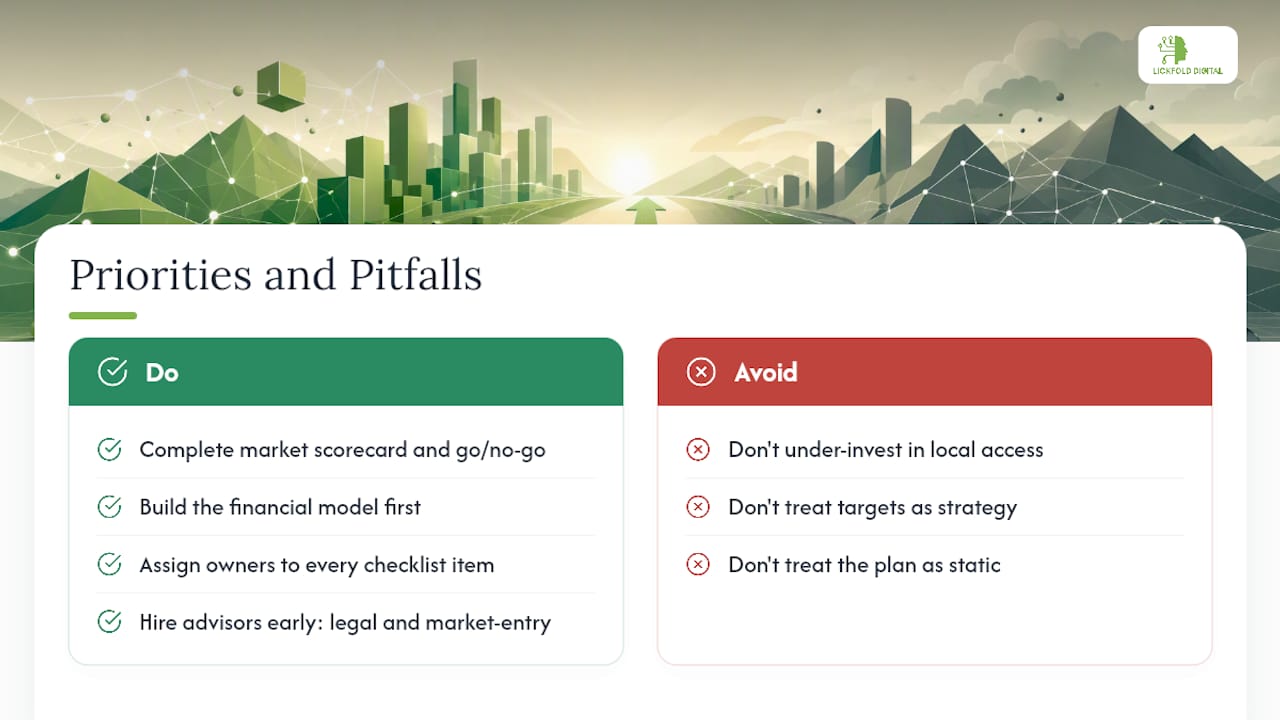
Under-investing in local access. Teams budget for marketing and product but not for the relationships that actually open doors. A local advisor, a well-connected reseller, or a single hire with deep market relationships is often worth more in year one than a six-figure ad campaign. The BDA research on localized stakeholder networks is unambiguous: without local relationships, even strong products face long ramp times.
Conflating targets with strategy. Setting a revenue goal is not a strategy. “We will reach $1M in the Texas market by Q4” is a target. The strategy is the specific combination of entry mode, channel, pricing, and outbound approach that makes that number achievable. Many leadership teams spend hours debating the target and 20 minutes on the how.
Treating the plan as a static document. An expansion plan written in January and reviewed in December is not a plan; it is a historical artifact. The teams that succeed treat the plan as a living project-management tool with documented owners, KPIs, and a weekly review cadence. The Business.com growth planning framework makes this explicit: deliverables, owners, and KPIs must be documented and updated continuously.
What to prioritize instead: Complete the market scorecard and go/no-go criteria first. Then write the financial model. Then assign owners to every checklist item. Everything else is execution.
When to hire advisors: bring in local legal counsel before you sign any partner agreement or make any hire in a new jurisdiction. Bring in a market entry consultant if your team has never operated in the target market before. The cost of good advice is a fraction of the cost of a compliance failure or a bad partner agreement.
Lickfold cuts the time from market entry plan to first qualified meeting
Most B2B teams entering a new market spend their first 60–90 days building lists, writing sequences, and debugging email deliverability. That is time you cannot get back.

Lickfold deploys dedicated AI agents that handle the entire outbound prospecting workflow: ICP-matched list building, personalized multi-touch sequences, warm-up infrastructure, and human qualification of every reply before it reaches your sales team. The result is a pipeline of qualified meetings in the new market while your team focuses on closing, not prospecting. In the first 90 days of a pilot engagement, clients typically see their first qualified opportunities within weeks, not months, because the outbound infrastructure is live from day one.
If you are planning a market entry and want to validate demand with real buyer conversations before committing to full-scale investment, reach out to Lickfold to discuss a tailored pilot.
Sources
The sources below are the most useful public references for executing the checklist above.
- The International Market Entry Checklist - Accuracast
- What Is Market Expansion? Strategies, Models & Examples
- Key Considerations for Small Business Expansion | CO- by US Chamber of Commerce
- Market development strategy (HubSpot blog)
- Market expansion: how to create a strategy that drives global growth (Phrase)