
How Agencies Target Marketing Directors: 2026 Guide
How Agencies Target Marketing Directors: 2026 Guide
TL;DR:
- Agencies target marketing directors effectively by using multi-channel outreach combined with authority-building content. They focus on revenue metrics in messaging and build highly targeted prospect lists based on decision-making signals.
Agencies target marketing directors most effectively by combining multi-channel outreach with authority-building content and messaging tied directly to revenue metrics. A well-structured outreach approach produces a 28% average connection acceptance rate, a 29% reply rate on accepted connections, and roughly 8% overall response from initial contact. Those numbers come from 316,703 outreach sequences run in 2026. They prove that precision beats volume every time. Marketing directors are revenue-focused decision-makers, and agencies that speak their language win the meeting.
How agencies target marketing directors: understanding the role first
Marketing directors own branding, campaign execution, and pipeline metrics. They report to the C-suite and are measured on revenue contribution, not activity. That distinction matters enormously for any agency trying to earn their attention.
The most common mistake agencies make is pitching features. Marketing directors evaluate vendors on pipeline math and contribution to revenue, not on tool capabilities or deliverable lists. An agency that opens with “we do SEO, paid media, and content” signals immediately that it does not understand the buyer. An agency that opens with “your category typically converts at X%, and we’ve moved that needle for three similar brands” signals category fluency.
Marketing directors also filter outreach at high speed. They receive dozens of pitches weekly. A message that does not connect to a metric they track gets deleted in seconds. Agencies that understand this reality build their entire outreach process around the director’s KPIs, not the agency’s service catalog.
The three priorities marketing directors track most closely:
- Pipeline contribution: how much revenue did marketing generate or influence?
- Cost per qualified lead: are we acquiring leads efficiently?
- Brand authority: are we recognized in our category?
Any outreach message that does not reference at least one of these priorities will feel irrelevant to the recipient.
Pro Tip: Before writing a single outreach message, research the target company’s recent campaigns, funding rounds, or product launches. Reference one specific detail in your opening line. Generic openers kill response rates before the second sentence.
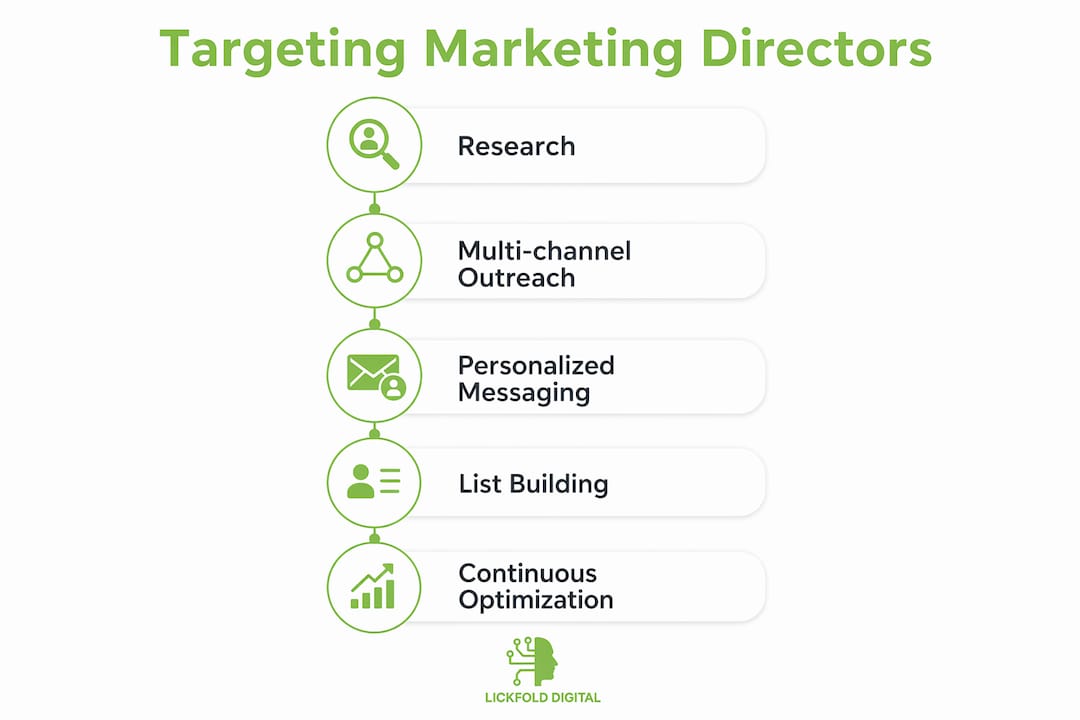
What multi-channel outreach strategies work best?
Single-channel outreach is the most common approach and the least effective one. Agencies that rely on email alone or LinkedIn alone miss the compounding effect of coordinated, timed touches across both channels.

Integrating LinkedIn into email sequences generated 47% of total responses in a 2026 case study targeting a 50-contact sample of B2B marketing directors. The overall response rate reached 46%, and 14% of contacts booked a meeting. Those results came from a disciplined sequence, not from blasting the same message across every channel simultaneously.
The sequencing logic matters as much as the channel mix. A LinkedIn touch that arrives around day 11 of an email sequence, after the prospect has already seen two or three emails, generates nearly half of all responses in a campaign. The email builds familiarity. The LinkedIn message closes the loop. Together, they feel like a coherent conversation rather than random interruptions.
A proven multi-channel sequence for reaching marketing directors:
- Day 1: Send a personalized cold email referencing a specific company metric or recent campaign.
- Day 3: Follow up with a short email adding one piece of relevant benchmark data.
- Day 7: Connect on LinkedIn with a brief, non-pitch note referencing the email thread.
- Day 11: Send a LinkedIn message that ties your agency’s work to a result the director cares about.
- Day 14: Final email with a clear, low-friction call to action (a 15-minute call, not a full demo).
Channel performance comparison for marketing director outreach:
| Channel | Strength | Weakness |
|---|---|---|
| Email only | High volume, easy to automate | Low trust, easy to ignore |
| LinkedIn only | High credibility, visible profile | Limited daily reach, slower |
| Email + LinkedIn | Highest response and meeting rates | Requires more coordination |
Pro Tip: Never send a LinkedIn connection request and a cold email on the same day. Simultaneous touches feel coordinated in a way that reads as automated. Space them by at least four days to preserve the appearance of genuine interest.
How to craft messaging that resonates with marketing directors
The opening line of any outreach message is the only line that matters until the reader decides to keep reading. Agencies that open with their own credentials lose. Agencies that open with a shared problem or a metric the director tracks win.
Marketing leaders immediately gauge agency quality based on the personalization and category understanding in the first message. A generic template signals that the agency does not do its homework. That signal is fatal because marketing directors know exactly what good research looks like. They do it themselves every day.
Category fluency is the real differentiator. An agency that can reference a specific benchmark, a competitor’s recent campaign, or a known challenge in the director’s vertical demonstrates that it has earned the right to be in the conversation. That credibility cannot be faked with a mail-merge field.
Warming prospects before outreach compounds this effect. Lead-magnet posts deliver roughly 20 times greater impressions and tenfold engagement compared to standard posts. Publishing campaign teardowns, benchmark reports, or category-specific data on LinkedIn before reaching out means that cold messages feel familiar rather than intrusive. The prospect has already seen your thinking. The outreach becomes a continuation, not an interruption.
“Successful targeting requires warming prospects with authority content, such as campaign teardowns and benchmark data, before outreach so that cold messages feel familiar rather than intrusive. Agencies that skip this step compete on volume. Agencies that do it compete on trust.”
Messaging principles that consistently improve reply rates:
- Open with a problem or metric, not a credential or service list.
- Reference something specific to the company or the director’s category.
- Keep the message under 100 words. Brevity signals respect for the reader’s time.
- Make the call to action low-friction. Ask for a conversation, not a commitment.
- Never attach a deck or a case study to a first message. Earn the right to share more.
How do you build a targeted marketing director prospect list?
Precise targeting starts before the first message is written. Agencies that build lists based on job title alone waste outreach capacity on contacts who lack budget authority or decision-making power.
Precise targeting using criteria such as titles, company size, and budget ownership enables a richer decision-maker density and higher reply rates. The right criteria filter out noise before the sequence begins. That efficiency shows up directly in acceptance and reply rates.
The most effective qualification criteria for marketing director prospect lists:
- Job title: Marketing Director, VP of Marketing, Head of Marketing, CMO at companies below enterprise scale.
- Company size: 50–500 employees, where the marketing director typically owns the budget and the vendor decision.
- Industry fit: Match your agency’s proven category experience to the prospect’s vertical.
- Budget signals: Recent funding rounds, hiring activity in marketing roles, or new product launches all indicate active spend.
- Tech stack: Tools the company uses reveal budget maturity and openness to new vendors.
Account-based marketing lifts revenue by up to 208% compared with broad outreach by tailoring messaging to specific companies’ problems. That figure reflects what happens when targeting criteria are tight and messaging is matched to the account, not to a generic buyer persona.
Pro Tip: Verify email addresses and LinkedIn profiles before launching any sequence. A 10% bounce rate signals poor list hygiene to email providers and damages deliverability for every message that follows.
Common mistakes agencies make when targeting marketing directors
The most damaging mistake is volume without relevance. Sending more than 20 LinkedIn invites daily reduces acceptance rates and signals low quality to marketing leaders who filter out generic templates. More outreach does not produce more results when the targeting and messaging are weak.
The most common outreach mistakes and how to avoid them:
- Templated value propositions: Marketing directors recognize copy-paste pitches instantly. Personalize every opening line with a company-specific or category-specific reference.
- Feature-first messaging: Leading with services instead of outcomes tells the director you do not understand their job. Lead with a result, then explain how you achieve it.
- Skipping the warm-up phase: Jumping straight to outreach without building any content authority means every message lands cold. Publish before you pitch.
- Ignoring retention while scaling acquisition: Aiming for 97%+ client retention through strong onboarding is foundational. Agencies that grow acquisition without fixing retention accelerate their own failure.
- Measuring vanity metrics: Profile views and connection counts tell you nothing useful. Track accepted-then-replied rate and booked calls per 100 connection requests instead.
A cohesive system where inbound authority content and outbound outreach reinforce each other compounds overall engagement and response success. Agencies that treat content and outreach as separate programs leave significant response rate gains on the table.
Key Takeaways
Agencies that reach marketing directors effectively combine precise list targeting, multi-channel sequencing, and revenue-focused messaging, with authority content warming prospects before any direct outreach begins.
| Point | Details |
|---|---|
| Lead with revenue metrics | Open every message with a pipeline metric or outcome, not a service list. |
| Use multi-channel sequences | Combining email and LinkedIn generates up to 47% of total responses in director-targeted campaigns. |
| Warm prospects with content | Publishing benchmark data or campaign teardowns before outreach makes cold messages feel familiar. |
| Target by budget ownership | Filter prospect lists by company size, funding signals, and decision-making authority, not just job title. |
| Track reply and meeting rates | Measure accepted-then-replied rate and booked calls per 100 requests, not profile views or connection counts. |
What I’ve learned from watching agencies win and lose this game
The agencies that consistently book meetings with marketing directors share one trait: they treat their own outreach as a demonstration of their capabilities. A marketing director who receives a well-researched, concise, outcome-focused message thinks, “If this is how they prospect, imagine how they run campaigns.” The message is the audition.
Most agencies get this backwards. They save their best thinking for the pitch deck and send generic messages to get there. Marketing directors see through that immediately. The outreach is the first deliverable, and it either earns trust or destroys it.
The other pattern I’ve observed is that agencies underestimate how much inbound content accelerates outbound results. When a marketing director has already seen your LinkedIn post breaking down a competitor’s campaign, your cold message lands as a follow-up from someone they recognize, not a stranger asking for time. That shift in perception changes everything about the response dynamic.
Track three numbers relentlessly: acceptance rate, accepted-then-replied rate, and booked meetings per 100 requests. Everything else is noise. When those numbers are healthy, the system works. When they drop, the problem is either in the list, the message, or the timing, and each one has a specific fix. Agencies that build this feedback loop into their process improve continuously. Agencies that ignore it repeat the same mistakes at higher volume.
— Duarte
Lickfold builds the targeting system most agencies try to build manually
Reaching marketing directors at scale requires precise list building, coordinated multi-channel sequences, and messaging that speaks directly to revenue outcomes. Most agencies attempt to build that system manually, which means inconsistent execution and slow iteration.
Lickfold deploys AI-driven prospecting to identify marketing directors who match your ideal client profile, build verified contact lists filtered by company size, budget signals, and decision-maker authority, and execute personalized multi-touch outreach across email and LinkedIn. Every reply is qualified by a human before it reaches your sales team. The result is a predictable pipeline of warm leads, not a spreadsheet of cold contacts. If you want a system that runs continuously and improves with every sequence, reach out to Lickfold to get started.
FAQ
How agencies target marketing directors most effectively?
Agencies achieve the highest response rates by combining personalized email sequences with timed LinkedIn touches and warming prospects with authority content before direct outreach. A multi-channel approach generates up to 46% overall response rates in campaigns targeting marketing directors.
What response rate should agencies expect from marketing director outreach?
A well-structured outreach sequence produces roughly a 28% connection acceptance rate and a 29% reply rate on accepted connections, yielding about 8% overall response from initial contact.
Why do feature-focused pitches fail with marketing directors?
Marketing directors evaluate vendors on pipeline contribution and revenue metrics, not service lists. Pitching features instead of outcomes signals a lack of category understanding and results in immediate disqualification.
How many LinkedIn invites per day is too many?
Sending more than 20 LinkedIn connection requests per day reduces acceptance rates and signals low-quality, automated outreach to marketing leaders who recognize templated approaches.
What metrics should agencies track in director-targeted outreach?
The most predictive metrics are accepted-then-replied rate and booked calls per 100 connection requests. Vanity metrics like profile views and total connections do not predict pipeline outcomes.