
Growing B2B Service Revenue Predictably in 2026
Growing B2B Service Revenue Predictably in 2026
Why predictable revenue separates scaling firms from stalling ones
Growing B2B service revenue predictably comes down to one structural shift: replacing project-based income with recurring revenue streams backed by repeatable systems. Companies that get at least 50% of revenue from recurring sources grow 30% faster and command exit valuations up to 10 times higher than project-only peers. That gap is not hypothetical. Buyers pay a premium for predictability because it signals a business that runs on systems, not on the founder’s hustle.
Traditional B2B service growth is reactive. A referral comes in, a project closes, the team delivers, and then the cycle resets. Revenue is a function of timing and luck, not of a machine you control. Predictable revenue flips that equation by building demand generation, sales process, and client retention into a single integrated engine.
Here is why this matters beyond the valuation story:
- Reduced founder burnout: When revenue depends on your personal network, growth has a hard ceiling tied to your energy.
- Faster compounding: Recurring contracts mean you start each month with a baseline already covered, so new sales add to a floor rather than replace a ceiling.
- Better forecasting: Objective pipeline data replaces gut-feel estimates, which is the foundation of any serious B2B sales forecasting method.
- Higher team stability: Predictable cash flow lets you hire ahead of demand rather than scrambling after a big win.
- Stronger client relationships: Retention-focused models force you to deliver ongoing value, which deepens trust and reduces churn.
The feast-or-famine cycle is not a personality problem. It is a structural one. Fix the structure, and the revenue follows.
Core frameworks that drive consistent service revenue growth
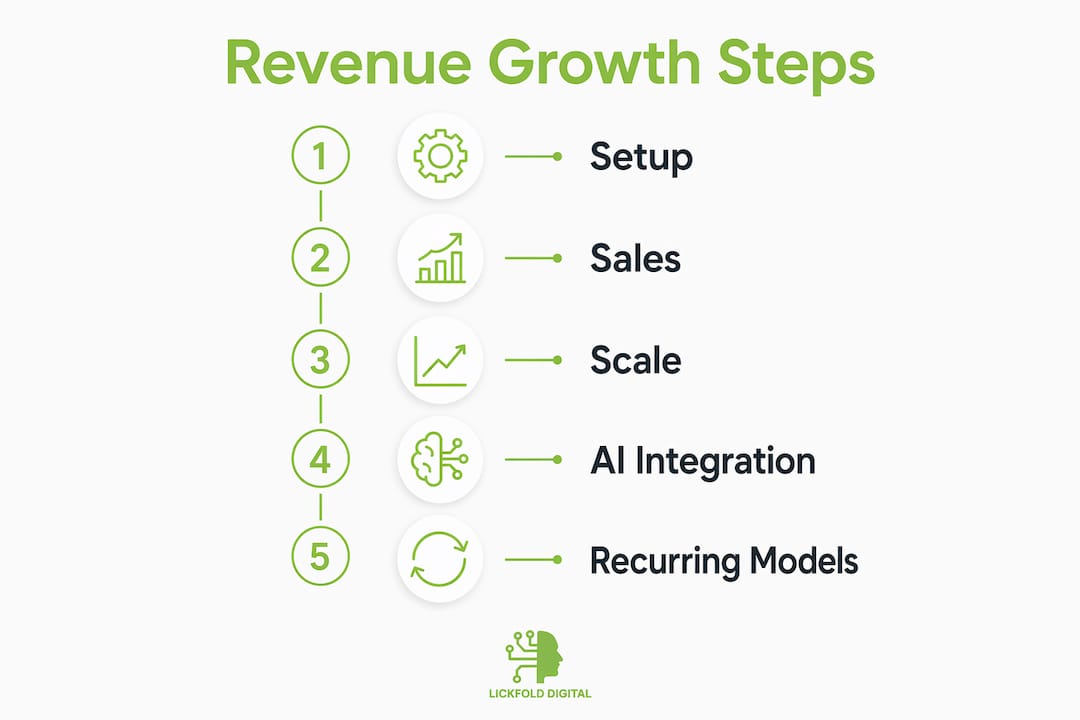
Several proven models give B2B service leaders a blueprint for building predictable income. The most widely adopted is the Predictable Profits Operating System (PPOS), which organizes growth into three stages: Setup, Sales, and Scale. Setup focuses on multi-channel demand generation so your brand reaches buyers before they ever speak to a rep. Sales covers lead refinement, recurring offer design, and conversion. Scale embeds data intelligence and team systems to sustain growth without founder dependency.
Within the Sales pillar, the RISE framework guides the design of recurring revenue offers:
- Research: Identify the ongoing problems your best clients need solved month after month.
- Innovate: Design a subscription-based solution that becomes embedded in their operations.
- Structure: Choose a pricing model (flat rate, tiered, or performance-based) and give the offer a branded name that communicates value, not just a “monthly retainer.”
- Engage: Launch with a retention-first mindset and track client health from day one.
The Honeycomb Client Flywheel complements RISE by focusing on the full client lifecycle. It treats lead nurturing, engagement, and retention as a continuous loop rather than a linear handoff. Buyers who consume more of your content before a sales call are 80% more likely to convert than cold prospects, which is why the flywheel invests heavily in pre-sale education.
The Revenue Factory concept takes this further by treating go-to-market as an engineering problem. Marketing, sales, and customer success share a unified pipeline view, and every motion is measured against pipeline velocity rather than activity volume.

| Framework | Core Focus | Primary Outcome |
|---|---|---|
| PPOS (Setup, Sales, Scale) | Full-funnel demand generation and systems | Founder independence, scalable pipeline |
| RISE Framework | Recurring offer design and retention | Monthly recurring revenue, higher LTV |
| Honeycomb Client Flywheel | Lead nurture, engagement, retention loop | Shorter sales cycles, lower churn |
| Revenue Factory | Cross-functional go-to-market alignment | Forecast accuracy, pipeline velocity |
Pro Tip: Give your recurring offer a branded name. “Brand Guardian Retainer” or “Growth Partnership Plan” signals unique value in a way that “monthly retainer” never will, and it makes the offer harder for clients to compare against a competitor’s hourly rate.
How to build a predictable revenue engine step by step
The fastest path to predictable service revenue starts with RevOps, not with more sales hires. Establishing a RevOps function early prevents the attribution confusion that plagues teams running multiple channels without a shared reporting model. Before you add pipeline volume, you need to trust your pipeline data.
- Define your Ideal Customer Profile (ICP) with precision. Segment by industry, company size, tech stack, and buying signals. Vague targeting produces vague pipeline.
- Audit your current revenue mix. Calculate what percentage comes from recurring versus project-based sources. If recurring revenue is below 30%, that is your first constraint to fix.
- Package a recurring offer using RISE. Identify the ongoing problem your best clients face, design a named subscription solution, and price it from the client’s ROI frame, not your cost frame.
- Instrument your pipeline. Set up stage-by-stage progression metrics in your CRM. Every deal should advance based on objective buyer commitment signals, not rep optimism.
- Build a multi-channel nurture engine. Email sequences, LinkedIn content, and retargeting work together to pre-heat prospects before they book a call. This shortens sales cycles and raises close rates.
- Deploy AI-powered outbound prospecting. AI agents that search across LinkedIn, hiring signals, and company news produce 3–5x the reply rate of traditional scraped lists while cutting SDR headcount in half.
- Develop a sales playbook with persona-specific messaging. Reps need call guides, objection-handling tools, and message maps tailored to each buyer persona, not a generic pitch deck.
- Install structured sales coaching. Two-thirds of top-performing companies use structured coaching programs with templates and playbooks. Regular coaching keeps execution consistent and prevents pipeline drift.
- Future-pace every client relationship. Show clients where they are on their growth path and what comes next. Clients who can see the next milestone stay significantly longer than those who feel the engagement is winding down.
- Track retention as a primary KPI. Increasing retention by 5% boosts profits between 25% and 95%. That range alone justifies treating retention as a revenue strategy, not just a customer service metric.
Key metrics to monitor weekly:
- Client retention rate (track quarterly, flag monthly)
- Recurring revenue as a percentage of total revenue
- Pipeline velocity (average deal value × win rate ÷ sales cycle length)
- Forecast accuracy (predicted versus actual closed revenue)
- Net Revenue Retention (NRR) to measure expansion against churn
For agencies looking to build a recurring revenue base, WordPress maintenance plans offer a concrete model for transitioning project clients into monthly contracts without rebuilding your entire service offering.
Advanced AI systems that accelerate revenue growth
The fastest-growing B2B organizations embed AI across the full customer journey, from prospecting through renewals, rather than concentrating technology only at the closing stage. That distinction matters because most of the revenue leverage sits earlier in the funnel, where buyer education and trust-building happen.
AI-driven prospecting changes the economics of outbound entirely. Instead of SDRs spending hours building lists manually, AI agents scan LinkedIn, company news, hiring spikes, and intent signals to surface in-market accounts. The result is a scored, verified shortlist that reps can act on immediately. At scale, this approach compresses the time from target identification to first qualified meeting from weeks to days.
Here is where AI integration delivers the most measurable lift:
- Intent-based targeting: Prioritizing the top 5–10% of in-market accounts based on third-party research signals and technographic shifts closes deals 2–3x faster than broad outreach.
- Automated multi-touch sequences: Personalized email cadences that adapt based on prospect behavior replace generic templates and maintain deliverability.
- Predictive forecasting: Machine learning models trained on historical pipeline data flag stalled deals and forecast revenue based on buyer commitment signals rather than rep sentiment.
- Client health monitoring: The Check Engine Light system tracks each client in a Red/Yellow/Green framework using NPS scores, content consumption, repurchase rate, and communication frequency. When a client goes Yellow, you have time to intervene. By Red, your only move is a save.
Pro Tip: Shift your forecasting standard from “what does the rep think will close?” to “what has the buyer committed to?” Objective commitment signals, like a signed scope document or a confirmed next step with a date, are the only reliable inputs for a B2B sales forecasting model.
Companies that execute four or more programmatic sales play best practices grow revenue up to 1.9 times faster than peers. That figure comes from Bain’s survey of 1,125 global commercial leaders and reflects a consistent pattern: structured, repeatable execution across the full customer journey outperforms intensity at any single stage.

For teams ready to put AI to work across their outbound motion, AI sales tips for B2B covers the specific workflows that produce qualified pipeline at scale.
Common mistakes that kill predictable revenue before it starts
Most B2B service firms sabotage their own predictability before they ever build a system. The mistakes are consistent enough to be predictable themselves.
- Over-diversifying acquisition channels too early. Running five channels with a small team means none of them get the focus needed to produce reliable pipeline. Concentrating resources on your highest-performing acquisition motion and cutting the rest often produces 40–60% pipeline growth without adding headcount.
- Treating referrals as a growth strategy. Referrals are a byproduct of good work. You cannot dial up referral volume when you need to hit a number, which makes them a dependency, not a system.
- Forecasting from rep optimism rather than buyer signals. Forecasting fails when it relies on subjective rep confidence instead of measurable buyer commitment. A deal that “feels close” is not a forecast input.
- Stalling between $5M and $25M due to lack of standardized offerings. Founders often hit this ceiling when they grow faster than their capacity to deliver, because every engagement is custom. Standardizing your core service into a repeatable delivery model is an operational requirement, not just a sales one.
- Weak onboarding that triggers early churn. The two highest churn points in recurring revenue models are month one and month three. Clients who reach month four tend to stay significantly longer. Invest in onboarding as if it were a sales activity, because it is.
- Neglecting RevOps alignment. When sales, marketing, and customer success operate from different data sets, pipeline attribution becomes guesswork and forecasts become fiction.
- Skipping client health scoring. If you are not tracking NPS, consumption, and communication frequency, you will not see churn coming until it has already happened.
What predictable revenue looks like in practice
The patterns that produce consistent B2B service revenue growth show up across industries, and the mechanics are more transferable than most founders expect.
A B2B distributor struggling to deploy its sales team effectively built a comprehensive account-level view of its customer base, integrating third-party data to estimate total addressable spend and likelihood to buy by product, region, and channel. By focusing reps on the highest-return opportunities, pilot regions increased incremental revenue by 20% and identified more than $250 million in near-term opportunity, with positive ROI inside six weeks.
A European industrials company reoriented its commercial organization around persona-specific sales plays with clear value propositions tied directly to customer problems. Proactive outbound bookings grew from 0% to 30% of total bookings, and revenue growth landed well above target. The company estimated that most of those new bookings would not have occurred under its prior product-led approach.
A chemicals company built persona-specific collateral for its top four sales plays, including outreach cadences, call guides, and competitive battlecards, supported by coordinated digital campaigns targeting the same priority accounts. The result was brand-new prospective revenue equivalent to a significant portion of the pipeline typically generated in a comparable period, with substantially higher advertising click-through rates.
The common thread across all three: they stopped treating revenue as a sales problem and started treating it as a systems problem. Pipeline generation became an engineering task. Messaging became persona-specific. Execution became repeatable. For agency leaders thinking through how to prioritize their own acquisition channels and revenue plays, this 2026 agency guide covers the channel selection decisions that matter most at different growth stages.
Lickfold builds the outbound pipeline your revenue system needs
Most of the frameworks covered here assume one thing: a consistent flow of qualified prospects entering your pipeline. That is exactly where most B2B service firms break down, not because the system is wrong, but because outbound execution is slow, expensive, and inconsistent when done manually.
Lickfold solves the top-of-funnel problem with AI-driven prospecting built specifically for B2B service companies. Dedicated AI agents identify decision-makers that match your ICP, verify contact data, and execute personalized multi-touch outreach campaigns at a volume no human SDR team can match. Replies are qualified by a human before they reach your sales team, so every conversation you have is worth having. Infrastructure setup, email warm-up, and sender reputation management are all handled, meaning your team focuses on closing, not on list-building or deliverability firefighting. If growing B2B service revenue predictably is the goal, Lickfold gives you the pipeline volume to make every other system in this article actually work. Get in touch to see how it fits your current growth stage.
Key Takeaways
Predictable B2B service revenue requires recurring revenue models, aligned cross-functional systems, and AI-powered pipeline generation working together as a single engine.
| Point | Details |
|---|---|
| Recurring revenue threshold | Firms with 50%+ recurring revenue grow 30% faster and achieve valuations up to 10x higher than project-only peers. |
| Retention as a revenue lever | A 5% increase in client retention raises profits between 25% and 95%, making retention the highest-ROI growth motion. |
| Structured execution multiplier | Companies running four or more programmatic sales play best practices grow revenue up to 1.9x faster than peers. |
| AI-powered outbound impact | AI prospecting produces 3–5x the reply rate of scraped lists while cutting SDR headcount requirements in half. |
| Lickfold’s role | Lickfold delivers AI-driven outbound pipeline so B2B service teams can feed every framework in this article with qualified prospects. |