
GetLeadLynx.com Alternatives for B2B Sales Teams in 2026
GetLeadLynx.com Alternatives for B2B Sales Teams in 2026
TL;DR:
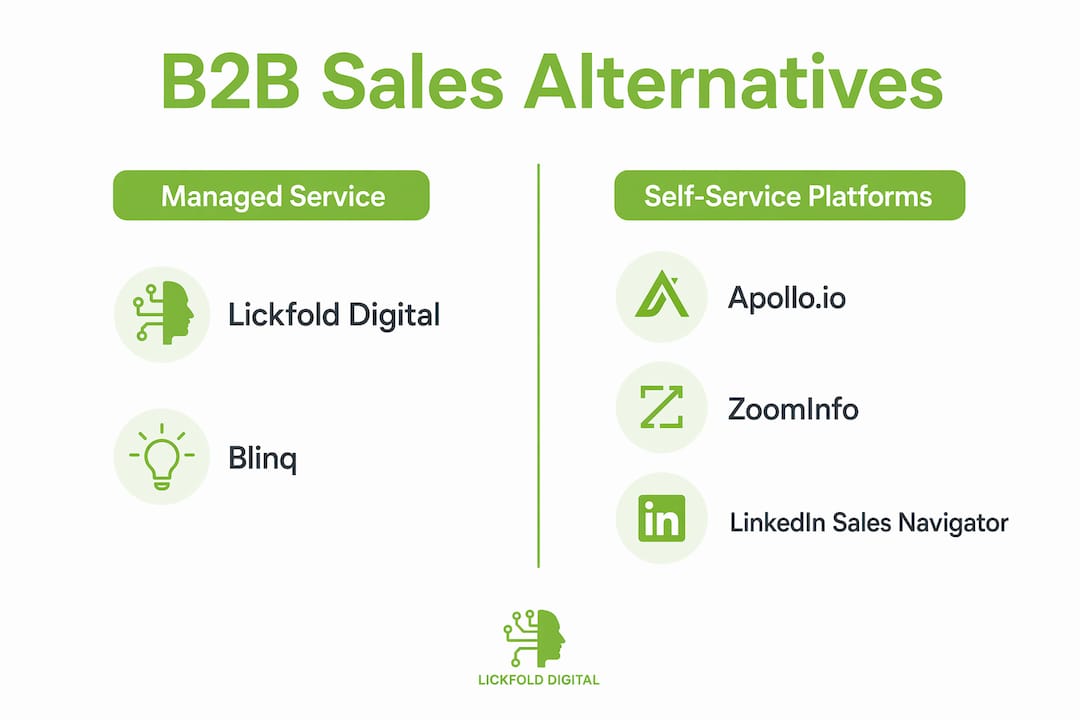
- The best alternatives to getleadlynx.com for outbound B2B teams include managed services like Lickfold Digital and self-service platforms such as Apollo.io and ZoomInfo. Lickfold offers end-to-end outbound workflows with human qualification and reputation management, ideal for teams lacking outbound operations. Self-service tools require internal setup but provide scalable data and automation for teams with existing outbound infrastructure.
If you need a direct answer: the strongest getleadlynx.com alternatives for outbound B2B teams right now are Lickfold Digital, Apollo.io, ZoomInfo (GTM Workspace), LinkedIn Sales Navigator, and Blinq. For teams that want a fully managed, done-for-you pipeline, Lickfold Digital is the standout pick. For self-service data access at scale, Apollo.io and ZoomInfo lead the field.
A few things drive that shortlist:
- Data quality and U.S. coverage separate the serious contenders. Apollo.io and ZoomInfo both maintain large verified U.S. contact databases, while Lickfold adds AI-driven decision-maker mapping on top of raw data.
- Outreach automation depth matters as much as data. Salesforce and HubSpot CRM integrations are table stakes; the differentiator is whether the platform handles warm-up, deliverability, and reply qualification, or leaves that to you.
- Managed services vs. self-service is the real fork in the road. Most tools hand you a database and a sequencer. Lickfold runs the entire outbound motion for you, including human qualification before a lead ever hits your CRM.
Table of Contents
- How top GetLeadLynx.com alternatives compare at a glance
- Short profiles: what each alternative actually does
- How to choose the right alternative for your team
- Why Lickfold Digital is our recommended pick for managed AI prospecting
- How we selected and compared these alternatives
- Pricing and contract expectations across the shortlist
- Key Takeaways
- What we see working in the market right now
- Lickfold Digital can run your outbound pipeline from day one
- Sources and further reading
How top GetLeadLynx.com alternatives compare at a glance
The table below maps each alternative across the dimensions that matter most for outbound B2B teams. Categorical values reflect publicly available product positioning; confirm integration depth and pricing directly with each vendor.
| Dimension | Lickfold Digital | Apollo.io | ZoomInfo | LinkedIn Sales Navigator | Blinq |
|---|---|---|---|---|---|
| Best for | Managed AI outbound | Self-service prospecting | Enterprise data enrichment | LinkedIn-centric prospecting | Digital networking / contact capture |
| Prospecting & enrichment | AI agents + decision-maker mapping | Large contact database + enrichment | Deep firmographic enrichment | LinkedIn profile data | Contact exchange, limited enrichment |
| Outreach automation | Multi-touch AI sequences | Built-in sequences | Engage add-on | InMail + alerts | No native sequencing |
| Deliverability / warm-up | Dedicated warm-up + reputation mgmt | Self-managed | Self-managed | N/A | N/A |
| CRM integrations | Salesforce, HubSpot, and others | Salesforce, HubSpot, Pipedrive | Salesforce, HubSpot, and others | Salesforce, HubSpot | Limited |
| Pricing / trials | Contact sales (managed service) | Free tier; paid plans available | Contact sales | Free trial available | Free tier; paid plans available |
| Data quality / verification | AI-verified + human-qualified | Real-time verification | Strong; enterprise-grade | LinkedIn-sourced | Basic |
| Ease of use / onboarding | Fully managed; minimal setup | Moderate self-setup | Steeper learning curve | Familiar LinkedIn UI | Very easy |
| Support & managed services | Full managed service | Self-service; support tiers | CSM at enterprise | Self-service | Self-service |
| U.S. data coverage | Strong | Strong | Very strong | Strong (LinkedIn US base) | Limited |
Two trade-offs stand out immediately:
- Managed services vs. DIY automation. Apollo.io and ZoomInfo give you powerful tools, but you own the setup, warm-up, and deliverability. Lickfold handles all of that, which matters if your team lacks a dedicated outbound ops function.
- Deeper enrichment vs. lower per-contact cost. ZoomInfo’s firmographic depth is unmatched, but it comes at enterprise pricing. Apollo.io’s free tier lets smaller teams get started, though real-time contact verification is a paid feature across most platforms.
Short profiles: what each alternative actually does
1. Lickfold Digital
Lickfold is a fully managed AI-driven prospecting service, not a self-service database. Dedicated AI agents for B2B prospecting handle market research, decision-maker identification, personalized multi-touch outreach, and email infrastructure setup, including warm-up accounts and ongoing reputation management. Human team members review and qualify replies before anything reaches your sales team. The result is a pipeline that runs continuously without requiring your reps to manage sequences or troubleshoot deliverability.
Pros:
- Full outbound motion handled end-to-end, including warm-up and IP reputation
- Human qualification of replies means sales reps only see genuinely interested prospects
- No need for a separate sequencing tool, deliverability stack, or outbound ops hire
Cons:
- Not a self-service tool; teams that want direct database access will need to look elsewhere
- Pricing is managed-service retainer, not a per-seat SaaS subscription
Best for: Service firms, agencies, and technical B2B sellers that want a predictable outbound pipeline without building an internal outbound team.

2. Apollo.io
Apollo.io is one of the most widely used self-service prospecting platforms in the U.S. market. It combines a large contact and company database with built-in email sequencing, making it a reasonable all-in-one starting point for outbound teams. The free tier is genuinely useful for early-stage testing, though enterprise features like deliverability operations sit behind paid plans. G2 lists Apollo.io among the top GetLeads alternatives based on user reviews and feature overlap.
Pros:
- Large U.S. contact database with real-time verification on paid tiers
- Native email sequencing reduces the need for a separate outreach tool
- Free plan available; accessible for smaller teams
Cons:
- Deliverability and warm-up are self-managed; no built-in reputation management
- Data accuracy can vary by industry and contact seniority
Best for: Growth-stage B2B teams that want self-service prospecting plus basic sequencing in one platform.

3. ZoomInfo (GTM Workspace)
ZoomInfo is the enterprise standard for B2B contact and firmographic data in the United States. Its GTM Workspace rebranding consolidates data enrichment, intent signals, and outreach tools under one roof. The depth of company and contact data is hard to match, particularly for enterprise accounts and complex org charts. That said, pricing is firmly in enterprise territory, and the platform has a steeper onboarding curve than most alternatives.
Pros:
- Best-in-class firmographic depth and U.S. data coverage
- Intent data layer helps prioritize accounts showing buying signals
- Strong Salesforce and HubSpot integrations
Cons:
- Annual contracts with enterprise pricing; no meaningful free tier
- Outreach automation (Engage) is an add-on, not core functionality
Best for: Enterprise sales teams with a dedicated RevOps function and a need for deep account intelligence.
4. LinkedIn Sales Navigator
Sales Navigator is the go-to tool when your ICP lives on LinkedIn and your reps sell through social channels. It surfaces real-time account and contact updates, flags job changes, and enables InMail outreach directly within the platform. It does not replace a contact database or an outreach sequencer, but it pairs well with either. The familiar LinkedIn interface keeps onboarding friction low.
Pros:
- Real-time LinkedIn data on job changes, company news, and account activity
- Strong Salesforce and HubSpot CRM sync for account and contact updates
- Free trial available before committing to a paid plan
Cons:
- No email outreach sequencing or deliverability management
- Contact data is LinkedIn-sourced only; no broader web enrichment
Best for: Account executives and SDRs who lead with LinkedIn touchpoints and need live account intelligence to time outreach.
5. Blinq
Blinq is a digital business card and contact-capture platform, which puts it in a different category from the other tools on this list. It earns a mention because it appears in several GetLeadLynx.com alternative roundups, likely due to its contact-exchange functionality. For outbound pipeline building, it is not a direct replacement. Where it adds value is in event-based lead capture and follow-up, particularly for field sales teams attending conferences.
Pros:
- Very easy to use; minimal onboarding required
- Free tier available; low barrier to entry
- Useful for in-person networking and event follow-up
Cons:
- No prospecting database, outreach sequencing, or CRM enrichment
- Not a viable standalone replacement for an outbound lead generation platform
Best for: Field sales reps who need a fast, professional way to capture and share contact information at events.
How to choose the right alternative for your team
The core decision dimensions for replacing an AI-driven prospecting platform come down to five practical questions. Work through these before you book a demo.
1. Data accuracy and verification. Ask vendors how often their database is refreshed and whether verification is real-time or batch. A stale contact list wastes sequences and damages sender reputation.
2. Deliverability and warm-up. This is the criterion most buyers skip, and it is the one that kills campaigns. Confirm whether the vendor provides dedicated sending infrastructure, warm-up accounts, and ongoing IP reputation management, or whether you are responsible for all of that. Verifying deliverability setup before a paid pilot is the single most underrated step in vendor evaluation.
3. CRM integration depth. “Integrates with Salesforce” can mean anything from a one-way data push to full two-way sync with field mapping. Ask specifically: does the integration write back to your CRM on reply, bounce, and status change? Does it support custom fields?
4. Multichannel sequencing. If your outbound motion includes email, LinkedIn, and phone, confirm the platform handles all three natively, or identify which third-party tools you will need to add.
5. Managed services vs. self-service. If your team does not have a dedicated outbound ops person, a self-service tool will underperform. Managed services cost more upfront but often produce faster results because the infrastructure is already built.
6. Pricing transparency. Many aggregator sites list tools without current pricing; always confirm directly. Watch for annual contract requirements and per-seat minimums that inflate the real cost.
7. U.S. data coverage. Not every tool in global roundups covers the U.S. market well. Ask for a sample pull against your ICP before committing.
Vendor questions to ask on discovery calls:
- What is your database refresh cadence, and how do you handle bounced contacts?
- Do you support automatic enrichment when a prospect replies or opens an email?
- Which CRMs have verified two-way sync, and what fields does the sync cover?
- Is warm-up and IP reputation management included, or is it an add-on?
- What does a typical onboarding timeline look like, and who owns deliverability?
Pro Tip: Run a 30-day deliverability pilot on a small segment of your ICP before committing to a full contract. Measure open rate, bounce rate, and reply rate against your current baseline. A tool that looks strong in a demo can underperform on your specific domain and audience.
Why Lickfold Digital is our recommended pick for managed AI prospecting
When the primary need is a fully operational outbound pipeline without building internal infrastructure, Lickfold is the strongest option among the getleadlynx.com alternatives covered here. The service deploys dedicated AI agents that handle market research, decision-maker mapping, and personalized multi-touch outreach from day one. Critically, Lickfold also manages email warm-up and sender reputation as part of the service, which is the piece most self-service tools leave entirely to the buyer.
What sets Lickfold apart from the self-service alternatives:
- AI agents run continuously across your target market, identifying and engaging decision-makers that match your ICP
- Dedicated warm-up email accounts and ongoing reputation management protect deliverability without requiring an in-house ops function
- Human team members qualify replies before they reach your sales reps, so your team only spends time on genuinely interested prospects
- Multi-touch outreach is personalized per contact, not templated blasts
Lickfold fits best when:
- Your team lacks a dedicated outbound ops or SDR function
- You need pipeline results within weeks, not months of platform configuration
- You sell a complex B2B service where personalized, multi-touch outreach outperforms volume blasting
A self-service tool may be a better fit when:
- You have an existing outbound ops team that wants direct database access
- Your sales cycle is short and volume-driven, with less need for personalization
- You want to own and iterate on sequences in-house
For a deeper look at how AI-driven workflows compare to traditional outbound, the AI prospecting guide for B2B leads covers the full setup logic.
How we selected and compared these alternatives
The shortlist above was built around the criteria that consistently surface in outbound B2B evaluations: data accuracy, deliverability practices, CRM integration depth, managed-service availability, U.S. data coverage, pricing transparency, and user reviews.
Evaluation criteria used:
- Feature coverage: prospecting, enrichment, outreach automation, and deliverability
- CRM integrations: Salesforce and HubSpot as baseline; additional integrations noted
- Managed-service options: whether the vendor runs the outbound motion or hands it to the buyer
- U.S. data coverage: verified availability for U.S.-based ICPs
- Pricing transparency: free tier or trial availability vs. enterprise-only contracts
- User reviews: community-driven signals from verified review aggregators as a first-pass filter
Sources used: Public product pages, G2 reviews, SaaSHub community listings, and AIxploria category data. Pricing and integration details change frequently; treat table values as directional and confirm specifics with each vendor.
One important caveat: aggregator sites catalog dozens of tools but rarely reflect current pricing or integration depth. Use them for discovery, then verify the details that matter to your stack on a vendor call.
Pricing and contract expectations across the shortlist
Pricing in this category spans a wide range, and the structure varies as much as the number.
Apollo.io offers a free tier with limited credits, making it accessible for early-stage testing. Paid plans scale by seat and feature access; outreach automation and higher verification limits sit behind paid tiers. No annual contract is required at entry level.
ZoomInfo operates on annual contracts with pricing that scales by seat count, data access, and add-ons like intent data and the Engage outreach module. Expect enterprise-level investment; public pricing is not listed, and a sales conversation is required.
LinkedIn Sales Navigator offers a free trial, with paid plans billed monthly or annually per seat. Pricing is publicly listed on LinkedIn’s site and is more predictable than ZoomInfo, though it covers only LinkedIn-sourced data.
Blinq has a free tier for basic digital card functionality, with paid plans for team features. It is the lowest-cost option on this list, reflecting its narrower use case.
Lickfold Digital operates as a managed service with subscription-based pricing. Because the service includes infrastructure setup, AI agent deployment, warm-up management, and human qualification, pricing reflects the full operational scope rather than a per-seat SaaS model. Contact Lickfold directly for a scoped proposal.
A pattern worth noting: many alternatives offer free plans or trial tiers for initial testing, but managed deliverability, warm-up operations, and enterprise enrichment consistently sit behind paid tiers. Budget accordingly if those capabilities are non-negotiable for your pipeline.
Key Takeaways
The strongest getleadlynx.com alternatives split cleanly into two categories: self-service data platforms (Apollo.io, ZoomInfo, LinkedIn Sales Navigator) and fully managed outbound services (Lickfold Digital), and the right choice depends entirely on whether your team has the ops capacity to run the former.
| Point | Details |
|---|---|
| Managed vs. self-service | Teams without outbound ops should prioritize managed services; self-service tools require internal setup and deliverability ownership. |
| Deliverability is the hidden variable | Warm-up, IP reputation, and sending infrastructure determine campaign success; confirm these before signing any contract. |
| CRM integration depth varies | “Integrates with Salesforce” is not enough; verify two-way sync, field mapping, and reply-status writeback with each vendor. |
| Run a pilot before committing | A 30-day deliverability pilot on a small ICP segment reveals real-world performance that demos cannot show. |
| Lickfold Digital | Best fit for B2B teams that need a fully managed AI outbound pipeline with human lead qualification and built-in deliverability management. |
What we see working in the market right now
The teams switching away from GetLeadLynx.com and similar platforms are not always doing so because the tool failed. More often, they outgrew the self-service model. They got the data, built the sequences, and then hit a wall: deliverability degraded, reply rates dropped, and no one on the team had the bandwidth to diagnose why.
The migration pitfall I see most often is skipping data hygiene before the switch. Teams import their existing contact lists into a new platform without scrubbing bounces, removing unresponsive contacts, or resetting sender reputation. The new tool inherits the old tool’s problems. The fix is straightforward: clean your list, warm up new sending domains for at least three to four weeks, and start outreach on a small segment before scaling.
The other underestimated factor is prospecting efficiency. Switching platforms does not automatically improve pipeline quality. What improves pipeline quality is tighter ICP definition, better personalization, and consistent follow-up. A managed service handles all three by design. A self-service tool only does if someone on your team is disciplined enough to enforce it. For most B2B sales teams, that is a bigger ask than it sounds.
If you want a framework for evaluating outbound tools against your specific pipeline needs, Chad Burmeister’s work on B2B sales and prospecting methodology is worth reviewing before your next vendor call.
Lickfold Digital can run your outbound pipeline from day one
Most teams evaluating getleadlynx.com alternatives are looking for better data or better automation. Lickfold delivers both, plus the operational layer that self-service tools leave out: dedicated AI agents, email warm-up, sender reputation management, and human qualification of every reply before it reaches your sales team.
The practical result is a pipeline that produces qualified conversations without requiring your team to manage sequences, troubleshoot deliverability, or sift through unqualified replies. Lickfold handles the full outbound motion so your reps can focus on closing. If you want to see what that looks like for your ICP and market, reach out to the Lickfold team to schedule a discovery call and get a scoped pilot proposal.
Sources and further reading
Research and review sources used in this article:
- Top GetLeads Alternatives in 2026 — Feature comparison and trial availability data
- GetLeads by Rainex Alternatives — SaaSHub — Community-driven rankings and verified listings
- GetLeads Alternatives — AIxploria — Broad category overview with 38 alternatives
- Top 10 GetLeads Alternatives on G2 — User reviews and verified competitor rankings
- Best lead generation tools — LeadsBridge — Editorial roundup of leading platforms
Lickfold resources for next steps:
- AI prospecting step-by-step guide for B2B sales — Tactical setup roadmap for pilots and new platform onboarding
- Why automate B2B prospecting in 2026 — Strategic rationale for switching to AI-driven outbound
- Prospecting tips for sales teams — Practical sequencing and personalization guidance for trials
How to use these sources during vendor evaluation: Use the aggregator and review links to build your initial shortlist and identify feature gaps. Then verify integration depth, pricing, and deliverability practices directly on vendor calls. Aggregators are useful for discovery; they are not a substitute for a scoped pilot against your real ICP and tech stack.