
Earn ChatGPT Citations: B2B Teams Track 4 Metrics
Earn ChatGPT Citations: B2B Teams Track 4 Metrics
ChatGPT citations are the source references and link attributions that ChatGPT and similar AI models insert when they pull from your web content to answer a question. If you run content, SEO, or outreach for a B2B brand, the single highest-leverage move is making your pages extractable: a BLUF opening, clean schema markup, and a crawlable page a model can actually parse. Everything else builds on that foundation.
TL;DR:
- Ensuring pages are easily crawlable and contain clear, extractable answer blocks are crucial for earning AI citations across multiple platforms.
- Platforms like Perplexity, ChatGPT, and Google AI cite different types of source content, making multi-platform optimization essential.
- Editing for structural clarity, question-based headings, and visible dates significantly increases your chances of being cited by AI models.
- Verifying sources through manual checks and only referencing primary, current information is vital to maintain citation accuracy and credibility.
- Buying artificial citations risks policy violations and offers low returns, emphasizing the importance of organic, structured content for AI visibility.
Table of Contents
- Why AI Citations Matter for B2B Visibility
- How Do LLMs Decide Which Pages to Cite?
- What to Fix First to Earn More AI Citations
- How to Measure Citation Impact and Run an Audit
- Is Buying AI Citations Against Google’s Policy?
- How Do You Verify the Sources ChatGPT Actually Cites?
- How Lickfold Digital Approaches Citation-Ready Content
- Get an AI Citation Audit for Your B2B Content
- What Marketers Get Wrong About AI Citations
- Sources
Why AI Citations Matter for B2B Visibility
Getting cited puts your brand inside the answer itself, often before a prospect ever opens a search results page. That’s a fundamentally different kind of visibility than ranking on page one, and it changes how B2B buyers form their first impression of a vendor.
Citations and backlinks do different jobs, and B2B teams that treat them as interchangeable miss half the opportunity. Backlinks build domain authority that supports long-term ranking, while citations determine whether a model surfaces your brand when someone asks a direct question. You need both, and research on AI citations versus backlinks confirms neither substitutes for the other.
The practical payoff for B2B teams shows up in a few measurable places:
- Referral traffic from AI platforms, tracked separately from organic search
- Brand mention volume across ChatGPT, Perplexity, and Gemini for category queries
- Higher-intent conversion behavior, since a buyer who reaches your site through an AI answer has already had a question resolved in your favor
Citations rarely replace demand generation. They compress the buyer’s research phase, and for agencies pitching AEO work, that compression is the story worth telling clients.
How Do LLMs Decide Which Pages to Cite?
Retrieval comes first, and it happens two ways: models pull from a trained index or crawl the live web during a browsing session. Either path requires your page to be discoverable and crawlable, and pages mentioned across multiple independent sources tend to surface more often because repetition signals reliability to the retrieval layer.
Selection is the second step, and it happens at the passage level, not the page level. A model extracts a specific 40 to 60 word block, not your whole article, so factual specificity and structural clarity determine whether that block gets pulled. Clear author attribution and visible publish dates add credibility signals that factor into which passage wins.
Platforms don’t behave the same way, and treating them as one target is a mistake:
- Perplexity displays inline numbered references tied directly to source passages
- ChatGPT’s browsing mode links more selectively, often citing just one or two sources per answer
- Google AI Overviews show source cards, and AI Overviews now appear across a large share of informational queries, frequently citing pages that don’t rank in the top organic results
Optimizing for one engine and ignoring the others leaves visibility on the table. A page tuned only for Google’s citation card format may perform poorly in Perplexity’s inline reference style.
What to Fix First to Earn More AI Citations
Start with editorial structure, because it’s the fastest change with the clearest payoff. Lead every important section with a one to two sentence answer, use question-based H2 headings, and write at least one 40 to 60 word passage per section that could stand alone as a complete answer if a model lifted it verbatim.
- Editorial: BLUF openers, question H2s, extractable answer blocks, and tables or lists wherever you’re presenting data.
- Schema and metadata: Implement Article, FAQPage, and Author schema, and keep datePublished and dateModified visible on the page, not just in the markup. Author pages with sameAs links to social and professional profiles measurably increase citation rates in controlled experiments.
- Technical audit: Check your robots.txt and llms.txt files for accidental bot blocks, confirm pages render without relying on JavaScript-only content, and verify AI crawlers can actually reach your content the same way a browser does.
- Distribution: Pursue digital PR, guest contributions, expert roundups, and active participation on Reddit and LinkedIn threads where your category gets discussed. Earned mentions compound, and combining structural tactics with earned coverage produces multiplicative gains rather than additive ones.
- Measurement baseline: Run your priority queries across major AI platforms before you change anything, so you have a real before-and-after comparison.
Pro Tip: Fix the technical layer before the editorial layer. A perfectly structured passage on a page blocked by robots.txt or hidden behind a paywall never gets seen by the model in the first place, no matter how well it’s written.
How to Measure Citation Impact and Run an Audit
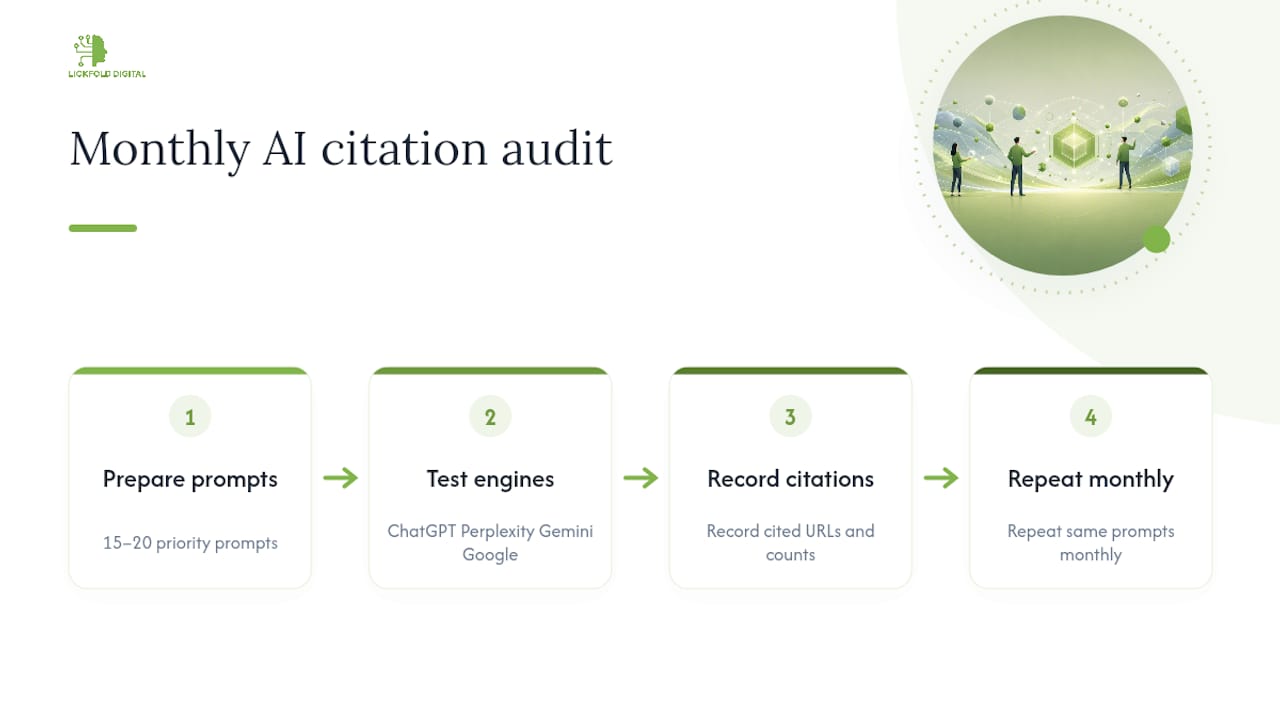
Track four numbers monthly: citation occurrences by platform, AI-referred sessions in your analytics, brand mention volume across models, and citation rate for a fixed set of target queries. Without that fixed query set, you’re comparing noise, not progress.
The audit itself is manual, and there’s no way around that yet. Run the same 15 to 20 priority prompts through ChatGPT, Perplexity, Gemini, and Google’s AI Mode, record which URLs get cited and how often, then repeat the exact same prompts a month later. Manual audits across these four platforms remain the fastest way to catch platform-specific gaps, since automated tracking tools haven’t fully caught up to how fragmented citation behavior is across engines.
For tooling, Google Search Console still tells you what’s ranking organically, which gives you a baseline to compare against AI citation behavior. DataForSEO’s API can help automate some prompt testing at scale, and a brand-monitoring tool paired with a shared spreadsheet is usually enough to track trends without over-engineering the process. If you want a faster first pass, BabyLoveGrowth’s AI citation audit tool gives a quick read on how extractable your existing pages already are.
Is Buying AI Citations Against Google’s Policy?
Yes, effectively. Google’s spam policy language now explicitly covers attempts to manipulate generative AI responses, which places paid or fabricated citation schemes in roughly the same risk category as manipulative link building.
Buying citations is also just a bad bet on effectiveness grounds, separate from the policy risk. Manufactured mentions don’t carry the topical consistency or cross-source corroboration that actually drives model selection, so the return rarely justifies the cost. If you’re evaluating outside vendors or paid campaigns, ask for full disclosure of tactics, confirm no fabricated reviews or sponsored “mentions” are involved, and insist on a paper trail showing organic, earned placement.
How Do You Verify the Sources ChatGPT Actually Cites?
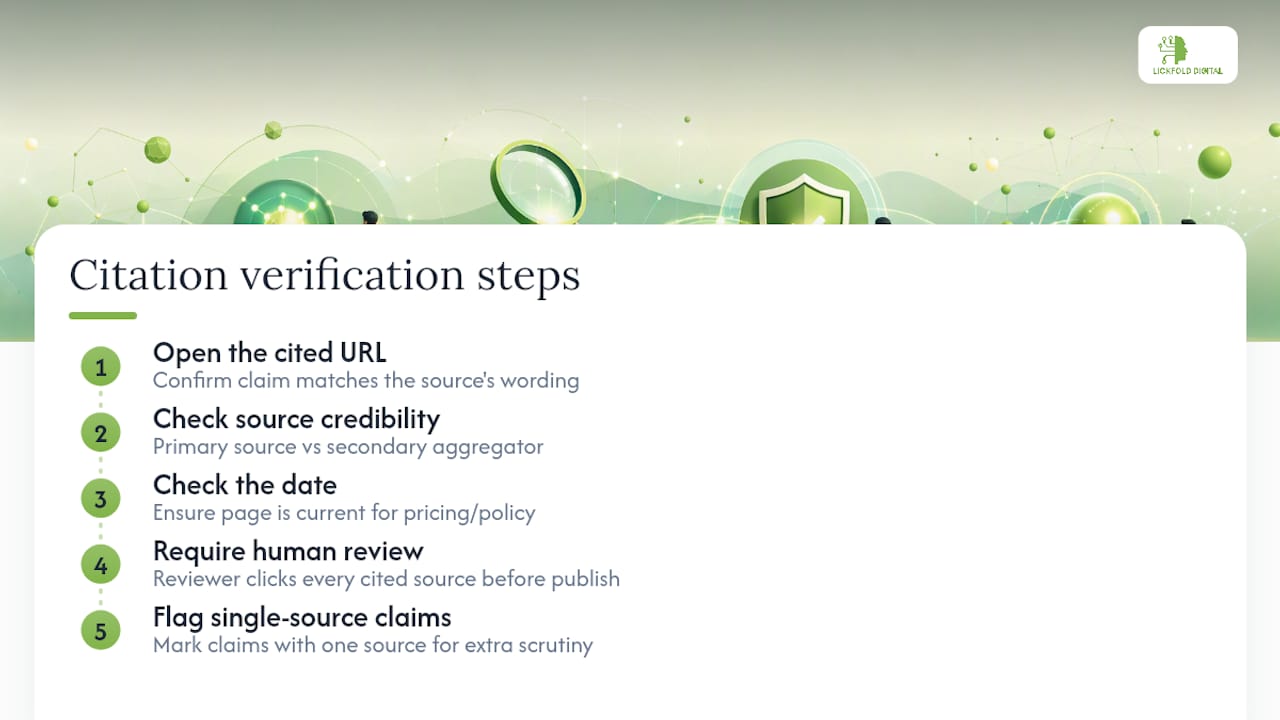
Cross-check every citation against at least one independent source before you treat it as fact, especially for anything client-facing or published under your brand’s name. ChatGPT can cite a real page while still misrepresenting what that page says, so the citation existing doesn’t guarantee accuracy.
Three checks catch most problems. First, open the cited URL directly and confirm the claim matches the source’s actual wording, not a paraphrase that drifted from the original meaning. Second, check the source’s own credibility: is it a primary source (a study, a company’s own data) or a secondary aggregator repeating someone else’s numbers? Third, look at the date. AI models sometimes surface outdated pages that no longer reflect current pricing, policy, or product details, particularly for fast-moving B2B categories like software pricing or compliance rules.
For content teams generating drafts with ChatGPT for research or outreach prospecting, build verification into the workflow rather than treating it as a final pass. Require a human reviewer to click through every cited source before publication, not just skim the citation list. Flag any claim with only one supporting source for extra scrutiny, since single-source claims are where AI-generated inaccuracy shows up most often. This matters just as much for outbound prospecting emails as it does for published articles: a factual error in a cold outreach message damages credibility just as fast as one in a blog post, and it’s harder to correct once it’s landed in someone’s inbox.
How Lickfold Digital Approaches Citation-Ready Content
Lickfold Digital’s AI agents already run structured market research and decision-maker mapping for outbound prospecting, and that same research discipline extends naturally into content built for citation. When an agent identifies what a target industry actually asks and searches for, that intelligence feeds directly into content designed to answer those exact questions in extractable form.
The infrastructure matters here too. Warm-up email systems and human qualification workflows exist to protect sender reputation and message quality, and the same discipline applies to published content: nothing goes out without a human checking it against the source. A practical starting point for most teams is a citation audit paired with a prioritized content refresh, targeting the highest-value queries first rather than rewriting everything at once.
Get an AI Citation Audit for Your B2B Content
Most B2B teams find out they’re invisible to AI answer engines the hard way, after a competitor shows up in a ChatGPT response and they don’t. Combining AI-driven prospecting with human-qualified outreach offers a combination of automation plus human review, which supports citation-ready content with consistent output at scale, checked before it reaches a prospect or a search engine.
If your content isn’t structured for extraction, no amount of publishing volume fixes that. Lickfold Digital’s approach pairs AI-powered outreach tactics with the same human qualification step used on every prospecting reply, so nothing goes live without a real check. Request a citation audit and pilot content refresh through the Lickfold Digital landing page, and see which of your existing pages are already close to citation-ready before you rebuild anything from scratch.
What Marketers Get Wrong About AI Citations
Most teams treat AI citations like a ranking factor they can game with the same tricks that worked for backlinks a decade ago. That instinct is understandable and it’s wrong. Backlink schemes worked because they gamed a link graph; citation manipulation fails because it’s gaming a model’s judgment about factual reliability, and that judgment updates faster and punishes inconsistency harder than any search algorithm did.
The bigger blind spot is that most B2B content still gets written for skimmers, not extractors. A page can rank well and read fine to a human while being nearly useless to a model looking for a clean 50 word answer buried under three paragraphs of throat clearing. Fixing that isn’t a content overhaul. It’s a structural discipline: answer first, support second, and stop assuming a reader (or a model) will wait around for the point.
Where I’d push back on the current conventional wisdom is the obsession with schema markup as the silver bullet. Schema helps, and the data on author pages backs that up clearly. But schema on top of vague, generic prose doesn’t earn a citation. Specificity does. A model can’t extract a confident answer from a hedge-everything paragraph no matter how well-tagged it is. Get the substance right first. The markup just tells the model where to look.
— Duarte
Sources
- Citations in AEO — HubSpot
- How to Get Your B2B SaaS Cited by ChatGPT: The Technical Guide | Conbersa
- How to optimize content for AI search engines — Semrush
- AI Citation Optimization: B2B Guide | Authoricy