
Why Agency Pitches Fail: A B2B Sales Playbook
Why Agency Pitches Fail: A B2B Sales Playbook
TL;DR:
- Most agency pitches fail because they focus on credentials and ideas instead of proving their ability to deliver measurable outcomes.
- Buyers prioritize evidence of repeatable, governed processes over creative talent and dislike vague scopes or unvalidated promises.
Most agency pitches fail for one reason: they sell credentials and creative ideas instead of proving the agency can deliver repeatable, measurable outcomes against the buyer’s actual business problem. Before your next meeting, pull your last pitch deck and count how many slides address their problem versus your portfolio. If credentials outnumber problem-solving slides, that’s your fix.
Procurement teams aren’t looking for the most exciting idea in the room. They’re looking for defensible decisions they can present to a board, backed by evidence of governed, repeatable processes. Clients consistently reject agencies that fail to articulate the specific business problem they’re being hired to solve.
One action before your next pitch: Replace your agency overview slide with a one-paragraph problem statement tied to a KPI the client has already named publicly.
Table of Contents
- Why do agency pitches fail? The most common failure modes
- What procurement actually evaluates during your pitch
- How to structure a pitch that proves delivery
- Questions to ask and red flags that kill trust
- How AI-driven outbound closes the gaps that sink pitches
- Your pitch checklist and slide order for the next meeting
- Key Takeaways
- The pitch problem nobody wants to admit
- Validate your next pitch with a measurable pilot
- Useful sources and further reading
Why do agency pitches fail? The most common failure modes
Understanding agency pitch failure reasons starts with recognizing the patterns that repeat across every industry and deal size.
- Failing to articulate the client’s problem. The pitch opens with agency history, award wins, and client logos. The buyer sits there wondering if the agency actually read the brief. Clients reject pitches when agencies emphasize self-promotion over problem diagnosis.
- Over-reliance on credentials. Awards don’t transfer risk. A buyer who has to justify the decision to a CFO needs process evidence, not trophies.
- Misreading chemistry. Many agencies treat chemistry as a personality contest and send the most charismatic person in the room. Buyers read chemistry differently: they want to see whether the agency adapts to feedback and acts like a candid partner rather than a vendor eager to please.
- No governance proof. Who owns delivery? What happens when scope drifts? Silence on these questions signals operational immaturity.
- Vague commercial model. Hidden assumptions about scope, unclear day rates, and no escalation path all read as future billing disputes waiting to happen.
- The “Act One” trap. Most pitches are polished performances that don’t plan for Act Three: the operational realities of budgets, timelines, and organizational constraints. Clients evaluate for endurance, not just opening night.
Micro-example 1: An agency pitches a brand refresh with three bold creative routes. No timeline, no named project lead, no measurement framework. The client loved the work and hired someone else.
Micro-example 2: A digital agency leads with a 12-slide credential deck. Slide 13 is the strategy. The buyer had already mentally moved on.
Pro Tip: Fix the highest-impact mistake first: open every pitch with a one-paragraph problem statement that names the client’s specific business challenge and the KPI it threatens. Everything else in the deck earns its place by connecting back to that statement.
What procurement actually evaluates during your pitch
Buyers aren’t grading creative flair. They’re running a risk assessment. Procurement favors evidence of repeatable, scalable, well-governed processes over one-off creative heroics. Here’s what that looks like as a checklist:

| Procurement Priority | What Buyers Look For | Failure Mode It Catches |
|---|---|---|
| Repeatability | Documented process, not one-off heroics | Act One trap |
| Governance | Named delivery roles, escalation paths | No governance proof |
| Measurable outcomes | KPIs tied to deliverables, not outputs | Vague problem articulation |
| Risk controls | Scope change protocol, pilot-to-scale staging | Hidden scope assumptions |
| Past evidence | Case studies with named KPIs, not logos | Credential over-emphasis |
| Commercial clarity | Day rates, milestone payments, exit terms | Vague commercial model |
Research on successful pitches shows that a significant majority of winning responses cited a clear understanding of the business or brand, and many successful chemistry calls highlighted that the agency had “clearly done their research.” Procurement isn’t mysterious. It rewards preparation that shows up in specifics, not slides.
How to structure a pitch that proves delivery
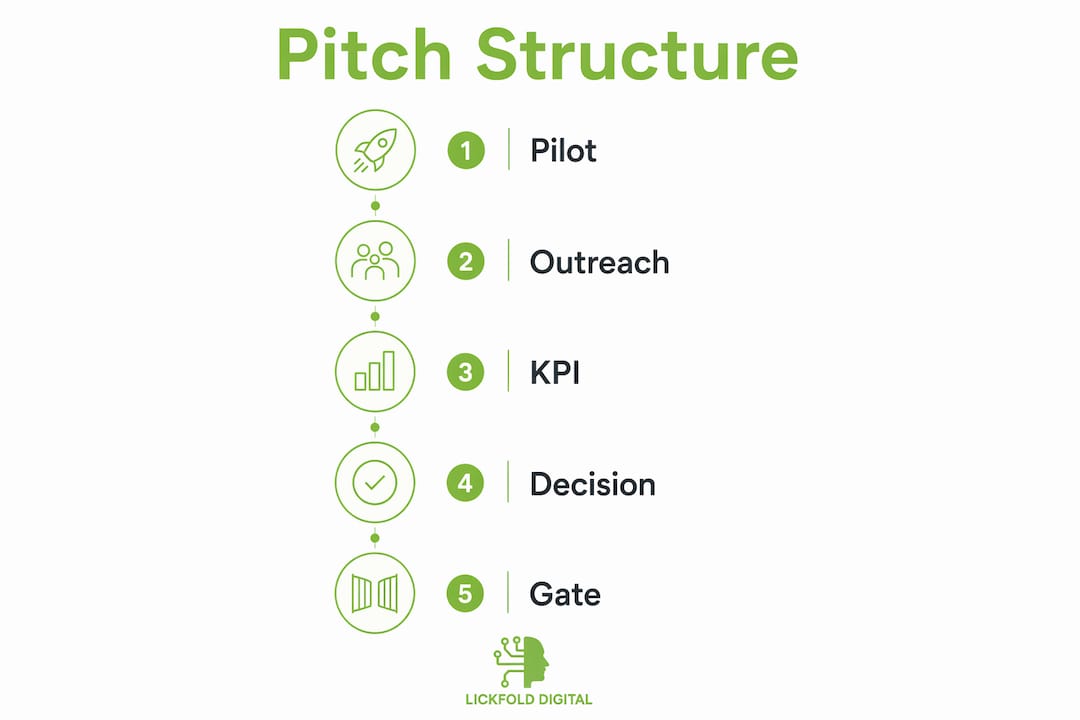
A pitch that wins treats the deck as a delivery contract in miniature. Every section must answer a question the buyer is already asking silently.
Essential pitch sections:
- Problem statement tied to a KPI — one paragraph, their words where possible
- Solution with mechanics — how it works, not just what it is
- Implementation timeline — phased, with named milestones
- Governance and roles — who owns what, day one through month six
- Pricing model — transparent, milestone-linked, with scope-change terms
- Measurement and success criteria — what “good” looks like at 30, 60, and 90 days
Sample measurement table:
| Phase | Activity | KPI | Decision Gate |
|---|---|---|---|
| Pilot (weeks 1–4) | Outreach setup, ICP mapping | Response rate, qualified leads | Continue / adjust |
| Scale (months 2–3) | Full campaign deployment | Pipeline value, conversion rate | Expand / pause |
| Review (month 4) | Performance audit | Cost per qualified lead | Renew / restructure |
Pro Tip 1: Stage senior attendance deliberately. The CEO signals commitment at the opening; the delivery lead must be present for the operational Q&A. Buyers notice when the person who will actually run the account isn’t in the room.
Pro Tip 2: Agencies routinely erode margin before formal negotiation by volunteering excessive detail and pricing optimism. Hold commercial discipline from the first conversation. Stage deliverables across pilot to scale rather than pricing the full engagement upfront.
For more on building a pitch structure that lands enterprise accounts, the enterprise client playbook covers proposal customization in depth.
Questions to ask and red flags that kill trust
The questions an agency asks during discovery reveal as much about competence as the pitch itself.
| Question to Ask | What It Surfaces |
|---|---|
| “What does success look like at 90 days?” | Buyer’s real KPI, not the brief’s stated objective |
| “Who else is evaluating this decision?” | Procurement structure and internal politics |
| “What’s happened with previous agency relationships?” | Risk tolerance and likely objections |
| “What’s the process if scope changes?” | Whether governance is a real concern for them |
| “What would make you regret this decision?” | Unstated fears that will surface post-award |
Red flags buyers notice:
- Refusal to name day rates or delivery roles
- Overcommitting on scope without asking clarifying questions
- Defensive responses to pushback
- Sending a pitch team that won’t be the delivery team
- No case study with a named outcome metric
Clients use pushback as a collaboration test. Agencies that respond defensively fail it. Agencies that iterate in real time pass it.
Pro Tip: When a buyer pushes back on price or scope, don’t defend. Ask: “What would need to be true for this to work for you?” That single question repositions the conversation from negotiation to co-design, which is exactly what procurement wants to see.
How AI-driven outbound closes the gaps that sink pitches
The core problem in most failed pitches isn’t the deck. It’s the absence of evidence. Agencies pitch promises; buyers want proof. AI-driven, repeatable outbound processes create that proof before the pitch even starts.
Three concrete ways this works:
1. Consistent lead qualification. AI agents running structured outreach campaigns generate a documented record of who responded, why, and at what stage. That data becomes evidence of repeatable process, not anecdote.
2. Evidence of measurable outcomes. A governed outbound system produces pipeline metrics: response rates, qualification rates, cost per lead. These are the exact KPIs procurement wants to see in a pitch.
3. Faster pilot validation. A time-boxed pilot with defined measurement windows lets an agency walk into a pitch with real outcome data rather than projected case studies.
Lickfold’s AI-driven prospecting system does exactly this: dedicated AI agents map decision-makers, run personalized multi-touch outreach, and pass only human-qualified leads to the sales team. The result is a documented pipeline with measurable qualification rates, giving agencies the outcome evidence that procurement actually wants to see. For practical AI prospecting tactics that feed directly into pitch evidence, AI-driven prospecting tips covers the implementation steps.
Scalable, governed delivery processes also matter beyond the pitch itself. Scalable SEO practices follow the same logic: repeatability and governance are what separate a one-time win from a long-term client relationship.
Your pitch checklist and slide order for the next meeting
Pre-pitch checklist:
- [ ] Problem statement written in the client’s language, tied to a named KPI
- [ ] Delivery lead confirmed and briefed for the meeting
- [ ] Governance slide drafted with named roles and escalation path
- [ ] Pricing model reviewed for scope assumptions and hidden commitments
- [ ] At least one case study with a named outcome metric prepared
- [ ] Discovery questions written and rehearsed
Recommended slide order:
- Problem statement — their challenge, their KPI, their words
- Why now — what’s changed that makes this urgent
- Our solution — mechanics, not just concept
- Implementation timeline — phased, with milestones and decision gates
- Team and governance — who does what, day one through month six
- Measurement framework — what success looks like at 30/60/90 days
- Commercial model — transparent pricing, scope-change terms
- Case study — named outcome, not logo
Post-pitch follow-up sequence:
- Within 24 hours: Send a one-page summary of the problem statement and proposed KPIs. Ask one clarifying question to keep the conversation open.
- Day 3–5: Share a relevant case study or data point that addresses a concern raised in the meeting.
- Day 7–10: Request a candid debrief regardless of outcome. Agencies that ask good post-mortem questions improve their win rate over time.
Key Takeaways
Most agency pitches fail because they prove creativity instead of proving delivery, and the fix is structural, not cosmetic.
| Point | Details |
|---|---|
| Lead with the problem | Open every pitch with a one-paragraph problem statement tied to the client’s named KPI. |
| Prove governance | Name delivery roles, escalation paths, and scope-change terms before procurement asks. |
| Stage commercially | Hold pricing discipline from the first call; pilot-to-scale framing protects margin and signals process maturity. |
| Treat pushback as a test | Buyers use objections to evaluate adaptability; iterate in real time instead of defending the original proposal. |
| Lickfold as evidence engine | Lickfold’s AI-driven outbound generates documented pipeline metrics that give agencies the outcome proof procurement requires before awarding a contract. |
The pitch problem nobody wants to admit
The hardest thing to tell an agency is that their pitch lost not because the idea was weak, but because the buyer couldn’t trust them to deliver it. Creative confidence is easy to project. Operational credibility is hard to fake, and procurement has seen enough pitches to tell the difference in about ten minutes.
The agencies that win consistently aren’t necessarily the most talented. They’re the ones who’ve built a repeatable commercial process: they know which clients to pursue (and which to decline), they show up with evidence instead of promises, and they treat the pitch as the first proof point of how they’ll behave as a partner. Positioning in agency sales matters precisely because a well-positioned agency never has to oversell.
The honest advice on when not to pitch: if you can’t name the client’s primary business problem, identify the decision-maker, or show a comparable outcome from a previous engagement, walk away. Pitching without those three things doesn’t just waste time. It trains buyers to see you as a commodity.
Validate your next pitch with a measurable pilot
Lickfold’s AI-driven outbound system gives B2B sales and marketing teams something most agencies can’t bring to a pitch: documented, human-qualified pipeline data generated by a governed, repeatable process.
The pilot is time-boxed and transparent. Lickfold deploys dedicated AI agents to map decision-makers within your ideal customer profile, runs personalized multi-touch outreach campaigns, manages email infrastructure and reputation, and passes only human-qualified leads to your team. Every step produces measurable output: response rates, qualification rates, cost per lead. That’s the evidence procurement wants to see, built before you walk into the room.
If you’re ready to replace pitch promises with pipeline proof, reach out to start a pilot and get a measurement framework tailored to your next target account.
Useful sources and further reading
| Source | What It Covers |
|---|---|
| When pitches fail — PRmoment | Client-side rejection reasons: problem articulation, credentials, post-pitch feedback |
| What procurement really wants — Beckon | Procurement priorities: governance, repeatability, commercial discipline |
| Why agencies lose pitches — Storyboard18 | The Act One trap and how pushback functions as a collaboration test |
| 5 reasons clients won’t tell you — PR Daily | Chemistry misreads and the adaptability signal buyers look for |
| Agency pitch factors — The GO Network | Data from numerous chemistry calls on what in-house marketers actually value |
| Why agencies lose pitches — Mercer Island Group | Practitioner analysis of “about us” thinking and strategy as the real differentiator |
| Enterprise client playbook — Lickfold | Proposal customization and pitch structure for enterprise accounts |
| AI prospecting tips — Lickfold | Practical AI-driven prospecting tactics and implementation steps |
| Scalable SEO for agencies — BabyLoveGrowth | Repeatable, governed delivery processes applied to SEO and content |