
Using AI to Assess New Market Viability in 2026
Using AI to Assess New Market Viability in 2026
TL;DR:
- AI-driven market validation uses machine learning and predictive analytics to evaluate market potential quickly and reliably. It requires structured data inputs, clear hypotheses, and multi-agent testing to generate actionable insights within minutes, helping teams avoid common pitfalls like overreliance on static reports or single-model outputs. Combining AI analysis with human judgment and real-time signals improves accuracy and reduces the risk of confirmation bias in market assessments.
AI-powered market viability assessment is the process of using machine learning, predictive analytics, and generative AI to evaluate whether a new market is worth entering before committing capital or resources. The industry term for this practice is AI-driven market validation. Business leaders who apply it correctly can compress what once took weeks of analyst work into a single afternoon. Global AI spending is projected to reach USD 2.59 trillion by the end of 2026, a 47% increase year-on-year. That investment is flowing directly into the tools and data infrastructure that make using AI to assess new market viability faster and more reliable than ever before.
What does using AI to assess new market viability actually require?

Before deploying any AI tool, you need the right inputs. Garbage in still means garbage out, regardless of how sophisticated the model is.
The three core data categories every AI market analysis workflow depends on are:
- CRM and sales data: Historical win/loss records, customer segments, and deal velocity tell AI models what your current market actually looks like.
- Industry and third-party reports: Sources like Gartner, IBISWorld, and Statista provide the structural market data AI tools use to size opportunity.
- Competitor intelligence: Pricing pages, job postings, product changelogs, and review platforms like G2 and Trustpilot feed competitive mapping models.
Beyond data, you need a clear hypothesis. AI tools work best when you give them a specific question: “Is there sufficient demand for a mid-market HR software product in the Midwest manufacturing sector?” That framing shapes which signals the AI prioritizes.
Tool selection matters equally. The three main categories of AI tools for market viability are generative AI platforms (such as Claude or GPT-4), predictive analytics engines, and multi-agent systems that pit independent AI models against each other. Each serves a different function in the assessment workflow.
Finally, define your success metrics before you start. The TAM/SAM/SOM framework (Total Addressable Market, Serviceable Addressable Market, Serviceable Obtainable Market) gives AI tools a sizing structure to work within. Without it, AI outputs tend to be directionally useful but not decision-ready.
| Input type | Purpose | Example sources |
|---|---|---|
| CRM and sales data | Baseline market fit signals | Salesforce, HubSpot exports |
| Industry reports | Market sizing and trend data | Gartner, IBISWorld, Statista |
| Competitor data | Competitive landscape mapping | G2, LinkedIn, job boards |
| Real-time signals | Demand validation | Reddit, Google Trends, job postings |
How to run an AI-driven market viability workflow
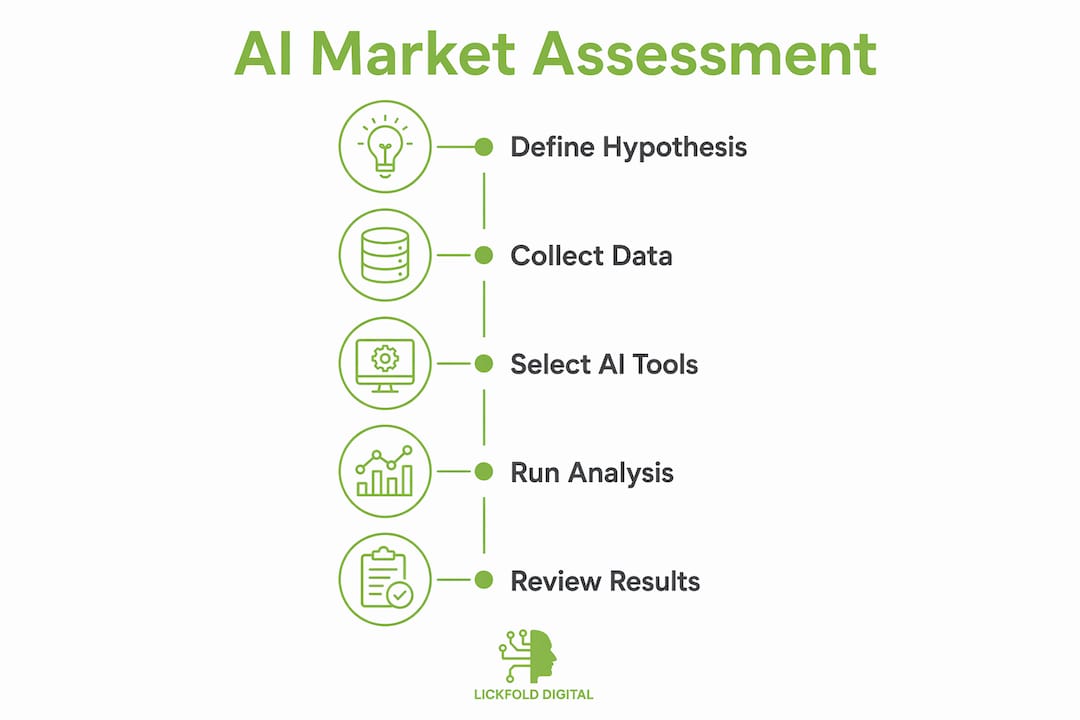
The practical execution of AI-driven market research follows a repeatable sequence. Each step builds on the last, and skipping any one of them weakens the final output.
-
Define the market hypothesis. Write a one-sentence statement of the opportunity you are testing. Example: “Mid-sized logistics companies in the Southeast are underserved by current freight analytics software.” This becomes the prompt anchor for every AI query that follows.
-
Upload or connect your data inputs. Platforms like MarketScope accept structured uploads of CRM exports, competitor lists, and industry reports. The AI then maps these inputs against its trained data to generate an initial market profile.
-
Run a competitor and demand analysis. Use the AI to generate a competitor map showing market share estimates, pricing tiers, and positioning gaps. Simultaneously, pull demand signals from real-time sources. Preuve AI stresses that validation must root in live context, using sources like Reddit threads and job board postings to identify where demand is actually emerging versus where it is assumed.
-
Deploy a multi-agent stress test. Single-model AI outputs carry a real risk of confirmation bias. A multi-agent setup is superior to single prompts, with independent AI models assigned adversarial roles such as Devil’s Advocate and Senior Analyst to challenge each other’s conclusions. BizChecker AI uses this approach to deliver a GO/NO-GO verdict in approximately 5 minutes.
-
Generate a financial viability model. Ask the AI to build a basic unit economics model using your pricing assumptions, estimated market penetration, and customer acquisition cost benchmarks. This is not a substitute for a CFO’s analysis, but it surfaces fatal flaws early.
-
Interpret the viability score. Most platforms output a composite score with weighted factors covering market size, competitive intensity, demand strength, and execution risk. Treat this score as a structured starting point, not a final verdict.
-
Build a living market model. Creating a living market model updated continuously with new variables differentiates successful ventures from failures. Set a recurring schedule to refresh your AI inputs with new competitor moves, regulatory changes, and demand signals.
Pro Tip: Before running any AI market analysis, write down your three biggest assumptions about the market. Feed those assumptions explicitly into your prompts. AI tools surface better insights when they know what you are trying to prove or disprove.
The entire workflow, from hypothesis to viability score, can now run in a single session. AI-driven market analysis tools can reduce comprehensive market research time from weeks to as little as 5 to 10 minutes. That speed does not replace depth. It compresses the time to a first draft of insight, which analysts then interrogate further.
What are the most common mistakes when evaluating new markets with AI?
The biggest mistake is treating AI as a black box that delivers final answers. AI market research expert Guillermo Flor advises using AI to impose structure on research rather than seeking definitive conclusions. The output is a structured framework for human judgment, not a replacement for it.
The second most common error is relying on a single AI model. One model reflects one set of training data and one set of assumptions. That produces groupthink at machine speed, which is worse than human groupthink because it feels more authoritative.
The third mistake is ignoring real-time context. A market analysis built entirely on historical reports misses the signals that matter most: where customers are complaining right now, which competitors are hiring aggressively, and which regulatory changes are pending. Static data produces static conclusions.
Four specific pitfalls to watch for:
- Over-indexing on TAM. A large total addressable market does not mean your specific entry point is viable. AI tools can inflate optimism if you do not constrain the sizing question.
- Skipping primary research. AI complements but does not replace primary customer research. Human conversations with actual buyers remain the only way to validate whether AI-identified demand signals reflect real purchasing intent.
- Ignoring tension maps. AI-driven research that identifies market tension, meaning contradictions and pressure points, builds living market models that expose gaps competitors have missed. Most analysts skip this step and produce flat, consensus-confirming reports.
- Treating the first output as final. AI market analysis is iterative. Run multiple prompt variations, challenge the outputs, and update your inputs as new information arrives.
Pro Tip: After your AI generates a market viability report, ask it to argue the opposite conclusion. If the counter-argument is stronger than the original, your hypothesis needs revision before you commit resources.
Which AI tools lead in market viability assessment?
The market for AI-driven market research tools is expanding rapidly. The broader AI market is projected to grow from USD 601.93 billion in 2026 to USD 3,638.08 billion by 2033, with generative AI as the highest growth segment at a CAGR of 36.8%. That growth is producing a new generation of purpose-built market assessment platforms.
MarketScope is built specifically for market viability analysis. It accepts structured data uploads, generates competitor maps, and produces weighted viability scores across market size, demand, and competitive intensity dimensions. The platform’s primary advantage is speed and report depth for analysts who need a defensible first draft quickly.
BizChecker AI takes a different approach. Its multi-agent architecture assigns independent AI models to competing analytical roles, then synthesizes their outputs into a GO/NO-GO recommendation. This adversarial design directly addresses the groupthink problem that plagues single-model assessments.
For teams already using Claude or GPT-4, a structured AI market research workflow built on general-purpose generative AI can match purpose-built tools in depth, though it requires more prompt engineering discipline.
| Tool | Approach | Turnaround | Best for |
|---|---|---|---|
| MarketScope | Structured data upload and scoring | 5–10 minutes | Analysts needing fast viability reports |
| BizChecker AI | Multi-agent adversarial review | ~5 minutes | Teams stress-testing market hypotheses |
| Claude or GPT-4 | Generative AI with custom prompts | Variable | Teams with strong prompt engineering skills |
The right tool depends on your team’s technical capacity and how much structure you need built in versus built yourself. Purpose-built platforms like MarketScope and BizChecker AI reduce setup time. General-purpose AI gives you more control over the analytical framework. For B2B teams specifically, pairing either approach with AI-powered B2B outreach turns market validation insights directly into targeted prospecting lists.
Key Takeaways
AI-driven market validation works when you combine structured data inputs, multi-agent stress testing, and real-time demand signals with human judgment at every decision point.
| Point | Details |
|---|---|
| Define your hypothesis first | Give AI a specific market question before uploading any data to get focused, usable outputs. |
| Use multi-agent stress testing | Adversarial AI models catch flaws that single-model outputs consistently miss. |
| Root analysis in real-time data | Live sources like Reddit and job boards reveal demand signals that historical reports cannot. |
| Combine AI with human validation | Primary customer conversations remain the only reliable way to confirm AI-identified demand. |
| Build a living market model | Continuously updating your AI inputs with new data separates durable market insights from one-time snapshots. |
Why I think most teams are using AI market analysis wrong
The teams I see getting the most value from AI-driven market validation share one habit: they treat AI as a structured thinking partner, not a research assistant. They do not ask “Is this market viable?” They ask “What would have to be true for this market to be viable, and where does the evidence contradict that?” That reframe changes everything about how you interpret the output.
The teams that struggle are the ones who run a single prompt, get a confident-sounding report, and present it to leadership as validated intelligence. AI is extraordinarily good at sounding authoritative. That is precisely why you need to build adversarial checks into every workflow. Moving beyond static TAM/SAM/SOM snapshots to dynamic tension mapping reveals the high-value opportunities that consensus analysis always misses.
My honest view is that the competitive advantage in 2026 will not go to the teams with the best AI tools. It will go to the teams with the most disciplined AI workflows. The tools are becoming commodities. The analytical rigor behind how you use them is not.
— Duarte
How Lickfold supports AI-powered market assessment
Lickfold builds AI-driven workflows that go beyond market analysis reports and connect validated market intelligence directly to outbound sales execution.
When your team identifies a viable market segment, the next challenge is reaching the right decision-makers inside it before competitors do. Lickfold deploys dedicated AI agents that perform targeted market research, locate relevant buyers, and run personalized multi-touch outreach campaigns at scale. The system handles infrastructure, reputation management, and human qualification of replies, so your sales team only engages with warm, vetted opportunities. If you want to put your market validation to work immediately, reach out to Lickfold to discuss how AI-driven prospecting fits your growth targets.
FAQ
How fast can AI assess a new market?
AI-driven market analysis tools can reduce comprehensive market research from weeks to as little as 5–10 minutes for an initial viability report. Full validation, including human review and primary research, takes longer.
What data do I need before using AI for market viability?
You need CRM data, industry reports, competitor information, and a clearly defined market hypothesis. Real-time sources like job boards and Reddit improve accuracy significantly.
Can AI replace traditional market research?
AI accelerates and structures market research but does not replace it. Primary customer conversations and human judgment remain necessary to validate AI-generated demand signals and conclusions.
What is a living market model?
A living market model is an AI-driven market analysis that updates continuously as new competitor moves, demand signals, and regulatory changes emerge. It replaces static one-time reports with an ongoing intelligence feed.
What is the biggest risk of using AI for market assessment?
The biggest risk is treating AI output as a final decision rather than a structured starting point. Single-model outputs carry confirmation bias, which multi-agent adversarial setups and human validation are designed to correct.