
Topical Authority SEO: POV and Third Party Proof to Earn AI Citations
Topical Authority SEO: POV and Third Party Proof to Earn AI Citations
Topical authority is when search engines and AI systems recognize your site as a trusted, comprehensive source on a specific subject, not just a page that happens to rank for one keyword. It matters because it drives broader rankings across related terms and raises your odds of being cited by ChatGPT, Perplexity, and Google’s AI Overviews. Start now: pick one narrow topic, publish a pillar page, and ship three cluster pages that show a distinct point of view.
TL;DR:
- Building topical authority requires creating a focused content hub with a clear core topic and supporting sub-pages aligned around a specific point of view.
- An effective cluster structure involves publishing a pillar page and three to five related pages that cover key sub-questions to improve AI citations and long-tail rankings.
- Topical relevance of backlinks matters more than domain authority, so links from thematically related sites have a greater impact on authority signals.
- Maintaining content concentration and avoiding off-topic drift or shallow posts are critical; regular audits should verify entity coverage and internal linking.
- Progress should be measured through share of voice, cluster-wide ranking, and AI citation share, with steady, consistent publishing over 12 to 18 months.
Table of Contents
- What Is Topical Authority SEO?
- Why Topical Authority Matters for Rankings and AI Citations
- How Search Engines and AI Systems Measure Topical Authority
- How Do You Build Topical Authority Step by Step?
- How Do You Measure Topical Authority Progress?
- What Mistakes Quietly Dilute Topical Authority?
- How Do You Prove E-E-A-T on a Topical Authority Site?
- What’s the Smartest Way to Start Building Topical Authority?
- How Lickfold Digital Supports a Topical Authority Program
- Sources
What Is Topical Authority SEO?
Topical relevance and topical authority get used interchangeably, but they operate at different scales. Topical relevance is a page-level trait: does this specific page answer this specific query well? Topical authority is a site-level reputation: has this domain published enough connected, high-quality content that search engines treat it as a default reference for the whole subject?
That distinction changes how you plan content. A single great article can rank on relevance alone. But it won’t lift the ranking potential of your other pages on related terms unless the site itself has earned authority around that subject. Topical authority is built by covering a subject comprehensively and connecting that content so search engines recognize the site as an expert, not by accumulating disconnected wins.
Domain authority, the third-party metric popularized by SEO tools, measures link equity in aggregate. It says nothing about subject focus. A domain can carry a high authority score while covering law, recipes, and software reviews, and still fail to rank well on any single one of those topics because the content sits scattered rather than clustered.
A few terms are worth knowing before you audit your own site:
- Site focus score: an informal way of describing how concentrated a domain’s content is around one core subject versus spread thin across many.
- Site radius: how far individual pages drift from that core subject before they stop contributing to authority and start diluting it.
- Topic embeddings: the vector representations search systems use to judge how semantically close your content is to a given subject area, rather than relying on exact keyword matches.
None of these require deep technical knowledge to act on. They translate into a simple question: if you mapped every page on your domain, would most of them cluster tightly around one subject, or would they scatter?
Why Topical Authority Matters for Rankings and AI Citations
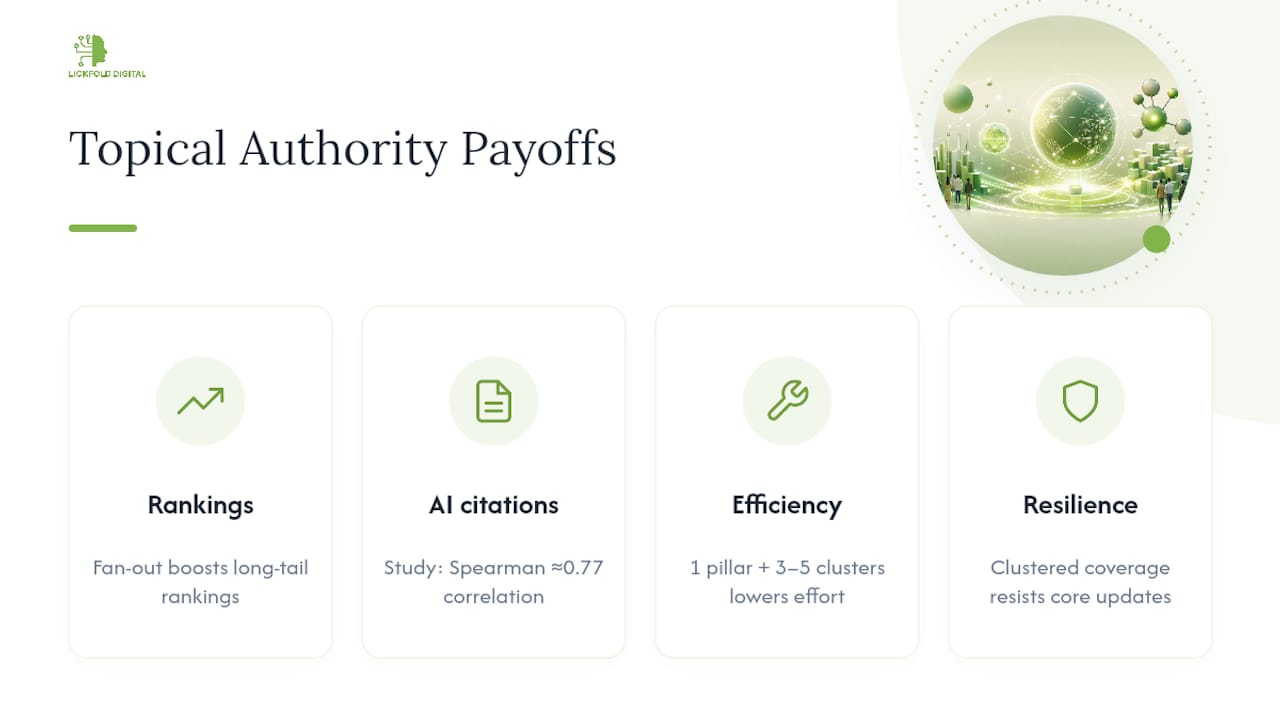
The payoff shows up in three places: broader rankings, AI visibility, and lower long-term effort per article.
Comprehensive coverage of a topic naturally answers dozens of related sub-queries you never explicitly targeted. This is sometimes called fan-out coverage, and it’s why a well-built cluster often outranks competitors on long-tail terms nobody wrote a dedicated page for. One industry analysis found a strong correlation between how thoroughly a site covers a topic’s fan-out queries and how often AI systems cite it, with a reported Spearman correlation around 0.77 in that study. The mechanism is intuitive: an AI system pulling together an answer prefers a source that already addresses the adjacent questions a user might ask next.
Quick math: publish one pillar page covering a topic’s core question, then three to five cluster pages addressing its most common sub-questions. Each cluster page becomes a candidate for its own long-tail rankings, and the pillar becomes the page most likely to get cited when someone asks the broader question.
Topical authority also builds resilience. Sites with concentrated, well-linked coverage tend to weather core algorithm updates better than sites with scattered content, because the ranking signal isn’t riding on one page’s link profile. It’s distributed across a cluster that reinforces itself.
There’s an efficiency dividend too. Once a pillar and its clusters are live, new content in that territory takes less effort to rank because the site has already established relevance for the surrounding entities. You’re not starting from zero on every new page.
How Search Engines and AI Systems Measure Topical Authority
Google’s 2024 API leak gave the SEO industry its first confirmed look at internal signals that had been theorized for years. Among them: siteFocusScore and siteRadius, internal signals that operationalize topical measurement by quantifying how concentrated a site’s content is and how far individual pages stray from that core.
You can’t see your own siteFocusScore, but you can audit for the same pattern it’s likely measuring:
- Content concentration: what percentage of your published pages sit within your declared core topic versus adjacent or unrelated subjects?
- Off-topic drift: identify pages published opportunistically (a trending keyword, a one-off client request) that share no entity overlap with your main subject.
- Entity coverage: map the people, concepts, tools, and processes an expert in your topic would be expected to discuss, then check whether your content actually names and explains them.
- Fan-out query coverage: pull the full range of questions real users ask around your pillar topic, then verify each has a home on your site.
Backlinks factor in too, but not the way most link-building advice frames it. Topical relevance of referring domains matters more than raw Domain Rating for building authority in a specific subject. A link from a mid-authority site that covers your exact niche typically does more for topical signals than a high-authority link from a site with no thematic connection. When you’re evaluating link opportunities, ask what the linking site is actually about before you ask what its authority score is.
How Do You Build Topical Authority Step by Step?
This is the part most guides rush. Building topical authority isn’t a checklist you finish in a sprint. It’s a sequencing problem, and the order you do things in determines whether your effort compounds or scatters.
1. Choose a narrow territory and a defensible point of view. Resist the instinct to cover an entire industry. Pick a slice you can genuinely go deep on, and decide what you believe about it that most competitors don’t say out loud. A generic “how to do X” pillar competes with a thousand other generic pillars. A pillar built around a specific, arguable position on X gets remembered, linked, and cited.
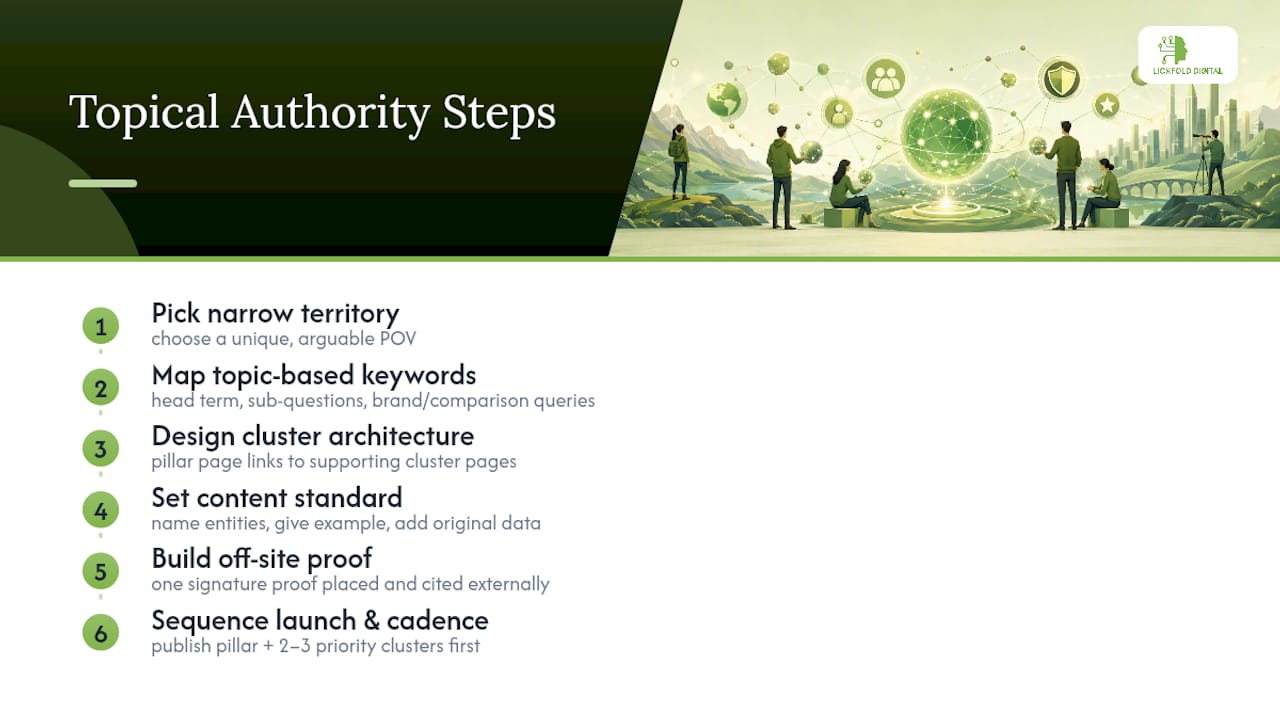
2. Run topic-based keyword research, not just keyword research. Instead of building a list of individual keywords, map the topic itself: the head term, every fan-out sub-question around it, and branded or comparison queries where your point of view is relevant. This becomes your content map before it becomes a content calendar.
3. Design the cluster architecture. One pillar page addresses the head term and links out to every supporting page. Each cluster page addresses one sub-question in depth and links back to the pillar, plus sideways to sibling cluster pages where genuinely relevant. This hub and spoke structure is what lets Google (and AI crawlers) traverse your coverage and understand its boundaries. Getting the internal linking conventions right matters more than most teams assume. If you haven’t audited your own internal link graph recently, a structured approach to internal linking is worth reviewing before you publish another page.
4. Set a content standard, not just a word count. Every authority page should name the relevant entities, work through a concrete example, and include something the reader couldn’t get from a five-minute search: original data, a tested opinion, or a specific process. Author credentials attached to the page reinforce this. A pillar with no named perspective behind it reads as generic, even if the information is accurate.
5. Build a proof layer off-site. This is the step most SEO content strategy plans skip entirely. A point-of-view-led approach combined with third-party verification makes AI systems more likely to cite your brand instead of quietly summarizing your content without credit. Build one signature proof point (an original data set, a distinctive framework, a survey) and get it placed with partners, cited in niche communities, and mentioned by others in your space. Independent confirmation carries more weight with AI systems than anything you say about yourself.
6. Sequence the launch, then commit to the cadence. Publish the pillar and your two or three highest-priority cluster pages first. Don’t wait for the full map to be finished. An end-to-end content strategy built around mapped territory and consistent cadence typically takes 12 to 18 months to fully compound, and that horizon assumes steady publishing, not a burst followed by silence.
Pro Tip: Before you write a single cluster page, list every entity a genuine expert in your topic would expect to see mentioned. If your draft is missing half of them, it’s not done. That gap is usually exactly what a thin competitor page is also missing, and it’s your opening.
Editorial discipline holds this together. Depth beats breadth every time you’re deciding what to publish next, off-topic drift kills more topical programs than bad writing does, and a consistent author voice across the cluster tells readers and algorithms alike that one entity, not a rotating cast of freelancers, owns this subject.
How Do You Measure Topical Authority Progress?
Per-article traffic is the wrong lens. Cluster-level share of voice and average position across the whole topic tell you far more about whether the program is working than any single page’s numbers.
Three KPIs matter most:
- Share of voice: your visibility across the full set of queries in the cluster, not just the head term.
- Average position across the cluster: are your supporting pages climbing together, or is one page carrying the whole group?
- AI citation share: how often your pillar or cluster pages get referenced or linked in AI-generated answers for the topic’s core questions.
| Data source | What it tells you | Where to pull it |
|---|---|---|
| Search Console query exports | Which sub-topics are gaining or stalling, grouped by cluster | Filter by URL path or custom regex grouping |
| Backlink topicality | Whether new links are thematically relevant to the cluster | Backlink tool filtered by referring domain topic |
| Internal link graph | Whether every cluster page correctly links to and from the pillar | Site crawl export, sorted by inbound internal links |
Check early signals (indexing speed, initial position movement) monthly. Save judgment on the bigger outcomes, ranking breadth and AI citation frequency, for quarterly reviews. A cluster that looks flat at 60 days can still be accumulating the entity coverage that pays off at month nine.
What Mistakes Quietly Dilute Topical Authority?
Most damage comes from small, defensible-sounding decisions made one at a time.
- Publishing off-topic content because it’s trending. Fix: prune it or move it to a separate property.
- Thin posts that repeat what the pillar already says without adding entity coverage. Fix: expand them or merge them into a stronger page.
- Weak internal linking, especially cluster pages that never link back to the pillar. Fix: audit and patch every missing hub-to-spoke connection.
- Chasing high-DR backlinks with no thematic connection. Fix: prioritize topically relevant referring domains, even at lower authority scores.
How Do You Prove E-E-A-T on a Topical Authority Site?
Proof has to exist in two places at once: on your site, and in independent channels you don’t control.
On-site, that means real author bios tied to the person actually writing, a case study or two that shows applied results, at least one signature data piece unique to your brand, and a pillar-to-cluster structure a reader can actually navigate. A phased approach to building authority shows how this looks in practice for service businesses building credibility from scratch.
Off-site, distribute that signature proof point deliberately: pitch it to partners, seed it into niche communities where your topic’s practitioners actually gather, and track every earned mention. A quick checklist to copy: one authority page per core sub-topic, one named author bio, one outreach list of five relevant partners, one proof point distributed quarterly, and one measurement review scheduled monthly.
Pro Tip: Don’t distribute your proof point everywhere at once. Place it with two or three genuinely relevant partners first, measure what actually gets picked up, then expand the list. A scattershot pitch to fifty outlets usually earns fewer real mentions than a targeted pitch to five.
What’s the Smartest Way to Start Building Topical Authority?
Most teams try to cover too much ground in month one. That’s backwards. Pick one narrow territory you can defend for 12 to 18 months, not one you’ll abandon after a slow quarter, because topical authority compounds when content publishes on a consistent cadence with deliberate sequencing, not when it arrives in one burst and stalls.
If I were starting today, I’d skip the twenty-page content calendar and build a 90-day plan instead: audit existing content for off-topic drift in week one, draft the pillar in week two, ship three cluster pages addressing the highest-value fan-out questions by week six, and spend the remaining time building one outreach relationship that can carry your signature proof point. Momentum matters more than completeness at this stage. A narrow, well-linked cluster with a real point of view will outperform a broad, generic library every time an AI system has to choose who to cite.
— Duarte
How Lickfold Digital Supports a Topical Authority Program
Building a pillar and cluster program takes consistent output over many months, which is exactly where most in-house teams lose momentum. The program includes services such as daily SEO content creation tied to a topic map, backlink building focused on thematically relevant referring domains, technical audits to identify off-topic drift, and AI and LLM visibility tracking to monitor citation share.

The infrastructure also supports outbound prospecting with AI agents that research and reach decision-makers likely to engage with new authority content, complementing the topical program with a lead generation pipeline. If your team wants a managed version of the 12 to 18 month sequence outlined above, without hiring an internal content team, see how the program works and get a plan built around your specific topic.
Sources
- Topical Authority: What It Is, How Google Measures It, and How to Build It
- How to Build Topical Authority in the AI Search Era (7 Steps) | Backlinko
- Topical Authority: From SEO Folklore to Confirmed Signal | Fahlout
- SEO content strategy: an end-to-end framework for building topical authority - Stridec