
Segmentation in Outbound Sales: The B2B Playbook
Segmentation in Outbound Sales: The B2B Playbook
The role of segmentation in outbound sales is to turn a broad, undifferentiated prospect list into prioritized, measurable outreach plays that lift reply rates, shorten sales cycles, and cut acquisition cost. Instead of sending one message to everyone, you group accounts by shared traits and match each group to its own cadence, offer, and level of personalization.
Segmentation moves the needle in ways you can put on a slide:
- Reply rates climb because messaging matches the account’s actual situation, not a generic pitch.
- Meeting rates rise when reps chase signal-rich accounts first instead of working a list top to bottom.
- Customer acquisition cost drops because reps stop spending equal time on unequal opportunities.
- Pipeline moves faster because the highest-fit accounts get found and engaged sooner.
Start by splitting your active list into multiple tiers based on revenue potential and buying signals, then send each tier a different cadence.
Key Takeaways
Segmentation works because it converts a flat, undifferentiated prospect list into prioritized plays that raise reply and meeting rates while cutting wasted rep time and acquisition cost.
| Point | Details |
|---|---|
| Define segments first | Agree on a moderate number of core segments using firmographic and technographic data before building any cadence. |
| Tier personalization deliberately | Split accounts into high, low, and zero effort tiers based on revenue potential and signals. |
| Track metrics by segment | Measure reply rate, meeting rate, pipeline created, CAC, and win rate separately for each group, not in aggregate. |
| Review and retire quarterly | Drop segments that don’t produce different outcomes, and refresh firmographic data at least monthly. |
Table of Contents
- What Is Segmentation and Why It Matters for Outbound
- Common Segmentation Dimensions in B2B Outbound
- How Segmentation Improves Outbound Sales
- Building and Scaling Segmentation: A 6-Step Process
- Pitfalls and Best Practices in Outbound Segmentation
- The Tiered Personalization Model for Scaling Outreach
- Get Segmentation Working Without Building It Yourself
- Why Most Teams Underinvest in the Tiering Step
- Sources
What Is Segmentation and Why It Matters for Outbound
Segmentation in B2B outbound means grouping prospects into repeatable clusters that each get their own messaging, cadence, and offer. A segment isn’t a spreadsheet filter you run once. It’s a standing category your team can point to and say, “this group gets this play.”
The payoff shows up in four places:
- Targeting and relevance. Messages that speak to a specific role, industry, or trigger event land better than a one-size pitch. HubSpot’s guidance on target audiences ties persona-based messaging directly to higher conversion.
- Rep efficiency. Reps stop reinventing messaging for every account and instead pull from a small set of proven plays per segment.
- Conversion metrics. Signal-personalized sequences produce reply rates notably higher than generic cold outreach, compared with an industry average reply rate for generic cold outreach.
- Lower CAC. Fewer wasted touches on poor-fit accounts means your cost per opportunity drops, an effect Harvard Business School’s research on target audiences links to well-executed segmentation in practice.
That reply-rate gap alone should be reason enough to stop treating your list as one homogeneous pool.
Common Segmentation Dimensions in B2B Outbound
Most B2B teams build segments from a handful of dimensions, layered rather than used in isolation.
- Firmographic. Company size, revenue, industry, and headcount. Use it as your first filter. Example: SaaS companies with $10 to 50 million in annual revenue. Firmographic segmentation remains the backbone of most B2B lists because it’s cheap to source and easy to verify.
- Technographic. What tools a company already runs. Useful when your product integrates with or replaces something specific. Example: companies running Salesforce but no dedicated sales engagement platform.
- Persona. Job title, seniority, and function. Pair this with buyer persona development so messaging speaks to what that role actually cares about, not just their title.
- Behavioral or intent. Website visits, content downloads, hiring signals. Best for timing outreach, not for building your base list.
- Lifecycle stage. New lead versus dormant account versus former customer. Each needs a different tone entirely.
- Account value or tiering. Revenue potential ranks accounts for personalization investment, covered in more detail further down.
- Geography. Useful for time zone and compliance reasons, rarely a primary driver on its own.
Job title alone is the dimension teams overuse. A VP of Sales at a 20-person startup and a VP of Sales at a 2,000-person enterprise need completely different messages, so title without firmographic context misleads more than it helps.
How Segmentation Improves Outbound Sales
Each segmentation decision maps to a specific metric, and that chain is what makes segmentation defensible in a budget conversation rather than a nice-to-have.
Personalizing to a segment’s actual pain point raises reply rate. Timing outreach to a buying signal, rather than a static list, raises meeting rate. Accounts showing three or more concurrent buying signals are far more likely to be actively evaluating solutions, so routing those accounts to reps faster converts more of them into meetings. Tiering accounts by value determines how much rep time each one deserves, which shows up in pipeline created per rep.
Track these by segment, not just in aggregate: open rate, reply rate, meeting rate, pipeline created, CAC, and win rate. Well-defined segments with mapped plays have driven meeting-rate gains of roughly 25% after teams aligned messaging to segment rather than running one script across the board. That’s the kind of number that ends the debate about whether segmentation is worth the setup time.
Building and Scaling Segmentation: A 6-Step Process
Building segmentation that survives contact with a real sales team takes discipline, not a big-bang rollout.
- Define shared segments and criteria. RevOps and marketing agree on 6 to 12 core segments using firmographic and technographic data. Starting with a small, actionable set beats a sprawling list nobody maintains.
- Prioritize by revenue and intent. Rank segments by deal size potential and current buying signals. A sample rule: if company revenue exceeds $50 million and the account uses your target tech stack, route to Tier 1.
- Design plays and templates. Sales enablement builds one cadence, one set of talk tracks, and one offer per segment, not per account.
- Enable reps. Load plays into your sales engagement platform and train reps on which segment triggers which sequence.
- Pilot and measure. Run the new segmentation against a control group for 4 to 8 weeks. Test two variables: subject line personalization depth, and cadence length (5-touch versus 8-touch).
- Scale and govern. Marketing and RevOps jointly own quarterly reviews of segment performance, retiring segments that don’t differentiate results.
Mapping segments to decision-maker targeting steps at the start of this process keeps step one grounded in who actually needs to say yes, not just who fits a firmographic filter.
Pitfalls and Best Practices in Outbound Segmentation
The most common failure isn’t bad segments. It’s good segments nobody maintains.
- Don’t let segment data go stale. Revenue and headcount fields drift within months.
- Don’t over-segment. Thirty micro-segments create more overhead than insight; six to twelve well-defined ones outperform them.
- Don’t build segments without mapping them to a cadence. A segment with no matching play is just a label.
- Do keep a central segment registry that both sales and marketing can see and edit.
- Do run quarterly reviews and retire segments that don’t produce different outcomes.
- Do align sales and marketing on the same KPI definitions before reporting results, so “qualified lead” means the same thing to both teams.
Pro Tip: Before adding a new segment, ask whether it changes the message, the cadence, or the offer. If the answer is no to all three, it’s not a segment. It’s a filter.
One compliance note that applies regardless of segment: every outbound list needs a working opt-out mechanism and accurate sender identification to stay within CAN-SPAM requirements.
The Tiered Personalization Model for Scaling Outreach
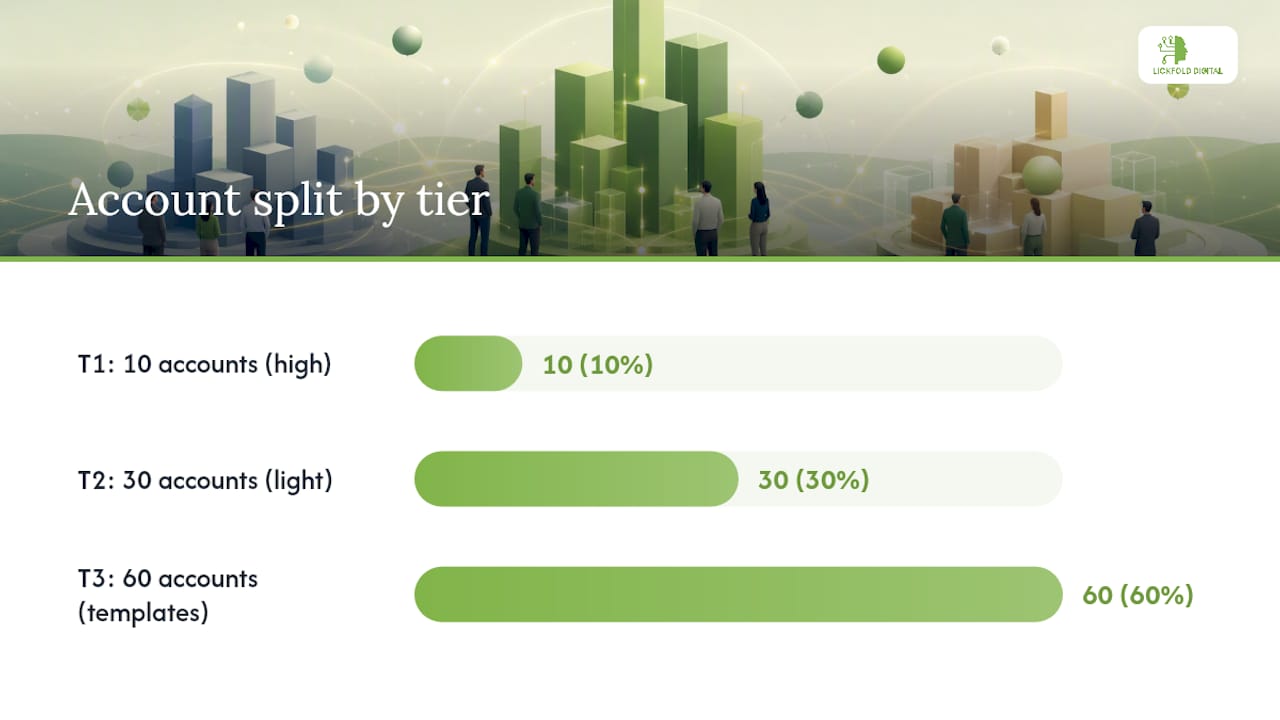
Segmentation only pays off if you’re honest about where personalization time actually goes. The model that works: Tier 1 gets high personalization, Tier 2 gets light personalization, Tier 3 runs on templates.
For a 100-account target set, a workable split looks like 10 accounts in Tier 1, 30 in Tier 2, and 60 in Tier 3. Tier 1 touches are researched line by line, referencing a specific trigger event or stakeholder detail. Tier 2 touches use a templated structure with one or two personalized fields pulled from firmographic data. Tier 3 runs fully automated sequences with merge fields and no manual review.
This isn’t a guess. Tier-based personalization allocation is how teams scale automated outreach without every message reading like a mail merge. Track reply rate and meeting rate separately by tier. If Tier 3’s numbers approach Tier 1’s, you’re either under-investing in Tier 1 or your Tier 3 signals need tightening. Signal-personalized sequences still outperform generic cold outreach by a wide margin at every tier, which is the whole argument for keeping even your Zero-effort tier signal-informed rather than fully static.
Lickfold’s AI agents apply this same tiering logic automatically, routing high-signal accounts to deeper personalization while keeping lower-tier volume moving without extra rep hours.
Get Segmentation Working Without Building It Yourself
Most sales and marketing teams know segmentation works. What stalls them is the manual grind: pulling firmographic data, verifying tech stacks, mapping signals, and keeping all of it current enough to trust. Lickfold’s AI agents handle that research automatically, mapping decision-makers within your ideal customer profile and running personalized multi-touch campaigns tiered to account value, without a rep manually researching every account by hand.

The platform maintains warm-up email infrastructure and reputation management behind the scenes, then has qualified replies reviewed by a human before they land in your pipeline. If you’re ready to stop treating your prospect list as one flat pool, explore how Lickfold’s AI-driven prospecting works for your specific segments.
Why Most Teams Underinvest in the Tiering Step
The part of segmentation everyone skips isn’t the grouping. It’s deciding how much personalization effort each group actually deserves. Teams will spend weeks debating firmographic cutoffs, then dump equal rep time across every segment anyway, which defeats the point entirely.
Conventional advice treats segmentation as a targeting exercise: find the right accounts, write the right message. That’s half the job. Skip that step and you either burn out your reps trying to personalize everything, or you flatten your best accounts into the same templated cadence as your worst-fit prospects.
If you take one thing from this, prioritize the tiering model before you obsess over which dimension (firmographic versus technographic versus intent) is theoretically superior. The dimension matters less than what you do with the ranking once you have it. Get the allocation right first. Refine the criteria later, once you have real reply and meeting data telling you where your assumptions were wrong.
Sources
You don’t need a dozen platforms, but you do need each category covered.
- The Outbound Sales Playbook for 2026 | Autobound
- Outbound sales strategy
- How do sales teams use segments in outreach?
- Target audience: How to find yours
- Target audience in marketing
Sync cadence matters as much as tool choice. Segments built on data older than 30 days start misrouting accounts, particularly for headcount and tech stack fields that change often. AI-driven prospecting platforms that refresh data continuously solve this without adding manual upkeep to your ops team’s plate.