
How to Manage Sales Reputation for Revenue Growth
How to Manage Sales Reputation for Revenue Growth
TL;DR:
- Sales reputation management actively shapes buyer perceptions of professionalism and reliability through proactive content, monitoring, and engagement. Implementing a structured, cross-functional process improves trust signals, enhances review volume, and ultimately increases revenue and deal success. Regular optimization, automation tools, and swift crisis responses are essential for maintaining a strong, credible sales reputation.
Sales reputation management is the practice of actively shaping and maintaining the perception buyers hold about your professionalism, reliability, and value through consistent behavior, digital presence, and feedback management. For sales professionals and business leaders, this is not a passive exercise. A single negative page-one search result can reduce leads by 20%, while increasing your average star rating by one point correlates with a 5 to 9% revenue increase. Knowing how to manage sales reputation is the difference between a pipeline that fills itself through trust and one that leaks deals to competitors with stronger credibility signals.
How to manage your sales reputation: the core framework
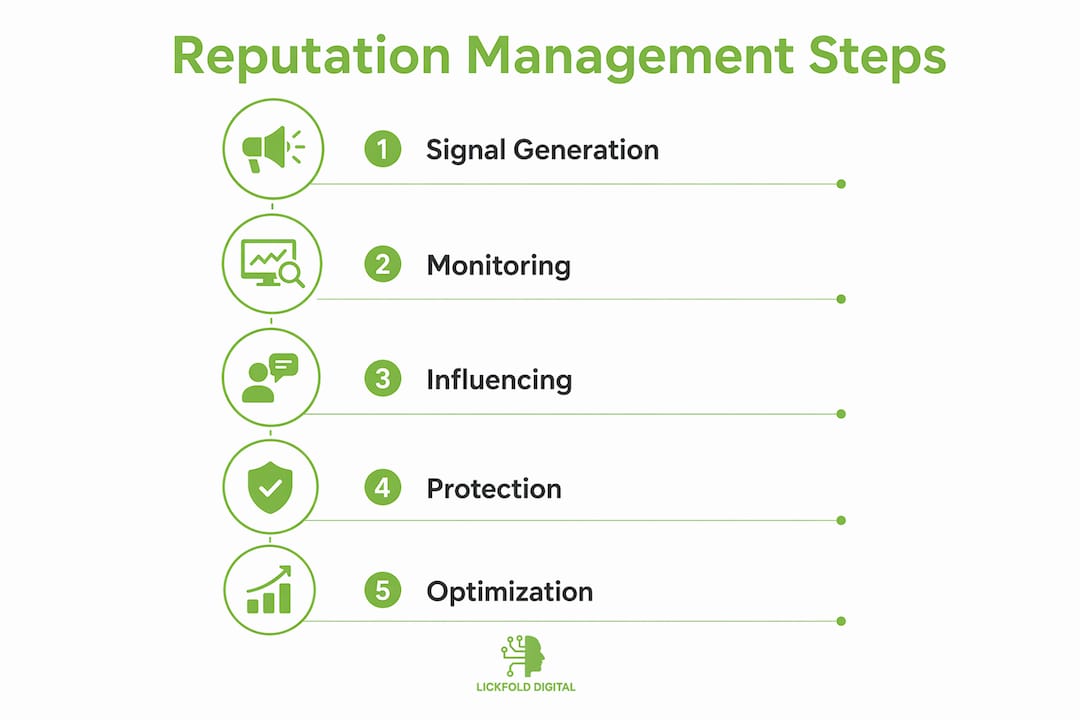
Reputation management in sales is the discipline of monitoring, influencing, and protecting the signals buyers encounter before, during, and after a purchase decision. The industry term for this practice is online reputation management (ORM), and it applies equally to individual sales professionals and to the companies they represent. Where ORM traditionally focused on damage control, modern sales reputation management is a proactive positioning strategy executed across LinkedIn, G2, Clutch, Google Business, and AI-generated search summaries.

The core framework has three layers. The first is signal generation, which means creating positive content, reviews, and social proof before a buyer ever searches your name. The second is signal monitoring, which means tracking what appears on page one of search results and in AI-generated overviews. The third is signal response, which means engaging with reviews, correcting misinformation, and turning complaints into visible demonstrations of accountability. Sales professionals who operate all three layers simultaneously build a reputation that compounds over time rather than one that requires constant repair.
What are the key components and benefits of sales reputation management?
A strong sales reputation rests on five components: personal branding, online reviews, executive presence, ethical sales behavior, and buyer trust signals. Each one feeds the others. A sales leader who publishes thought leadership on LinkedIn generates trust signals that make their G2 profile more credible. A company whose sales team responds to every Clutch review within 24 hours signals accountability that converts hesitant buyers.
The benefits are measurable. Businesses that respond to reviews earn 35% more revenue than those that do not. 94% of consumers say online ratings and reviews influence their purchasing decisions more than price or return policies. That statistic means your buyer has already formed an opinion about your credibility before your first sales call. Corporate and executive reputation now accounts for 25 to 40% of enterprise market value, which means reputation is not a marketing concern. It is a balance sheet concern.
The compounding benefits include:
- Higher close rates because buyers arrive pre-sold on your credibility
- Longer customer lifetime value because trust reduces churn
- Referral generation because satisfied buyers who see you engaging publicly become advocates
- Preferred vendor status in competitive procurement processes where reputation scores are evaluated alongside price
Pro Tip: Request reviews immediately after a successful delivery or project milestone. Timing is everything. A buyer who just experienced a win is far more likely to leave a detailed, enthusiastic review than one contacted weeks later.
Which tools and platforms support effective sales reputation management?
The right platform depends on whether you are managing a personal brand, a company brand, or both. The table below compares the most relevant tools for B2B sales professionals.
| Platform / Tool | Primary Use | B2B Credibility Impact | Automation Support |
|---|---|---|---|
| Personal brand, thought leadership | Very high | Partial (scheduling tools) | |
| G2 | Software and SaaS reviews | Very high | Review request campaigns |
| Clutch | Agency and services reviews | High | Manual with some integrations |
| Google Business Profile | Local and general search reputation | High | Limited |
| AmpliRep | Automated review requests and responses | High | Full automation |
LinkedIn remains the single most powerful platform for individual sales reputation because it combines professional credibility signals with content distribution. A sales director who publishes weekly insights on their industry builds a searchable record of expertise that buyers reference during due diligence. G2 and Clutch serve a different function. They are the platforms buyers consult when comparing vendors, and a strong presence on both directly influences shortlist decisions.
Automated review systems like AmpliRep reduce the administrative burden of reputation management significantly. Manual review responses average 10 to 20 minutes each. Automation enables responses in seconds while matching your business tone, which means review velocity stays consistent even during high-growth periods when your team has less bandwidth. For B2B companies running outbound campaigns, pairing reputation tools with targeted outreach campaigns creates a reinforcing loop where prospects encounter strong reviews at the exact moment they receive personalized outreach.
How to implement a step-by-step sales reputation management process
A structured process prevents the reactive scramble that most sales teams fall into after a negative review or a bad press mention. Follow these six steps to build a reputation management system that runs continuously.
-
Audit your current digital footprint. Search your name and your company name on Google, Bing, and ChatGPT. Document every result on page one. Note star ratings, review volume, and any negative content. This baseline tells you where you are starting from and what gaps need immediate attention.
-
Claim and optimize all review profiles. Claim your G2, Clutch, and Google Business profiles if you have not already. Complete every field, upload current branding, and add a description that reflects your current positioning. Incomplete profiles signal neglect to buyers.
-
Build a programmatic review acquisition strategy. Identify the three to five moments in your customer journey where satisfaction is highest, such as after onboarding, after a successful renewal, or after a project delivery. Automate review requests at those moments using a tool like AmpliRep or a CRM workflow in HubSpot.
-
Establish a response protocol for all reviews. Respond to every review, positive and negative, within 24 hours. For negative reviews, thoughtful responses increase consumer likelihood to engage by 45%. Tone and speed are the two variables that determine whether a negative review becomes a trust signal or a liability.
-
Build executive and personal brand visibility. Publish original content on LinkedIn at least twice per week. Comment substantively on posts from buyers, partners, and industry analysts. Visibility creates familiarity, and familiarity accelerates trust in sales conversations.
-
Create a crisis response protocol. Structured reputation recovery follows a five-phase timeline: acknowledge within 24 hours, investigate within 3 days, communicate your findings within a week, implement fixes within 2 to 4 weeks, and follow up with affected parties up to 90 days later. Having this protocol written down before you need it is what separates companies that recover quickly from those that lose accounts.
Pro Tip: Run a 90-day review sprint at the start of each quarter. Set a specific review volume target, automate requests to recent customers, and track the impact on your star rating and inbound lead quality. The data from one sprint gives you a clear picture of the revenue correlation.
What common mistakes undermine sales reputation and how to avoid them?
Most reputation damage is self-inflicted and preventable. These are the five mistakes that consistently cost sales professionals deals and relationships.
-
Ignoring negative reviews. Silence reads as guilt. Buyers who see an unanswered one-star review assume the complaint is accurate and the company does not care. Every negative review is a public conversation. Treat it as one.
-
Responding defensively. A combative response to a complaint is worse than no response. It confirms the buyer’s concern and signals to every future prospect reading the thread that your team prioritizes ego over accountability.
-
Over-promising during the sales process. Misrepresenting capabilities is the fastest way to generate negative reviews at scale. One disappointed customer who expected a feature you implied but never delivered will write a detailed, specific review that ranks on page one for your company name.
-
Failing to monitor your digital footprint proactively. Reputation management in B2B requires monitoring AI-generated summaries, professional networks, and search engines continuously. Silent losses occur when stale or negative content sits unchallenged on page one for months.
-
Treating reputation management as a solo function. An effective program requires cross-functional ownership across marketing, customer success, and sales operations. When only one team owns it, gaps appear at every handoff.
“Trust compounds through consistent, transparent, and ethical sales behavior, building a moat around your sales success.” — Sales Mastery Series
How to measure and optimize your reputation management efforts
Tracking the right metrics connects reputation activity to revenue outcomes. The table below maps reputation metrics to the sales KPIs they influence most directly.
| Reputation Metric | Sales KPI It Influences | Optimization Action |
|---|---|---|
| Star rating | Lead quality, conversion rate | Run review sprints; respond to all reviews |
| Review volume and velocity | Branded search visibility | Automate post-delivery review requests |
| Response time | Buyer trust, churn rate | Set 24-hour response SLA across all platforms |
| Sentiment analysis | Deal size, renewal rate | Flag recurring complaint themes for product or process fixes |
| Page-one search content | Inbound lead volume | Publish positive content to displace negative results |
Combining reputation metrics with sales KPIs reveals correlations that neither dataset shows alone. A company that tracks star rating alongside conversion rate will often find that a 0.5-point improvement in rating corresponds to a measurable lift in close rate. That connection justifies budget allocation for reputation tools and makes the case to leadership for cross-functional investment.
For decision-makers who want to understand how reputation influences the perceived value of their business, the relationship between buyer perception and firm value is well documented in professional services contexts. Measurement must anchor on pipeline outcomes rather than vanity metrics like total review count. Volume without quality or recency carries little weight with buyers or search algorithms.
Pro Tip: Build a simple dashboard in HubSpot or Google Looker Studio that pulls star rating, review count, and response rate alongside your lead volume and conversion rate. Review it monthly. The patterns will tell you exactly where to focus your reputation efforts next quarter.
Key takeaways
Effective sales reputation management requires proactive signal generation, consistent monitoring, and cross-functional ownership to convert buyer trust into measurable revenue growth.
| Point | Details |
|---|---|
| Reputation drives revenue | A one-star rating increase ties to a 5 to 9% revenue gain; responding to reviews adds 35% more revenue. |
| Proactive monitoring is non-negotiable | Monitor Google, LinkedIn, G2, and AI summaries continuously to catch negative content before it costs you deals. |
| Automation sustains velocity | Tools like AmpliRep reduce response time from 20 minutes to seconds, keeping review volume consistent at scale. |
| Crisis response needs a protocol | A five-phase recovery timeline from 24 hours to 90 days turns complaints into visible trust signals. |
| Measure reputation against pipeline | Link star rating and sentiment data to conversion rate and deal size to justify investment and guide optimization. |
Why reputation is the asset most sales teams undervalue
I have worked with sales teams that spend six figures on outbound technology and almost nothing on the reputation signals their prospects check the moment they receive an email. That is a structural blind spot. The prospect who receives a perfectly personalized outreach message from your AI-powered sequence will still open a new tab and search your company name before they reply. What they find in that tab determines whether your message gets a response or gets archived.
The teams that get this right treat reputation as infrastructure, not as a reaction to bad press. They build review acquisition into their post-sale process the same way they build follow-up sequences into their outbound motion. They assign ownership, set response SLAs, and track the numbers monthly. The sales professionals who build strong personal brands on LinkedIn are not doing it for vanity. They are doing it because decision-maker engagement is dramatically easier when the person you are reaching out to already recognizes your name from a post they read last week.
The uncomfortable truth is that most reputation damage is not caused by bad products or dishonest salespeople. It is caused by neglect. A company that never asks for reviews, never responds to the ones it receives, and never monitors what appears on page one is not protecting a neutral reputation. It is allowing a negative one to form by default. The shift from reactive to proactive is not complicated. It requires a decision, a process, and consistent execution. The compounding returns on that decision are among the highest available to any sales organization.
— Duarte
Build a reputation that fills your pipeline automatically
Lickfold builds AI-driven outbound systems for B2B companies that need a predictable pipeline without scaling a manual sales team. Part of that infrastructure is reputation management built directly into the outreach process, including dedicated warm-up email accounts, personalized multi-touch sequences, and ongoing monitoring to protect delivery rates and sender credibility. When your outbound motion and your reputation signals work together, prospects arrive at your calendar already trusting you. If you want to see how that system works for your specific market, reach out to Lickfold and we will walk you through the setup.
FAQ
What is reputation management in sales?
Reputation management in sales is the practice of monitoring and shaping the perception buyers form about a salesperson or company through online reviews, digital content, and professional behavior. It covers platforms like LinkedIn, G2, and Google, and includes both proactive brand building and reactive crisis response.
How does a bad review affect sales revenue?
A single negative page-one search result reduces leads by approximately 20%, while a one-star improvement in rating correlates with a 5 to 9% revenue increase. Responding to negative reviews thoughtfully increases consumer likelihood to engage by 45%.
How often should I request customer reviews?
Request reviews at the highest-satisfaction moments in your customer journey, such as after onboarding or a successful delivery. Automating these requests through a tool like AmpliRep or a HubSpot workflow maintains consistent review velocity without manual effort.
What metrics should I track for sales reputation management?
Track star rating, review volume and velocity, response time, sentiment trends, and page-one search content. Link these to sales KPIs like conversion rate, lead quality, and deal size to measure the direct revenue impact of your reputation efforts.
How do I recover from a reputation crisis in sales?
Follow a five-phase protocol: acknowledge the issue within 24 hours, investigate within 3 days, communicate findings within a week, implement fixes within 2 to 4 weeks, and follow up with affected parties within 90 days. Speed and transparency are the two factors that determine how quickly trust is rebuilt.