
Automation Trends in 2026: A Leader's Action Guide
Automation Trends in 2026: A Leader’s Action Guide
Eight forces are reshaping enterprise automation in 2026: agentic and multi-agent AI systems, Cloud 3.0 hybrid/edge execution, hyperautomation and AI-first process redesign, plug-and-play industrial robotics, digital twins and sensor fusion, AI-driven developer automation, governance-as-code, and workforce reskilling. The strategic implication is direct: organizations that treat these as isolated tools will fall behind those that prioritize orchestration, governance, and process redesign first.
Three data points anchor the urgency:
- UiPath’s 2026 Agentic Automation Trends Report finds that a large majority of executives say they must reinvent operating models to capture agentic value, with multi-agent systems and governance-as-code emerging as the core architectural patterns.
- The International Federation of Robotics signals renewed growth in industrial robot installations in 2026, projecting a long-term CAGR corridor of roughly 6–7% through 2030.
- MIT Sloan’s FutureTech research shows AI performing minimally sufficient work on roughly 50–75% of text-based tasks today, a “rising tide” pattern that gives organizations a multi-year window for staged task-level augmentation rather than forced occupation-wide replacement.
The leaders who will capture the most value aren’t the ones deploying the most agents. They’re the ones redesigning processes before deploying agents, then governing what they build.
Key Takeaways
| Point | Details |
|---|---|
| Redesign before you automate | Map processes end-to-end and eliminate broken steps before deploying agents, or you automate inefficiency at scale. |
| Governance-as-code is non-negotiable | Embed compliance rules, audit trails, and FinOps guardrails into the agent lifecycle before production, not after the first incident. |
| Data readiness unlocks everything else | No orchestration layer or agent fleet performs reliably on fragmented data; close lineage and searchability gaps first. |
| The pilot-to-production gap is your opportunity | With only 21% of enterprises at enterprise-scale AI workflow deployment, moving one proven pilot to production in 2026 creates measurable competitive distance. |
| Reskill at the task level, not the job level | MIT Sloan’s rising-tide finding gives you a multi-year window; use it for staged, task-specific augmentation rather than reactive workforce restructuring. |
Table of Contents
- What are the defining automation trends in 2026?
- Where does adoption actually stand, and what’s the realistic timeline?
- Which sectors are seeing the biggest automation outcomes in 2026?
- What technical foundations do you need to support 2026 automation?
- How does automation reshape your organization and workforce in 2026?
- What governance and security risks should leaders prioritize in 2026?
- What’s your 90/180/365-day roadmap for capturing automation value?
- How were the adoption numbers and projections in this article derived?
- What agentic automation means specifically for B2B sales and outbound
- Sources
What are the defining automation trends in 2026?
Agentic and multi-agent systems
Single AI agents that execute one task are giving way to coordinated fleets. Multi-agent systems divide complex workflows across specialized agents, each handling a discrete step, then passing outputs to the next. Manufacturing, finance, and sales ops teams are the early adopters. The UiPath report frames this as the defining operational shift of 2026.
Governance-as-code and risk controls
As agents gain autonomy, governance can’t stay in a policy document. Governance-as-code embeds compliance rules, audit trails, and cost guardrails directly into the agent lifecycle, enforced at runtime rather than reviewed after the fact. Regulated industries — financial services, healthcare, defense — are driving adoption fastest, but the pattern is spreading across every sector deploying multi-agent workflows.
Cloud 3.0: hybrid, private, and edge execution
Capgemini’s Top Tech Trends 2026 report characterizes 2026 as the year enterprises shift from cloud-first to Cloud 3.0: a hybrid fabric that routes AI workloads to the right execution environment, whether public cloud, private data center, or edge node, based on latency, sovereignty, and cost. This matters most for real-time inference in manufacturing, logistics, and healthcare.
Hyperautomation and intelligent operations
Hyperautomation has matured past the RPA-plus-AI hype. The 2026 version is AI-first process redesign. Organizations map end-to-end workflows, identify where human judgment is genuinely required, and rebuild the rest around orchestrated agents. The payoff isn’t incremental efficiency; it’s a fundamentally different operating cost structure.
Plug-and-play industrial robotics and “automating the automation”
Siemens and peers describe a shift toward modular, AI-enabled automation where robots arrive pre-configured for common tasks, AR-assisted commissioning replaces weeks of custom engineering, and environment-aware systems adapt on the floor. Smaller manufacturers, previously priced out of robotics, are the biggest beneficiaries.

Digital twins, sensor fusion, and predictive operations
A digital twin is only as good as the sensor data feeding it. In 2026, the combination of high-density IoT sensors, edge inference, and real-time twin synchronization is enabling predictive maintenance and quality control that were impractical two years ago. The NIST 2026 roadmap for AI and smart manufacturing identifies digital twins, explainability, and reliability as the top technical priorities for industrial AI deployments.
AI-driven developer automation and continuous auto-refactoring
Code generation has moved from autocomplete to autonomous refactoring. AI systems now propose, test, and merge changes to production codebases, reducing technical debt accumulation and accelerating release cycles. Platform engineering teams are embedding these pipelines into CI/CD workflows, making continuous refactoring a standard practice rather than a quarterly sprint.
Workforce reshaping and reskilling
Automation doesn’t eliminate jobs uniformly. MIT Sloan’s research shows a rising-tide pattern: AI capability improves across many task types simultaneously, giving organizations time to reskill at the task level rather than scramble at the job level. The organizations moving fastest are those treating reskilling as an operational priority, not an HR afterthought.
Pro Tip: Treat your AI agents as a digital workforce with formal onboarding: define their scope, set performance SLAs, assign FinOps budgets for token costs, and build retirement policies. Unmanaged agent stacks become technical debt faster than any legacy system.
Where does adoption actually stand, and what’s the realistic timeline?
The gap between pilot and production is the defining tension in enterprise automation right now. Deloitte’s Tech Trends 2026 analysis finds double-digit pilot activity for agentic AI but low production rates, and recommends process redesign rather than layering agents onto existing broken workflows.
The Stonebranch Global State of IT Automation report puts the enterprise-scale AI workflow deployment rate at roughly 21%, meaning the large majority of organizations are still running AI in isolated pockets rather than as a connected operational layer. Meanwhile, 88% of enterprises report operating in a hybrid IT model, which means orchestration across environments is the practical reality, not a future aspiration.
The critical number for planning: Only about 21% of enterprises have achieved enterprise-scale AI workflow deployment, per Stonebranch’s 2026 survey. That gap between pilot and production is where most organizations are losing competitive ground right now.
Industrial robotics tells a different story. The IFR’s renewed growth signal for 2026 reflects catch-up investment after a period of slower installations, with a projected 6–7% CAGR through 2030. Roland Berger’s 2026 industrial automation update points to regionally varied recovery, with North American manufacturers accelerating adoption as labor costs and supply-chain resilience concerns converge.
| Automation layer | Current status (2026) | Projected scale |
|---|---|---|
| Agentic AI in enterprise workflows | ~21% at enterprise scale | Broad production expected soon |
| Hybrid IT operating model | 88% hybrid today | Cloud 3.0 migrations accelerating |
| Industrial robot installations | Renewed growth in 2026 | 6–7% CAGR projected through 2030 |
| Multi-agent orchestration | Early production in regulated sectors | Mainstream adoption expected soon |
| Digital twins in manufacturing | Pilot-to-production transition | NIST roadmap targets 2026 as critical window |
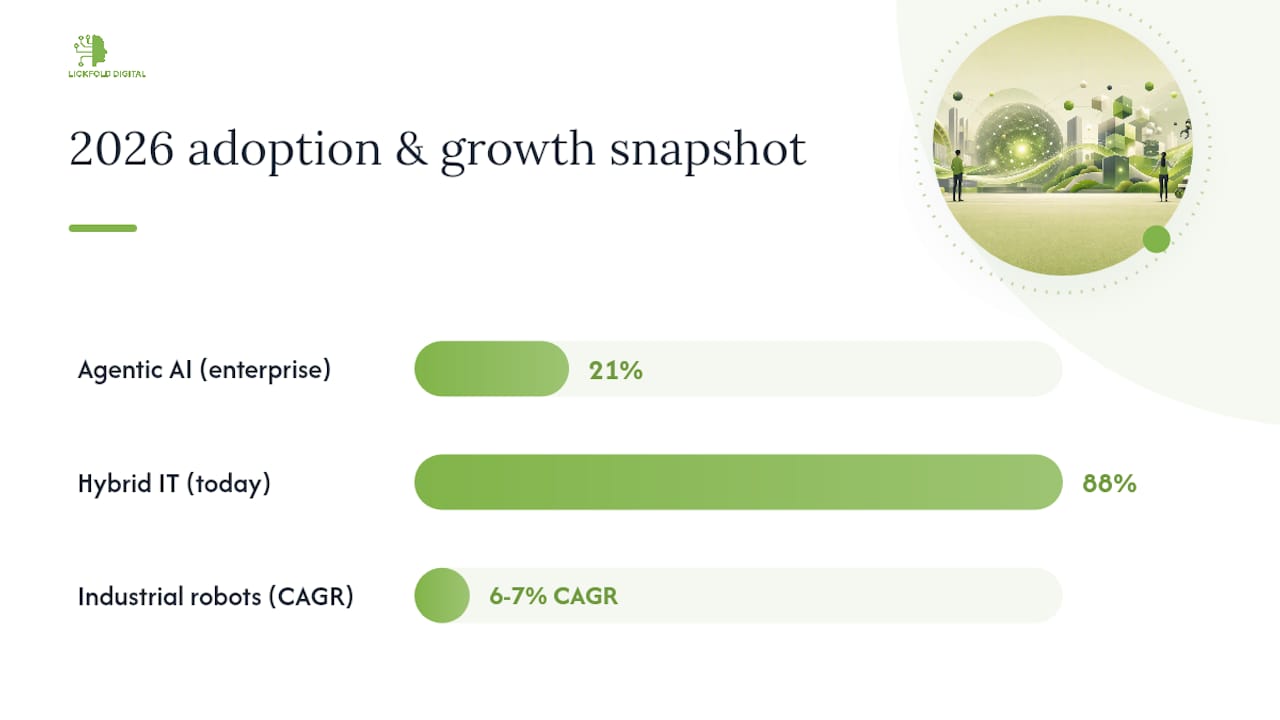
For planning purposes, treat 2026 as the year to move your best pilot into production and build the governance infrastructure for scale. Waiting for the technology to mature further is a false comfort: the orchestration and data readiness gaps are organizational, not technical.
Which sectors are seeing the biggest automation outcomes in 2026?
Manufacturing and discrete production
Digital twins paired with plug-and-play robotics are compressing commissioning timelines from weeks to days. A mid-size automotive supplier running real-time twin synchronization can catch a quality deviation before it reaches the assembly line, not after. The NIST roadmap’s emphasis on reliability and explainability reflects what manufacturers actually need: AI they can trust on the floor, not just in the lab.
Supply chain and logistics
Orchestrated value chains are replacing point-to-point integrations. Intelligent operations platforms now coordinate demand signals, carrier availability, and warehouse robotics in a single workflow, improving forecast accuracy and reducing expedite costs. The payoff is resilience: when a supplier drops out, the system reroutes automatically rather than waiting for a human to notice.
Finance and back-office operations
Intelligent document processing (IDP) has made month-end close faster and more accurate for finance teams running high transaction volumes. Automated reconciliation, exception flagging, and regulatory reporting are production-ready for most large enterprises. The remaining frontier is agentic orchestration across ERP, treasury, and compliance systems, which is where the 2026 pilots are concentrated.
Sales and marketing
AI agents for prospecting and outreach are moving from experiment to standard practice. Multi-touch agent workflows can identify decision-makers, personalize messaging at scale, and hand off warm replies to human reps, all without a manual sequence. For AI workflow automation in sales, the outcome metric that matters most is qualified pipeline per rep, not raw outreach volume.

Pro Tip: The highest-performing sales automation deployments share one pattern: human qualification at the reply stage. Agents handle volume and personalization; humans handle intent assessment and relationship escalation. Don’t automate the handoff.
Healthcare and pharma
Predictive maintenance for lab equipment and quality control automation in pharma manufacturing are delivering measurable uptime improvements. AI-assisted clinical documentation is reducing administrative load for care teams. Both use cases share a common requirement: explainability. Regulators and clinicians need to understand why the system flagged something, not just that it did.
Energy and utilities
Edge inference is enabling real-time grid coordination that centralized cloud processing can’t match on latency. Utilities running edge AI on substation equipment are detecting anomalies in milliseconds rather than minutes. The sustainability angle is real: better load forecasting and automated demand response reduce both waste and peak-demand carbon intensity.
What technical foundations do you need to support 2026 automation?
The architectural priority sequence matters as much as the component list. Data readiness comes first. No orchestration layer, agent fleet, or digital twin performs well on fragmented, inconsistent data. Before investing in agents, audit your data fabric: searchability, lineage, and access controls.
The priority sequence runs: data readiness, then orchestration, then agent onboarding, then hybrid execution, then continuous refactoring. Skipping steps is how organizations end up with expensive agent stacks that produce unreliable outputs.
Core components to invest in now:
- Data fabric and searchability: unified metadata, semantic search, and governed access across structured and unstructured sources
- LLMs and foundation models: fine-tuned on proprietary data for domain-specific decision intelligence, not generic off-the-shelf inference
- Multi-agent orchestration layers: coordination logic that manages agent sequencing, conflict resolution, and state persistence
- Service Orchestration and Automation Platforms (SOAPs): the pragmatic control plane for coordinating multiple specialized automation tools and AI workflows across hybrid environments
- Hybrid cloud and edge architectures: Cloud 3.0 patterns that route workloads based on latency, sovereignty, and cost, per Capgemini’s 2026 framework
- Digital twins and sensor fusion: real-time synchronization between physical assets and their digital models, with NIST-aligned reliability and explainability standards
- Secure MLOps and FinOps practices: model versioning, drift detection, cost monitoring, and automated rollback
Pro Tip: Build for modularity from day one. Containerized inference stacks, API-first agent interfaces, and multi-cloud portability frameworks let you swap models and execution environments without rebuilding workflows. The technical debt you avoid in year one compounds into speed advantage by year three.
For practical AI agent workflow examples that map these components to real orchestration patterns, the architecture principles above translate directly into production deployment decisions.
How does automation reshape your organization and workforce in 2026?
The workforce impact of automation in 2026 is task-level, not job-level, for most roles. MIT Sloan’s rising-tide finding is the most useful planning frame available: AI capability is improving broadly across text-based tasks, which means specific task bundles within jobs become automatable before entire occupations do. That distinction matters for reskilling strategy.
New roles organizations need to hire or develop now:
- AI collaboration designers: map human-agent task boundaries and design exception-handling workflows
- Agent ops engineers: monitor agent performance, manage SLAs, and handle drift or failure escalation
- FinOps specialists for AI: track token costs, model inference spend, and ROI per agent workflow
- Edge AI engineers: deploy and maintain inference models on edge hardware in manufacturing and utilities
- Governance owners: own policy-as-code, audit trail integrity, and regulatory compliance for automated systems
- Prompt engineers and model fine-tuning specialists: adapt foundation models to proprietary data and domain requirements
Reskilling approaches that work in practice: task-mapping workshops that show workers exactly which parts of their role are being augmented (not replaced), micro-credentialing programs tied to specific agent tools, and internal agent-onboarding programs that mirror how IT onboards new software systems. The framing matters. “Your job is changing” lands differently than “your job is disappearing.”
Human-agent workflow orchestration requires clear supervision protocols. Agents handle volume, speed, and pattern recognition. Humans handle ambiguity, relationship judgment, and exception escalation. Performance metrics need to reflect both: measure time-to-decision, error rates, and human supervision load alongside traditional productivity metrics.
Pro Tip: Start reskilling with task-level augmentation pilots, not job-replacement announcements. Pick one high-volume, low-judgment task in a willing team, automate it with an agent, and let the freed capacity flow into higher-value work. The proof-of-concept builds trust faster than any change-management deck.
What governance and security risks should leaders prioritize in 2026?
Agentic systems introduce a category of risk that traditional IT governance wasn’t designed for: autonomous action at scale, across systems, with cascading effects that can propagate faster than human review cycles. The governance playbook for 2026 has to be built into the agent architecture, not bolted on afterward.
Core risk areas to address:
- Runaway agent actions: agents with broad tool access can trigger unintended downstream effects; sandbox permissions and scope limits are non-negotiable
- Data lineage and privacy: multi-agent workflows touch multiple data sources; every handoff needs a traceable audit trail
- Model drift and explainability: production models degrade; continuous validation and explainability requirements (especially in regulated sectors) need to be automated, not manual
- Supply-chain and third-party risk: agents calling external APIs or third-party models inherit those systems’ vulnerabilities
- Cloud and edge sovereignty: data processed at the edge or in foreign cloud regions may trigger regulatory obligations; Cloud 3.0 routing logic must encode sovereignty rules
Governance stat to act on: Only 21% of enterprises have achieved enterprise-scale AI workflow deployment, per Stonebranch’s 2026 survey — meaning most organizations are scaling governance infrastructure before they’ve even hit production scale. Build the controls now, not after the first incident.
Governance controls that belong in every agentic deployment:
- Governance-as-code: compliance rules enforced at runtime, versioned alongside agent code
- Agent sandboxing: restricted execution environments with explicit permission grants
- Continuous audit trails: immutable logs of every agent action, decision input, and output
- FinOps cost guardrails: automated spend limits per agent workflow with alerting thresholds
- Policy-as-code integration with CI/CD pipelines: governance checks run at deployment, not post-deployment review
On the regulatory front, U.S. leaders should watch sector-specific AI safety guidance from the FDA (healthcare AI), FINRA and SEC (financial services automation), and NIST’s evolving AI Risk Management Framework. The EU AI Act’s extraterritorial reach also applies to U.S. companies operating in European markets.
Pro Tip: Embed governance into the agent lifecycle at three points: onboarding (define scope and permissions), monitoring (continuous drift and cost alerting), and retirement (formal decommission with audit trail archival). Governance that only exists at deployment is governance that fails at scale.
What’s your 90/180/365-day roadmap for capturing automation value?
90-day priorities
- Inventory all currently automated processes and score them by reliability, cost, and strategic value.
- Run task-level feasibility assessments using MIT-style task mapping: identify which specific tasks within high-value workflows are candidates for agent augmentation.
- Select one orchestration pilot with a defined success metric (time-to-decision, error rate, or cost-per-transaction).
- Define governance guardrails for the pilot: scope limits, audit trail requirements, and a human escalation protocol.
180-day priorities
- Launch a multi-agent pilot with governance-as-code embedded from day one, not added after.
- Implement data fabric improvements identified in the 90-day audit: close the lineage and searchability gaps that will constrain agent performance.
- Define FinOps monitoring for AI workloads: token costs, inference spend, and ROI per workflow.
- Start targeted reskilling programs for the roles most affected by the pilot workflows.
365-day priorities
- Scale proven agents from pilot into production, with formal SLAs and performance monitoring in place.
- Adopt Cloud 3.0 hybrid patterns for latency-sensitive workloads: route inference to edge nodes where real-time response is required.
- Adopt a SOAP as your control plane for coordinating multiple automation tools and agent workflows across environments.
- Formalize continuous refactoring pipelines: AI-assisted code review and automated technical debt reduction become standard engineering practice.
For practical B2B prospecting automation use cases that map directly to this roadmap, the 90-day pilot framework applies equally to outbound sales workflows as to internal operations.
Pro Tip: Measure four outcome metrics from day one: time-to-decision, error rates, cost-per-transaction, and human supervision load. If supervision load isn’t decreasing as agents mature, the workflow design needs revisiting, not the technology.
Checklist for the 365-day arc:
- Task-level feasibility assessment completed
- Governance guardrails defined before pilot launch
- Data fabric gaps closed before agent onboarding
- FinOps monitoring active from first production deployment
- Reskilling programs tied to specific workflow changes, not generic AI training
- Continuous refactoring pipeline in CI/CD by month 12
How were the adoption numbers and projections in this article derived?
The numeric claims in this article draw from a specific set of primary and secondary sources, each with different methodological characteristics.
Primary sources used:
- UiPath 2026 AI and Agentic Automation Trends Report: vendor-commissioned survey of enterprise executives; reflects adoption intent and strategic posture, not observed production metrics. Use for directional signals on agentic adoption.
- Stonebranch Global State of IT Automation (2026): independent survey of enterprise IT automation professionals; the 88% hybrid and 21% enterprise-scale figures come from this survey’s observed metrics, not projections.
- International Federation of Robotics (IFR): industry body estimates for robot installations and CAGR projections; the 6–7% CAGR through 2030 is a projection corridor, not a point estimate.
- MIT Sloan FutureTech study: academic research using large-sample worker evaluations; the 50–75% text-task competence range reflects preliminary findings and should be treated as a scenario frame, not a definitive benchmark.
- NIST 2026 Roadmap for AI and Smart Manufacturing: government technical roadmap; reflects research and deployment priorities, not market adoption rates.
- Capgemini Top Tech Trends 2026: consulting firm analysis combining survey data and expert synthesis; useful for structural framing, less reliable for precise adoption percentages.
- Deloitte Tech Trends 2026: similar methodology to Capgemini; strongest on qualitative adoption dynamics and transformation recommendations.
- Roland Berger Industrial Automation Update 2026: industry analysis with regional market signals; useful for directional manufacturing recovery signals.
Most consequential figure for planning: The Stonebranch survey’s finding that only 21% of enterprises have achieved enterprise-scale AI workflow deployment is the single most actionable number in this article. It tells you the competitive window is open, and it quantifies exactly how much runway remains before the gap closes.
Confidence notes: treat CAGR projections as scenario corridors, not forecasts. Survey-based adoption figures reflect respondent populations that skew toward larger, more digitally mature enterprises. Smaller organizations may lag these figures by 12–24 months. Use scenario bands for investment planning rather than treating any single projection as a fixed date.
What agentic automation means specifically for B2B sales and outbound
The automation trends reshaping enterprise operations are hitting B2B sales in a specific and consequential way. Agentic AI doesn’t just speed up outreach; it changes the economics of prospecting entirely. A well-orchestrated multi-agent system can run continuous, personalized multi-touch campaigns across hundreds of accounts simultaneously, something a human team can approximate only with significant headcount.
The shift that matters most for sales ops leaders is the move from sequence-based outreach to agent-orchestrated outreach. Traditional cadences are static: email on day 1, follow-up on day 4, LinkedIn on day 7. Agent-orchestrated outreach is dynamic: the system reads reply signals, adjusts timing and channel, escalates high-intent responses to human reps, and deprioritizes accounts showing disengagement. The throughput improvement is real, but the qualification improvement is what changes pipeline quality.
Human-in-the-loop qualification remains the non-negotiable element. Agents handle volume, personalization, and follow-up cadence. Humans assess intent, manage relationship nuance, and make the judgment call on when to escalate. Reputation management for scaled outbound, including domain warm-up, deliverability monitoring, and sender score maintenance, is the infrastructure layer that most teams underinvest in until they hit a deliverability crisis.
For AI-driven B2B prospecting, the measurement model also needs to evolve. Raw outreach volume is a vanity metric. The metrics that matter are qualified replies per thousand contacts, cost per qualified opportunity, and time-to-first-meeting. Agencies adopting AI-powered content and outreach workflows are reporting significant productivity gains when they pair agent automation with disciplined human qualification.
Pro Tip: Treat your prospecting agents as a continuous experiment. Run A/B tests on subject lines, messaging angles, and follow-up timing at a scale no human team can match. When a high-intent reply comes in, route it immediately to a human rep with full context. The speed of that handoff is often the difference between a booked meeting and a lost opportunity.
Sources
The reports below are the primary sources cited in this article. Each is worth reading in full for the depth behind the figures summarized here.
- AI and Automation Trends 2026 Report | UiPath
- International Federation of Robotics (IFR)
- Crashing waves vs. rising tides: preliminary findings on AI automation from thousands of worker evaluations | MIT Sloan
- 2026 roadmap: artificial intelligence and machine learning for smart manufacturing | NIST
- Top Tech Trends of 2026 | Capgemini