
AI-Powered Sales Solutions for B2B Teams in 2026
AI-Powered Sales Solutions for B2B Teams in 2026
The fastest path to a predictable B2B pipeline in 2026 is an agentic, human-in-the-loop AI outbound model. Pair autonomous AI agents that handle prospecting, sequencing, and initial engagement with human reviewers who qualify replies before anything reaches your sellers. That combination delivers faster pipeline build, consistent lead quality, and governance you can actually defend to legal and leadership. Lickfold Digital is built around exactly this model, making it the recommended starting point for seller-led B2B teams.
This approach fits you if:
- Your team spends a significant portion of selling time on prospecting and admin
- You need a predictable weekly flow of qualified meetings without scaling headcount
- You want outbound running 24/7 across multiple markets or verticals
- You have a defined ideal customer profile (ICP) but lack the infrastructure to reach it consistently
Skip this approach if:
- Your revenue is entirely inbound and referral-driven with no outbound motion
- You sell B2C or to consumers rather than business buyers
- You need a single-seat tool, not a managed outbound system
Table of Contents
- What can AI-powered sales solutions actually do for your team?
- How do the different categories of AI sales tools compare?
- What features should you actually test before buying?
- What does implementation actually cost, and how long does it take?
- How do you design a low-risk pilot that proves value fast?
- How do you measure ROI and present it to stakeholders?
- What governance controls do you need before going live?
- What are the real challenges and limitations of AI in sales?
- Where is AI in sales headed over the next 12–24 months?
- What ethical risks should you account for in AI sales tools?
- How do you get your sales team to actually adopt AI tools?
- Key Takeaways
- The gap between AI hype and what actually moves pipeline
- Lickfold Digital: built for B2B teams that need pipeline, not promises
- Useful sources for deeper reading
What can AI-powered sales solutions actually do for your team?
The honest answer: quite a lot, but only if you match the tool to the task. Here are the use cases delivering real workflow change for B2B sales teams right now.
- Automated prospect research. AI agents scan company databases, news feeds, and LinkedIn signals to build account profiles without a rep lifting a finger. Agentic CRM shifts the system from storing data to actively performing work, scaling best practices like opportunity prioritization across entire teams.
- Personalized outreach drafts. Generative AI drafts prospecting messages tailored to each account, summarizes meetings, and proposes next steps, cutting rep admin time significantly.
- Multi-touch follow-up sequencing. Instead of a rep manually tracking who got email three, AI runs the sequence, adjusts timing based on engagement signals, and flags replies for human review.
- Lead scoring. Machine learning models rank inbound and outbound leads by fit and intent, so reps work the highest-probability accounts first.
- Meeting scheduling. Autonomous agents handle back-and-forth calendar coordination, removing one of the most time-consuming non-selling tasks from a rep’s day.
- Conversation intelligence. AI transcribes and analyzes sales calls, surfaces objection patterns, and generates coaching cues. Revenue operations leaders describe best-in-class platforms as a central Revenue AI OS that unifies data across email, phone, and social to support accurate forecasting.
“Successful deployments combine AI agents with strong human governance: agents accelerate reaching prospects while humans keep brand voice, complex negotiations, and final qualification.” — IBM AI Sales guidance
For CRM integration, the practical standard is bidirectional sync: the AI reads account data from your CRM and writes back enriched profiles, activity logs, and lead scores automatically. Sales force automation platforms can include autonomous agents that qualify leads, generate quotes, and schedule meetings, reducing the administrative load that typically consumes a notable portion of a rep’s week.
Pro Tip: Before you evaluate any vendor, map which of these use cases your team actually needs. Buying a full conversation-intelligence suite when your core problem is prospecting volume is a common and expensive mismatch.

How do the different categories of AI sales tools compare?
Not all AI sales tools are the same category of product. Knowing the difference saves you from buying a forecasting platform when you need an outbound engine.
- Agentic outbound platforms. These deploy dedicated AI agents to research prospects, build contact lists, and run personalized multi-touch outreach campaigns. Best for teams that need predictable, high-volume outbound without adding headcount. Lickfold operates in this category, with dedicated warm-up infrastructure and human qualification built into the workflow.
- AI-enabled CRM / Revenue OS. Platforms like Microsoft Dynamics 365 embed AI agents directly into the CRM layer. The Sales Qualification Agent prioritizes and engages leads autonomously, while the Sales Opportunity Agent continuously researches deals. Best for enterprise teams already standardized on a single CRM.
- Sales engagement platforms with generative assistants. These add AI-drafted messaging and sequence optimization on top of traditional email and call cadence tools. Best for teams with an existing outbound motion that needs better personalization at scale.
- Conversation-intelligence suites. Purpose-built for call analysis, coaching, and deal risk detection. Best for sales managers who want visibility into what is happening on calls and where deals stall.
- Sales forecasting and analytics tools. Focus on pipeline accuracy, deal health scoring, and revenue prediction. Best for RevOps and sales leadership who need reliable numbers for board-level reporting.
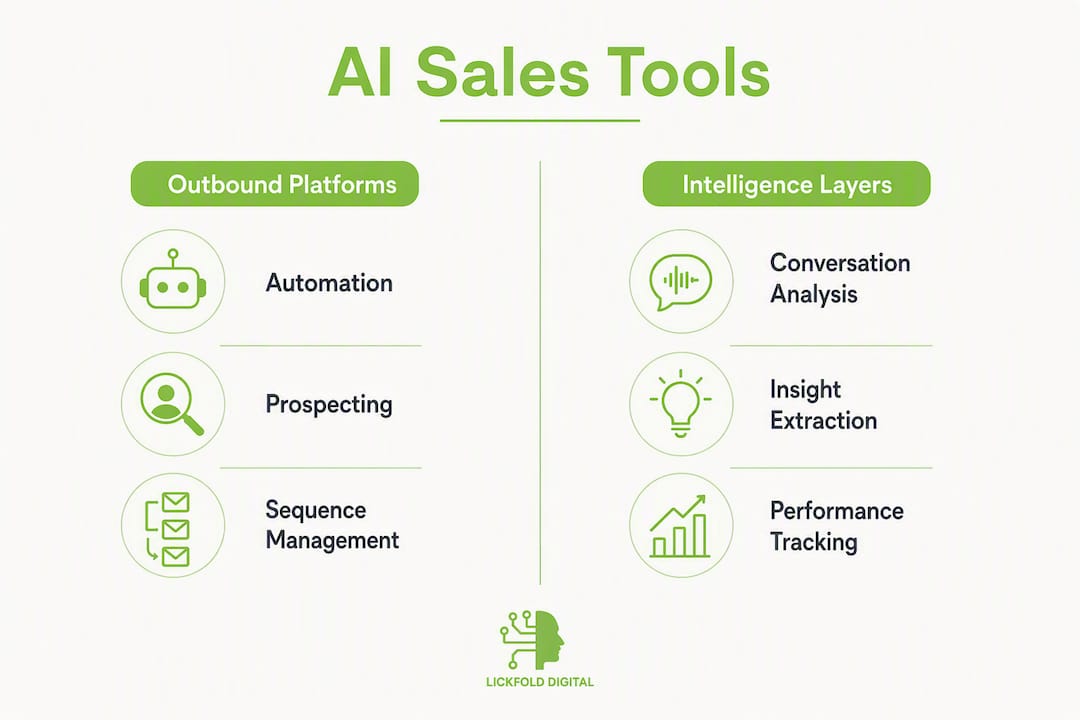
Many teams end up combining two categories, typically an outbound platform plus a conversation-intelligence layer. That combination works well once each tool is integrated with the CRM, but it adds integration complexity and cost. Start with one category, prove value, then expand.
What features should you actually test before buying?
Vendor demos are optimized to impress, not to reveal weaknesses. Use this checklist to stress-test what you see.
- Data portability and CRM integration. Can you export your contact and activity data without vendor lock-in? Does the sync run bidirectionally in real time or on a delay?
- Outbound sequencing controls. Can you set daily send limits, time-zone rules, and reply-detection pauses at the account level?
- Deliverability infrastructure. Does the vendor provide dedicated warm-up domains and IP reputation monitoring, or do they send from your primary domain? Deliverability is often the gating factor for outbound pilots.
- Agent autonomy levels. Is the AI suggestive (drafts for human approval) or autonomous (sends without review)? Know which mode is active by default.
- Conversation intelligence accuracy. Ask for a transcript accuracy benchmark on industry-specific vocabulary, not just generic speech.
- Audit logs and explainability. Can you see why the model scored a lead a certain way? AI-powered platforms commonly offer opportunity scoring and AI coaching, but audit trails vary widely.
- SLA for data security. Where is data stored? What is the breach notification timeline? Does the vendor hold SOC 2 Type II certification?
Questions worth asking in a live demo: “Show me a live account profile built from at least three data sources.” “Walk me through what happens when a prospect replies with a question the agent cannot answer.” “Show me the audit log for a lead that was scored and then reclassified.”
Pro Tip: Run a 10-day deliverability test before committing. Send a controlled batch from the vendor’s infrastructure to a seed list you control and measure inbox placement rate. Any vendor confident in their deliverability will agree to this.
What does implementation actually cost, and how long does it take?
Pricing models vary by vendor category, and the wrong model for your buying situation can inflate total cost of ownership fast.
Common pricing models:
- Per-seat SaaS. Fixed monthly fee per user. Predictable, but costs scale with headcount rather than output.
- Volume-based. Priced per message sent or leads delivered. Aligns cost to activity, but can spike if sequences are misconfigured.
- Usage-based credits. Pay for AI actions (enrichment calls, agent tasks). Flexible for low-volume pilots, harder to budget at scale.
- Managed-service tiers. A subscription that includes infrastructure setup, ongoing management, and human qualification labor. Higher monthly cost, lower internal resource requirement. Lickfold uses this model.
Typical implementation stages:
- Discovery (1–3 weeks): ICP definition, data audit, CRM mapping, and stakeholder alignment.
- Integration (2–8 weeks): CRM connectors, data pipelines, deliverability infrastructure setup, and warm-up domain configuration.
- Pilot (4–8 weeks): Controlled outbound run with a defined prospect cohort, baseline metrics captured, and human qualification active.
- Ramp (1–3 months): Expand to full ICP, tune scoring models, and hand off qualified pipeline to sellers.
Budget line items to include regardless of vendor:
- Integration and technical setup
- Dedicated warm-up domain and IP reputation management
- Human qualification labor (internal or vendor-provided)
- Ongoing subscription or managed-service fee
- CRM data cleanup (often underestimated)
Small-team pilots typically run at a lower monthly investment than mid-market deployments, which add integration complexity and data enrichment costs. Enterprise pilots add compliance review and security assessment time on top. Get a full line-item quote before signing, not just the headline subscription price.
How do you design a low-risk pilot that proves value fast?
A well-designed pilot answers one question: does this tool generate qualified pipeline at a cost and quality we can sustain? Here is a repeatable six-step structure.
- Define the objective. One measurable goal: for example, generate 15 qualified sales-accepted leads (SALs) in six weeks from a defined ICP segment.
- Select the cohort. 200–500 target accounts that match your ICP but have not been contacted in the past 90 days. Clean data matters more than cohort size.
- Set data and integration requirements. CRM sync active, warm-up domains live, and baseline metrics captured before day one.
- Write messaging guardrails. Define tone, prohibited claims, and the exact point at which a reply escalates to a human. Human-in-the-loop governance means agents handle prospecting and initial engagement while humans define strategy and approve final qualifications.
- Define human handoff rules. Any reply showing buying intent, a question the agent cannot answer, or a complaint goes to a human within two business hours.
- Run for six weeks minimum. Shorter pilots do not generate enough data to distinguish signal from noise, especially with warm-up periods factored in.
Pilot metrics: baseline vs. target
| Metric | Baseline (pre-pilot) | Pilot target | Measurement method |
|---|---|---|---|
| Email deliverability rate | Establish in week 1 | 90%+ inbox placement | Seed list monitoring |
| Response rate | Establish in week 1 | 2x baseline | CRM / sequence tool |
| Qualified leads per week | Current weekly average | 1.5x baseline | Human qualification log |
| Pipeline velocity | Current average days | Reduce by 15% | CRM opportunity stage dates |
| Cost per SQL | Current blended cost | Below current benchmark | Finance + CRM data |
Pro Tip: Design pilots to report both activity and outcome metrics: track message deliverability and response rate alongside SQLs and pipeline value. Activity metrics alone are a false positive. A high response rate that produces zero qualified meetings means the targeting or messaging is wrong, not that the pilot succeeded.
How do you measure ROI and present it to stakeholders?
Tie every metric back to revenue, not activity. Stakeholders care about pipeline and closed revenue, not email open rates.
Core KPIs to track:
| KPI | Measurement method | Reporting cadence |
|---|---|---|
| SQL conversion rate | Qualified leads ÷ total responses | Weekly during pilot, monthly post-ramp |
| Pipeline velocity | Average days from first touch to opportunity stage | Bi-weekly |
| Average deal size change | CRM opportunity value, pilot cohort vs. control | End of pilot |
| Close rate | Won opportunities ÷ total SQLs | Monthly |
| Rep time reclaimed | Time-tracking or rep survey (hours/week) | Monthly |
| Cost per SQL | Total program cost ÷ SQLs generated | Monthly |
For attribution, multi-touch attribution is more accurate than last-touch for outbound sequences, because a prospect typically receives several touches before responding. During a pilot, use a clean cohort with no other active outbound to isolate the AI program’s contribution. Revenue operations leaders who treat the AI layer as a Revenue OS connect signals from email, phone, and social to produce accurate attribution across the full funnel.
A simple ROI formula for stakeholder presentations: (Pipeline generated by pilot cohort × average close rate × average deal size) ÷ total pilot cost. If that number is above 3x, the program is worth scaling. Below 1.5x, revisit targeting and messaging before expanding.
What governance controls do you need before going live?
Automation without governance creates legal exposure, deliverability damage, and brand risk. Build these controls in before launch, not after a problem surfaces.
- Human-in-the-loop approval gates. Agents handle prospecting and initial engagement; humans approve final qualifications and any message that deviates from the approved template.
- SQL rubric and qualification review. Define what a qualified lead looks like in writing. Sample and review a percentage of AI classifications weekly to catch drift early.
- Audit logs. Every agent action, lead score, and message sent should be logged with a timestamp and the model version that generated it.
- Periodic model reviews. Scoring models degrade as market conditions change. Schedule a quarterly review of lead scoring accuracy against actual close rates.
- Access controls. Limit who can modify agent parameters, messaging templates, and ICP definitions. Changes should require approval from a sales leader or RevOps.
- Deliverability monitoring. Track bounce rates, spam complaints, and unsubscribe rates daily during the pilot. A spike in any of these requires immediate pause and review.
- Bias in scoring models. Audit lead scores by industry, company size, and geography to confirm the model is not systematically deprioritizing segments that could convert.
Treating AI agents as “set-and-forget” is the most common governance failure. Even advanced systems need ongoing human oversight for qualification review and model tuning.
This article is general information, not legal or compliance advice. Consult qualified legal counsel for your specific data privacy obligations under applicable U.S. federal and state law.

What are the real challenges and limitations of AI in sales?
AI in sales is genuinely useful, but the gap between vendor promises and day-one reality is wide enough to derail a pilot if you are not prepared.
Data quality is the ceiling. AI models are only as good as the data they run on. Dirty CRM data, incomplete contact records, and inconsistent ICP definitions produce poor targeting and wasted outreach. Most teams underestimate the data cleanup required before a pilot can generate reliable results.
Personalization at scale has limits. Generative AI can produce personalized-sounding messages, but prospects are increasingly good at detecting templated outreach. The quality gap between a well-crafted human message and an AI draft narrows every month, but it has not closed.
Integration complexity is real. Connecting an AI outbound platform to a CRM, a calendar tool, and a conversation-intelligence suite requires technical resources most small sales teams do not have in-house. Underestimating integration time is the most common reason pilots run over budget and timeline.
Change resistance from reps. Sellers who feel the AI is replacing them rather than helping them will find ways to work around it. Adoption rates drop when reps are not involved in pilot design and do not see a direct personal benefit.
Regulatory exposure. CAN-SPAM, TCPA, and emerging state-level AI transparency laws all apply to automated outbound. The rules are evolving fast, and a misconfigured agent can generate compliance risk at scale.
Where is AI in sales headed over the next 12–24 months?
The trajectory is toward more autonomous, more connected, and more accountable systems.
Fully agentic deal cycles. The current model has AI handling prospecting and humans closing. The next wave extends agent autonomy deeper into the deal cycle, with agents handling discovery scheduling, proposal drafting, and follow-up through negotiation, with humans stepping in only at key decision points.
Multimodal outreach. AI agents are moving beyond email and LinkedIn to coordinate outreach across voice, video, and chat simultaneously, adjusting channel mix based on prospect engagement patterns.
Real-time intent signals. Platforms are integrating third-party intent data (job postings, funding announcements, technology install signals) directly into agent workflows, so outreach triggers on a buying signal rather than a static list.
Tighter CRM unification. The agentic CRM model where AI executes work rather than just surfacing insights will become the standard architecture. Data unification across email, phone, social, and product usage will feed more accurate forecasting and account health scoring.
Regulatory pressure on transparency. Expect disclosure requirements for AI-generated outreach to expand at the state level. Teams that build audit logs and human-in-the-loop controls now will adapt faster when compliance requirements tighten.
What ethical risks should you account for in AI sales tools?
Ethics in AI sales is not abstract. It has direct business consequences.
Bias in lead scoring. If a model was trained on historical win data that skews toward certain industries, company sizes, or geographies, it will systematically deprioritize accounts outside that pattern, even when those accounts could convert. Audit your scoring model’s outputs by segment before trusting it to prioritize your pipeline.
Transparency with prospects. Sending AI-generated outreach without any disclosure sits in a legal and ethical gray zone that is narrowing. Some states are moving toward disclosure requirements for AI-generated commercial communications. Getting ahead of this is cheaper than reacting to it.
Data sourcing and consent. AI prospecting tools pull contact data from multiple sources. Verify that your vendor’s data sourcing complies with applicable privacy law, including the California Consumer Privacy Act (CCPA) and any sector-specific regulations relevant to your industry.
Pressure to remove human oversight. As AI systems improve, there will be internal pressure to remove human qualification steps to cut costs. Resist this until you have at least six months of data showing the model’s classification accuracy is stable and audited.
How do you get your sales team to actually adopt AI tools?
Adoption is where most AI rollouts fail, and it is almost never a technology problem.
Involve reps in pilot design. Sellers who help define the ICP, review messaging guardrails, and set the SQL rubric feel ownership over the outcome. Those who are handed a finished system feel replaced by it.
Show the personal benefit first. The fastest adoption driver is demonstrating that the AI removes tasks reps hate, specifically manual prospecting, CRM data entry, and follow-up tracking, before asking them to change how they work.
Train on the handoff, not the tool. Most reps do not need to understand how the AI works. They need to know exactly when a lead lands in their queue, what information comes with it, and what their first action should be. Train on that workflow, not the platform interface.
Set realistic expectations with leadership. AI outbound takes four to eight weeks to ramp. Managers who expect week-one results will pull the plug before the system has enough data to perform. Align on the pilot timeline and the metrics that matter before launch.
Run a structured change management process. Assign an internal champion, schedule weekly check-ins during the pilot, and create a feedback channel where reps can flag messages that feel off-brand or targeting that seems wrong. That feedback loop improves the system and builds trust simultaneously.
Key Takeaways
AI-powered sales solutions deliver the fastest ROI when agentic outbound automation is paired with human-in-the-loop qualification, clean data, and a structured six-week pilot before any full rollout.
| Point | Details |
|---|---|
| Start with a structured pilot | Run 6 weeks minimum with a clean 200–500 account cohort and baseline metrics captured before day one. |
| Governance is non-negotiable | Build human approval gates, audit logs, and weekly qualification reviews before the first message sends. |
| Match tool category to use case | Agentic outbound, AI-enabled CRM, conversation intelligence, and forecasting tools solve different problems — pick the right category first. |
| Measure outcomes, not activity | Track SQL conversion rate, pipeline velocity, and cost per SQL — not just open rates or response volume. |
| Lickfold for outbound automation | Lickfold’s agentic outbound model includes deliverability infrastructure, human qualification, and managed multi-touch sequencing for B2B teams. |
The gap between AI hype and what actually moves pipeline
Most of the conversation about AI in sales focuses on the technology. The smarter question is what the technology changes about the economics of outbound.
Here is what gets underestimated: the constraint in B2B outbound has never been the number of messages sent. It has been the quality of targeting, the consistency of follow-up, and the speed at which a warm reply reaches a human who can close it. AI solves all three, but only when the infrastructure is right. Deliverability, data quality, and human handoff design matter more than which AI model writes the first-touch email.
The teams that get the most from AI sales tools are not the ones with the most sophisticated tech stack. They are the ones that defined their ICP precisely, built clean data before launch, and kept a human in the loop at the qualification stage. The automation handles volume. The human judgment handles quality. That combination is what produces pipeline you can actually forecast.
Lickfold Digital: built for B2B teams that need pipeline, not promises
Most AI sales platforms hand you a tool and leave the infrastructure, data, and qualification to you. Lickfold takes a different approach: a fully managed agentic outbound system that includes dedicated warm-up domains, ongoing reputation management, AI-driven prospect research, personalized multi-touch sequencing, and human qualification of every reply before it reaches your sellers.
The result is a predictable weekly flow of sales-accepted leads without adding headcount or managing deliverability yourself. B2B teams using Lickfold’s model have reported measurable improvements in qualified pipeline volume and a significant reduction in the time reps spend on prospecting. The system runs continuously across your target markets, adapts messaging based on engagement signals, and keeps your brand voice consistent through human review at every handoff point.
If you are ready to run a structured pilot or want to see how the model maps to your ICP, reach out to the Lickfold team and request a pilot consultation.
Useful sources for deeper reading
The sources below are worth bookmarking depending on your role and where you are in the evaluation process.
- Microsoft Dynamics 365 Sales — Detailed coverage of agentic CRM architecture, the Sales Qualification Agent, and the Sales Opportunity Agent. Open first if you are evaluating enterprise CRM-embedded AI. Best for: RevOps and enterprise sales leaders.
- Salesforce Sales Cloud — Covers sales force automation capabilities, autonomous agent features, and CRM centralization benefits. Useful for teams already on the Salesforce platform. Best for: Sales operations managers.
- Salesforce Agentforce and Sales AI — Explains generative AI applications for prospecting message drafting, meeting summaries, and next-step proposals. Also covers the governance pitfalls of autonomous agents. Best for: Sales leaders evaluating generative AI features.
- IBM AI Sales guidance — Covers human-in-the-loop governance models and the principle that agents handle prospecting while humans control final qualification. Best for: CTOs and compliance leads.
- Gong Revenue Intelligence — Explains the Revenue AI OS concept and how unified interaction data across email, phone, and social improves forecasting accuracy. Best for: RevOps and sales analytics teams.
- Pega Sales Automation — Feature-level detail on opportunity scoring, conversation intelligence, CPQ integration, and AI coaching. Useful as a benchmark for feature evaluation checklists. Best for: Technical buyers and RevOps.
- Lickfold: AI workflow automation examples — Practical examples of AI-powered sales workflows across prospecting, follow-ups, and CRM updates. Best for: Sales managers designing their first AI workflow.
- Lickfold: AI agents use cases in B2B sales — Deep dive into autonomous agent governance and use cases. Best for: RevOps and sales leaders evaluating agent autonomy levels.
- Lickfold: human and AI qualification — Practical governance patterns and human-in-the-loop workflows for B2B qualification. Best for: Sales managers setting up handoff rules.