
The Outbound Prospecting Process That Actually Fills Pipeline
The Outbound Prospecting Process That Actually Fills Pipeline
Outbound prospecting is seller-initiated outreach to a defined set of target accounts, built to book qualified meetings and create pipeline you can forecast instead of hope for. The process runs in five stages: define your ideal customer profile, build and verify a contact list, research each account for a personalization hook, run a multi-channel cadence, then qualify replies before handing warm leads to an account executive.
Do these three things in the next 72 hours and you’re already ahead of most teams:
- Define your ICP in writing. Firmographics, tech stack, and one trigger event that signals urgency, not a vague “mid-market SaaS” description.
- Build a contact list of appropriate size and verify every email. Bad data kills reply rates faster than bad copy ever will.
- Launch a 7 to 14-day multi-channel cadence mixing email, LinkedIn, and a phone touch, using a qualification framework like BANT to filter replies before they hit an AE’s calendar.
Teams that hit these basics in month one typically see 200 to 300 contacts reached per rep with a 2 to 5 percent reply rate, which is a realistic floor, not a ceiling, once the process tightens.
Key Takeaways
A working outbound prospecting process depends on a tight ICP, a verified list, multi-channel sequencing, and disciplined qualification before any lead reaches an account executive.
| Point | Details |
|---|---|
| Nail the ICP first | Define firmographics, tech stack, and trigger events before building any list. |
| List quality beats list size | A small, verified list consistently outperforms a large, unverified one. |
| Sequence channels deliberately | Lead with email, add LinkedIn and calls for warmer, higher-value targets. |
| Qualify before handoff | Use BANT or a similar framework so AEs only receive genuinely warm opportunities. |
| Automate research, keep judgment human | Lickfold pairs AI-driven prospecting and warm-up infrastructure with human qualification before leads reach sales. |
Table of Contents
- What Is Outbound Prospecting and Why Does It Matter?
- What Groundwork Do You Need Before Launching Outbound?
- What Are the Steps in the Outbound Prospecting Process?
- Why Do Outbound Campaigns Stall, and How Do You Fix Them?
- How Is AI Changing the Outbound Prospecting Process?
- What Should Sales Leaders Prioritize When Running Outbound?
- Get an Automated, Predictable Outbound Pipeline
- Frequently Asked Questions
- Sources
What Is Outbound Prospecting and Why Does It Matter?
Outbound prospecting means your team initiates contact with accounts and contacts who haven’t raised their hand yet. You pick the target, you make the approach, and you control the timeline. Inbound waits for someone to fill out a form; outbound goes and finds the person who fits your ICP but has never heard of you.
That distinction matters because outbound sales workflows typically move through five stages: market segmentation, lead generation, outreach and qualification, sales calls or demos, and close, with SDRs, BDRs, and AEs each owning a piece of that chain. Inbound can’t replicate that control. It’s reactive by design.
Outbound wins when you need:
- New market entry, where nobody is searching for you yet because you haven’t built awareness there.
- Competitive displacement, targeting accounts using a rival’s product where inbound content won’t reach a happy customer.
- Strategic account expansion, going after specific logos your revenue plan requires rather than whoever happens to convert organically.
Inbound tends to win on cost per lead over time and works well when your buyer already searches for solutions like yours. Outbound wins on speed and precision. If your target account list is small and high value, and enterprise sales usually falls into this bucket, outbound is often the only way to get in the door before a competitor does.
What Groundwork Do You Need Before Launching Outbound?
Skipping this stage is the single most common reason outbound campaigns produce noise instead of pipeline. Before a single email goes out, lock down three things.
Your ICP checklist should specify:
- Firmographic filters: employee count, revenue band, industry, and geography.
- Technographic filters: what tools or platforms the account already runs, since that often signals fit or conflict.
- Trigger events: funding rounds, leadership changes, expansions, or compliance deadlines that create urgency now.
- Role-level targeting: the exact titles with budget authority and the exact titles who’ll champion you internally.
Vague ICPs produce vague lists, and vague lists produce the generic messaging that tanks reply rates.
Your value proposition needs a one-line template your whole team can adapt: “We help [ICP] achieve [specific outcome] without [common pain point], unlike [status quo approach].” A rep should be able to fill that in for any account in under two minutes and have it sound specific, not templated.
Set KPI targets before you launch, not after. Early benchmarks worth aiming for:
- Month 1: 200 to 300 prospects contacted per rep, 30 to 50 percent open rate, 2 to 5 percent reply rate.
- Month 3: reply rates climbing to 5 to 8 percent as personalization and list quality improve.
- Month 6: a mature rep booking 15 to 25 meetings monthly.
If you’re tracking below those numbers by month three, the problem is almost always list quality or messaging, not volume.
What Are the Steps in the Outbound Prospecting Process?
Here’s the operational sequence, stage by stage, with the specifics that separate a working process from a script that gets ignored.
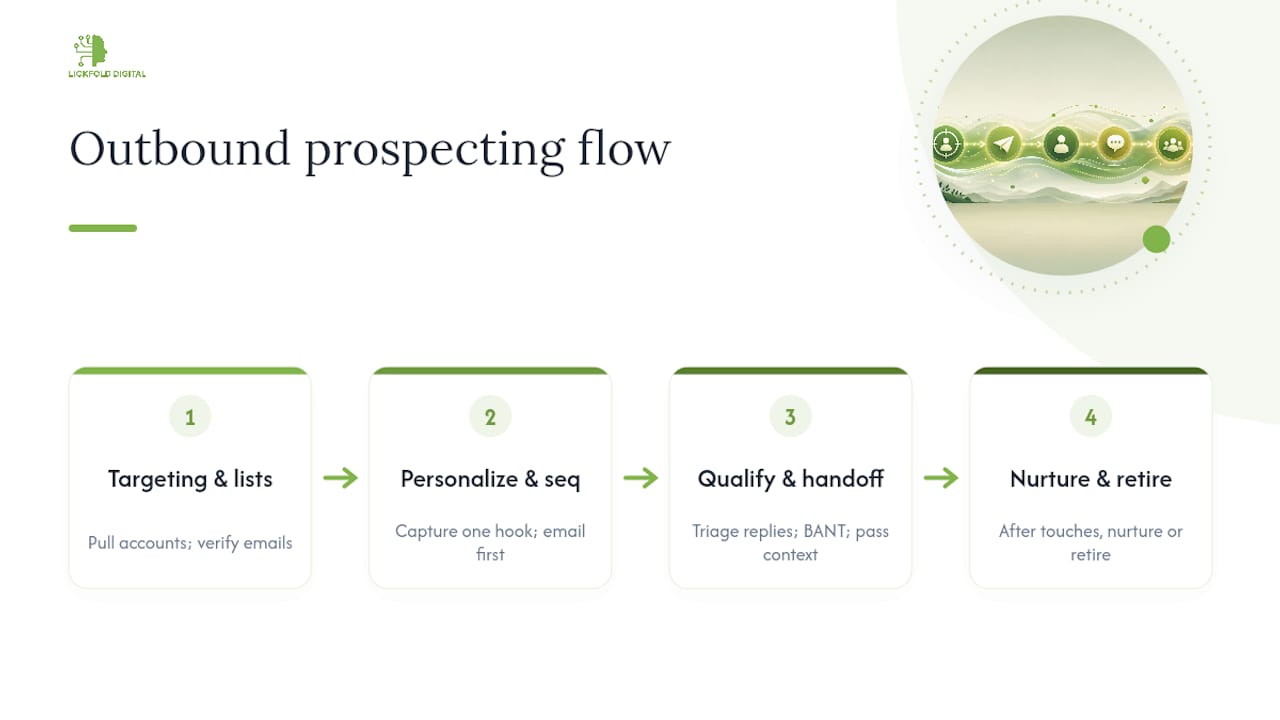
1. Target selection. Pull accounts matching your ICP filters from a database like Crunchbase for funding and firmographic data, or your CRM’s existing account universe. Rank by trigger-event recency, since a company that just raised a Series B is a warmer target than one that’s been static for two years.
2. List build and verification. Pull contacts through an enrichment tool, then verify every email address before it enters a sequence. This step alone often decides whether your campaign works. List quality is the highest-impact variable in outbound: a smaller, accurate list consistently outperforms a larger, sloppy one.
3. Personalization data capture. For each contact, capture one specific hook: a recent LinkedIn post, a job change, a company announcement. You don’t need five personalized lines per email. You need one that proves you did your homework, an approach that lets teams personalize efficiently without burning hours per lead.
4. Multi-channel sequencing. Layer email, LinkedIn, and phone in a deliberate order. Email scales best for volume, LinkedIn and calls convert higher but cost more rep time, so sequence lower-cost touches first and reserve calls for contacts who’ve already engaged.

5. Reply handling and qualification. Every reply gets triaged fast. A “not now” gets nurtured. A “tell me more” gets a qualification pass using BANT or a similar framework, checking budget, authority, need, and timing before it moves further.
6. Handoff to AE. Pass only qualified opportunities, with full context (the trigger, the pain point, the conversation history) attached. A poor sales handoff is where good leads go to die, so document everything the AE needs before the call.
7. Nurture and retire rules. Set a clear rule for cold contacts: after a defined number of touches with no response, move them to a long-term nurture track or retire them from active sequencing entirely.
Sample cadences
A 5-touch cadence over 10 days works for high-volume, lower-touch segments: email on day 1, LinkedIn connection request on day 3, follow-up email on day 5, LinkedIn message on day 7, breakup email on day 10.
An 8 to 12-touch cadence over three weeks fits higher-value targets: opening email, LinkedIn engagement (comment on a post before connecting, since warming a connection before messaging outperforms a cold InMail), a phone call, a short personalized video touch (video-based outreach has shown reply rates of 26 to 35 percent in some benchmarks), a second email referencing the trigger event, another call attempt, and a final breakup email.
Qualification checklist
- Does the contact have budget authority or direct access to it?
- Is there a specific pain point tied to your solution, not a generic interest?
- Is there a timeline or trigger event creating urgency?
- Has the contact engaged more than once (opened, replied, clicked)?
KPIs to watch weekly
| Stage | Metric | Healthy range |
|---|---|---|
| Outreach | Open rate | 30 to 50 percent |
| Outreach | Reply rate | 2 to 8 percent (improves by month 3) |
| Qualification | Reply to meeting | 30 to 50 percent |
| Pipeline | Meeting to opportunity | Varies by deal size |
Pro Tip: Track reply rate by channel, not just overall. If email replies are strong but LinkedIn is dead, the fix might be your connection note, not your entire cadence.
Why Do Outbound Campaigns Stall, and How Do You Fix Them?
Most underperforming outbound campaigns trace back to one of four problems.
- Deliverability issues: emails landing in spam usually mean poor domain warm-up or sending volume that spiked too fast. Slow down and warm up new sending domains gradually.
- Bad data: high bounce rates almost always mean the list wasn’t verified. Rerun verification before your next send.
- Generic messaging: low reply rates despite high opens usually mean the personalization hook is missing or feels templated. Go back to one specific detail per contact.
- Scaling too fast: adding volume or automation before the process is proven just multiplies whatever is already broken.
To diagnose the weak link, check opens first (a deliverability or subject-line problem), then replies (a messaging problem), then meetings booked from replies (a qualification or scheduling problem). One-sentence compliance reminder: always include a clear opt-out and honor unsubscribe requests immediately, since that’s both good practice and a baseline expectation for professional outreach.
How Is AI Changing the Outbound Prospecting Process?
AI has taken over the parts of outbound that used to eat the most rep time: research, list enrichment, and drafting personalized fields at scale. What it hasn’t replaced, and shouldn’t, is judgment. A human still needs to read a reply, sense the tone, and decide whether a prospect is genuinely qualified or just being polite.
The practical split looks like this:
- Automate: account research, trigger-event monitoring, contact enrichment, first-draft personalization, and sequence scheduling.
- Keep human: final message review before send, reply triage, qualification decisions, and any judgment call about tone or timing.
Reputation management matters just as much as the messaging itself. Dedicated warm-up email accounts, gradual sending throttles, and manual review checkpoints before high-volume sends all protect deliverability that automation alone can wreck in a week.
An outbound sequence that combines AI-driven research with a human review gate before send tends to keep reply quality high while still scaling volume, because the automation handles the repetitive research work and a person still owns the final judgment call on tone and qualification.
This is where the innovations reshaping outbound are heading: not replacing reps, but removing the parts of the job nobody enjoyed doing manually.
What Should Sales Leaders Prioritize When Running Outbound?
Three priorities separate outbound teams that build predictable pipeline from teams that burn out their SDRs chasing volume.
Process over tools. A great sequencer running a bad process just fails faster. Fix the ICP and the qualification rules before buying anything new.
List quality over list size. A tight, verified list of 300 accounts will consistently outperform a sloppy list of 3,000, and it protects your sender reputation in the process.
Measure funnel stages, not just meetings booked. Weekly coaching should ask: where exactly is this rep’s funnel leaking? Opens, replies, or booked-to-held conversion each point to a different fix.
Run through this three-question checklist in your next coaching session: is the list verified, is the hook specific to the account, and is the qualification bar being applied consistently before handoff?
Get an Automated, Predictable Outbound Pipeline
Building this process in-house takes months of trial and error, plus a rep’s worth of time spent on research and list-building that never touches a prospect’s inbox. Lickfold runs that entire front end for you: AI agents handle market research, decision-maker mapping, and multi-touch outreach, while dedicated warm-up infrastructure and ongoing reputation management protect your deliverability the whole time.
Every reply gets a human qualification pass before it reaches your sales team, so what lands on your AE’s calendar is a genuinely warm conversation, not a raw lead. Service firms, agencies, and other sales-driven B2B organizations use this to lower cost per meeting and make pipeline predictable instead of lumpy month to month. If you’re ready to see what a continuously running outbound engine looks like for your ICP, visit Lickfold Digital and get a look at how the setup would work for your team.
Frequently Asked Questions
What’s the difference between outbound prospecting and cold calling?
Cold calling is one channel within outbound prospecting. The full process includes email, LinkedIn, video, and sometimes direct mail, sequenced together, not a single unplanned call.
How long before outbound prospecting produces results?
Most teams see initial replies within the first two weeks of a cadence, but meaningful pipeline volume typically takes 60 to 90 days as list quality and messaging improve through iteration.
What reply rate should I expect from cold email?
Early-stage campaigns often see 2 to 5 percent reply rates, climbing toward 5 to 8 percent by month three as targeting and personalization tighten.
Do I need a large list to run outbound successfully?
No. A verified list of 200 to 500 well-matched contacts, run through a disciplined cadence, usually outperforms a much larger list with poor data quality.
Can AI fully automate outbound prospecting?
AI can automate research, enrichment, and first-draft personalization, but reply triage and final qualification decisions still need human judgment to keep quality and deliverability high.
Sources
Your tool stack needs four categories: a CRM to house the account and contact records, a data or enrichment provider to build and refresh lists, a sales engagement platform to run sequences, and a verification service to catch bad emails before they damage your sender reputation.
Salesforce remains the standard CRM for tracking outbound activity against pipeline stages, while Crunchbase is useful for firmographic and funding-trigger data, and LinkedIn doubles as both a data source and an outreach channel through Sales Navigator.
When evaluating any tool, check four things: data coverage for your specific ICP, how frequently records refresh, whether it surfaces direct-dial numbers (not just switchboard lines), and how cleanly it integrates with your CRM and sequencer.
Maintain list quality on a recurring schedule: verify emails before every new campaign launch, re-enrich contact records quarterly, and run direct-dial checks before any phone-heavy cadence. Reply rates climb from roughly 2 to 5 percent in month one toward 5 to 8 percent by month three largely because teams tighten this exact discipline.
- Outbound Prospecting Playbook: Building… | DataStackGuide
- What is outbound sales? Guide to best practices and strategies | Zendesk
- Outbound Prospecting: B2B Playbook & Strategies | Sendspark