
90 Day Content Velocity SEO Plan: Quality Floor First, Cluster Focus
90 Day Content Velocity SEO Plan: Quality Floor First, Cluster Focus
Protect a quality floor before you touch your publishing calendar. Velocity only pays off when it’s paired with topical focus and a pruning plan, because output without direction just widens your index without deepening your authority. Before scaling anything, measure your pipeline speed and time-to-first-impression so you know whether faster actually means better.
TL;DR:
- Publishing faster only benefits SEO if content quality remains high; otherwise, it risks index bloat, keyword cannibalization, and trust issues.
- Tracking content velocity requires measuring volume, pipeline speed, and time-to-first-impression, with a focus on quality metrics like the pass rate and ranking stability.
- Building topical clusters with a hub and supporting node pages outperforms scatter publishing by boosting authority and indexing speed within focused content areas.
- Regular pruning and updates of existing pages often yield better ranking improvements than creating new content, especially for pages in middle rankings.
- Using a tiered publishing approach and modular content production enables scaling velocity while maintaining quality standards through AI support and clear review processes.
Table of Contents
- What Is Content Velocity SEO and Why Does Publishing Speed Matter?
- When Does Content Velocity Hurt SEO Performance?
- How Do You Measure Content Velocity? Metrics and a Sample Calculation
- What Belongs in a Content Quality Floor?
- How Do You Speed Up Content Production Without Sacrificing Quality?
- What Is Cluster-Based Velocity and Why Does It Beat Scattered Publishing?
- How Often Should You Prune, Consolidate, and Update Content?
- Which Tools and KPIs Actually Track Content Velocity?
- A 90-Day Starter Plan for Scaling Content Velocity Safely
- Author Perspective: Balancing Speed and Rigor
- How Lickfold Digital Helps You Scale Content Velocity Safely
- Sources
What Is Content Velocity SEO and Why Does Publishing Speed Matter?
Content velocity in SEO refers to how quickly and consistently a site publishes and updates content, measured in volume, pipeline speed, and how fast a new page earns its first organic impression. Search engines don’t reward speed for its own sake. They reward the coverage and freshness that speed makes possible, but only when the underlying pages clear a quality bar. Get that pairing right, and velocity becomes a genuine ranking lever.
Crawlers allocate a limited crawl budget to every domain, and a steady stream of new, well-linked pages signals to Googlebot that a site is worth visiting more often. That translates into faster indexing for emerging topics, which matters enormously if you’re chasing a trend or a newly searched category before competitors show up. AI Overviews and citation systems like Perplexity and ChatGPT search tend to favor fresh, tightly structured topic clusters over isolated one-off posts, because clustered content gives these systems clearer signals about what a site actually knows.
Velocity also compresses your learning cycle. Publish five pieces in a focused cluster over a month, and you get five data points on what resonates, what ranks, and what needs a rewrite, all inside the time it would take to publish one deeply “perfect” piece.
Three concrete ways velocity pays off when it’s disciplined:
- Faster indexing and crawl frequency for new or trending subtopics
- Better raw material for AI summarization tools that prefer clustered, structurally consistent content
- Shorter feedback loops between publishing and knowing what worked
When Does Content Velocity Hurt SEO Performance?
Speed without a quality floor turns into a liability fast, and the damage shows up in ways that are hard to reverse quickly. Search engines increasingly treat uncontrolled publishing velocity as a risk amplifier: it only helps a site that’s already publishing above a consistent quality threshold, and otherwise it accelerates index bloat, topical confusion, and trust dilution.
Three failure modes show up most often when teams chase output over direction:
- Index bloat and orphan pages. Publishing faster than you can properly internally link creates pages with no incoming links, wasting crawl budget on content Google barely bothers to revisit.
- Keyword cannibalization. Two or three similar pages targeting nearly identical intent compete against each other in the same search results, splitting authority instead of building it.
- Scaled-content abuse signals. A sudden spike in near-duplicate, low-effort pages can trip the same detection systems built for mass-produced spam, even when the intent behind the push was legitimate.
Pro Tip: Before you approve any velocity increase, run a quick cannibalization check across your existing URL list for the target topic. If two pages already rank for the same query, consolidate before adding a third.
How Do You Measure Content Velocity? Metrics and a Sample Calculation
Volume alone is a vanity metric. Real content velocity SEO tracking means measuring volume, pipeline speed, and time-to-first-impression together, then auditing your workflow to find where the bottlenecks actually live.
Here’s the core metric set worth tracking monthly:
- Volume: pages published or substantially updated per month
- Pipeline speed: average days from brief approval to live publication
- Time-to-first-impression: days from publish to a page’s first recorded impression in Search Console
- Update velocity: percentage of monthly output that’s a refresh versus a net-new page
- Topic velocity: number of clusters actively receiving new content versus clusters left dormant
Track that number monthly. A falling rate usually means your new content is landing in low-competition or poorly targeted territory, not that Google is slow to notice you.
One benchmark worth internalizing: sites that hold a measurable quality threshold see their publishing volume compound into faster visibility growth, while sites publishing below that threshold see volume flatten or actively hurt rankings over time.
Build a rolling 30-day quality rate by scoring every published piece against your rubric (pass/fail) and tracking the percentage passing. Pair it with a visibility-stability metric: the percentage of pages holding their ranking position 60 days after publication. Competitive benchmarking helps set expectations, but copying a competitor’s publishing cadence without their editorial resourcing is how most velocity pushes fail.
What Belongs in a Content Quality Floor?
A quality floor is the non-negotiable bar every piece must clear before it publishes, regardless of how urgent the deadline feels. Without one, velocity just means shipping mediocrity faster. A hybrid model that sets this threshold before scaling output consistently outperforms either pure-volume or pure-quality extremes.
A workable rubric includes:
- Intent match: does the page actually answer what the target query is asking?
- Unique insight: does it say something the top five ranking pages don’t already say?
- Evidence: are claims backed by data, named sources, or direct experience rather than generic assertion?
- Editorial passes: has a human reviewed structure, accuracy, and tone, not just grammar?
- Schema and metadata checks: are title tags, meta descriptions, and structured data complete and accurate?
Routing matters as much as the rubric itself. Set clear rules for who reviews what: a subject-matter expert should sign off on anything making a factual, technical, or regulated claim, while an editor can clear lower-stakes pieces on structure and voice alone. Build a pass/fail gate, not a suggestions box. A piece that fails goes back to drafting, full stop.
Pro Tip: Reserve your SMEs for the 20% of content that actually needs their expertise. Let AI-assisted drafting and editorial review handle the rest, or you’ll bottleneck your own velocity trying to get everyone’s eyes on everything.
How Do You Speed Up Content Production Without Sacrificing Quality?
Most velocity problems trace back to the pipeline, not the writers. Fixing the workflow itself is where the real throughput gains hide.
Start with three structural fixes:
- Standardize briefs. A template-driven outline with pre-filled intent, target entities, and internal link suggestions cuts research time dramatically compared to a blank-page brief.
- Set approval SLAs. If a draft sits in review for five days because nobody owns the decision, that’s your real bottleneck, not your writers’ speed.
- Tier your work by strategic weight. Not every article deserves the same resourcing.
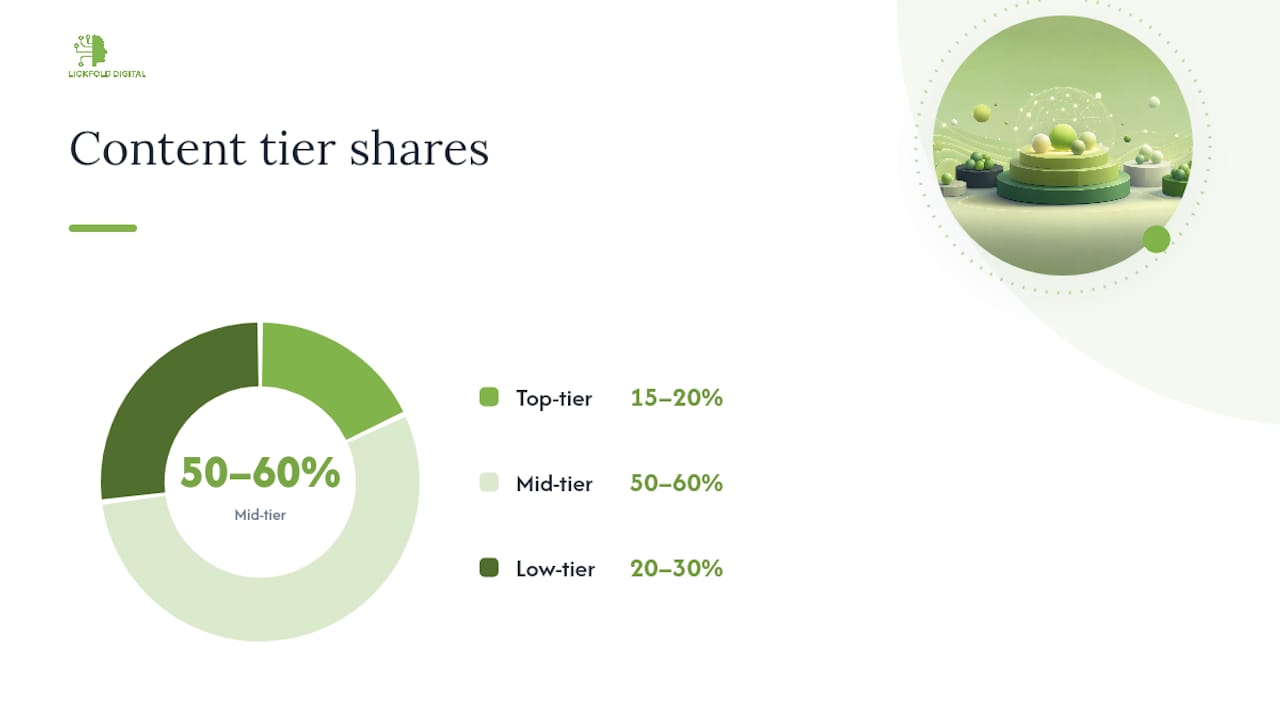
A workable tiering split, based on how content teams structure output to protect a quality floor while scaling volume:
- Top-tier (roughly 15 to 20% of output): strategic, competitive-intent pieces with full SME review and original research
- Mid-tier (roughly 50 to 60%): AI-assisted drafts with editor oversight, covering supporting cluster topics
- Low-tier (roughly 20 to 30%): template-driven, faster-turnaround pages for long-tail or informational queries
Modular content is the other lever most teams underuse. Instead of writing one long guide and moving on, splinter it: pull out a data point for a LinkedIn post, a section for a standalone FAQ page, a table for a comparison piece. One well-researched core asset can seed four or five smaller pieces without repeating the research phase. This is where pairing AI drafting with personalization earns its keep. AI handles the first pass and the repetitive structural work, humans handle the judgment calls, and nobody wastes a rewrite cycle on a draft that never had a real angle.
What Is Cluster-Based Velocity and Why Does It Beat Scattered Publishing?
Concentrating your publishing output inside a single topic cluster builds topical authority faster than spreading the same volume across unrelated subjects. Cluster-focused velocity consistently outpaces scatter publishing because search engines and AI systems both reward depth signals over breadth signals when they’re evaluating who actually knows a topic.
The sequencing that tends to work:
- Hub first. Publish the comprehensive, high-intent pillar page that anchors the cluster.
- Supporting nodes next. Push out several closely related subtopic pages in quick succession, each linking back to the hub and to each other.
- Bridge content last. Once the cluster is dense, add pieces that connect it to an adjacent cluster, extending your authority outward rather than starting cold in a new topic.
Watch for saturation signals before you keep piling on pages. Redirect velocity toward the next cluster instead of squeezing a saturated one for marginal returns. A phased approach to building authority works the same way at the domain level: depth in one area before expansion into the next.
How Often Should You Prune, Consolidate, and Update Content?
Publishing new pages without maintaining old ones is how sites quietly lose the ground they gained. Refreshing an existing page in positions 5 through 20 often produces a faster ranking lift than publishing something brand new, because the page already has some authority and indexing history working in its favor.
A workable maintenance cadence:
- Run a quarterly audit flagging orphan pages, thin content, and anything sitting in positions 5 to 20 that hasn’t been touched in six months.
- Set a rule of thumb: allocate at least 20 to 30% of monthly velocity to updates rather than net-new pages, especially once a cluster matures.
- Watch for negative signals like falling click-through rates or sudden ranking drops across multiple pages, and be willing to pause new publishing to investigate before pushing more volume into a cluster showing strain.
Which Tools and KPIs Actually Track Content Velocity?
You need four tool categories to run this properly: crawl and publish-date extraction tools to track how fast new pages get indexed, visibility trackers for ranking and impression data, a content ops platform to manage the pipeline itself, and an internal-link analysis tool to catch orphan pages before they become a problem.
The KPI set worth putting on a dashboard:
- Rolling 30-day quality rate (percentage of pieces passing your rubric)
- Topic velocity by cluster (active clusters receiving content vs. dormant ones)
- Time-to-first-impression, tracked monthly
- Visibility stability (percentage of pages holding rank at 60 days)
A workflow automation approach to content operations can help formalize these checkpoints so they don’t rely on someone remembering to check a spreadsheet.
A 90-Day Starter Plan for Scaling Content Velocity Safely
Days 1 to 30: Audit existing content, define your quality rubric, and set baseline metrics for pipeline speed and time-to-first-impression.
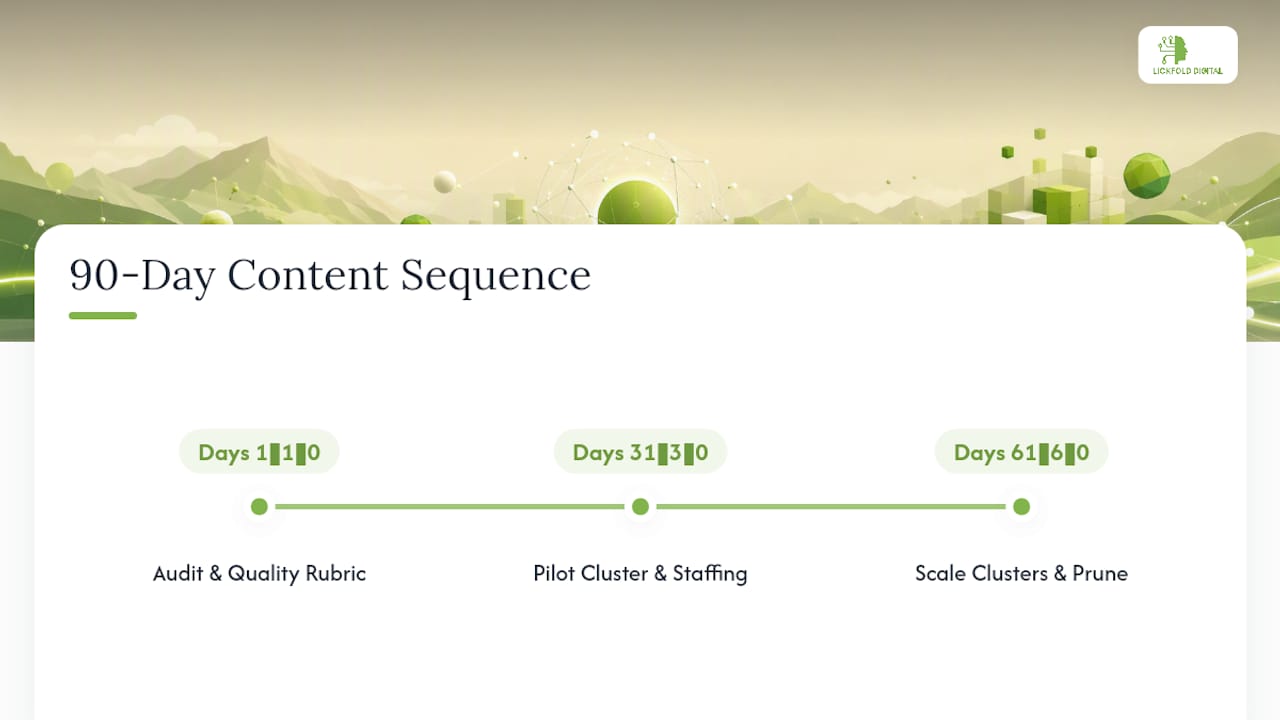
Days 31 to 60: Pilot cluster-based velocity on one topic area using modular assets and a tiered staffing mix.
Days 61 to 90: Scale velocity within proven clusters and formalize a pruning cadence based on what the pilot revealed.
Lickfold Digital’s own content production work follows this exact sequence with B2B clients, pairing daily publishing capacity with human QA gates so speed never outruns the quality floor. Early success looks like a rising quality rate alongside growing topic velocity, not just a bigger publishing count.
Author Perspective: Balancing Speed and Rigor
Set the quality floor first. Everything else is negotiable. That’s the stance this entire framework rests on, and it holds up because the data backs a hybrid model over either extreme. Lickfold Digital’s own content operations run on daily publishing paired with human review before anything ships, which is the only version of “fast” worth building a strategy around.
What doesn’t get said enough: pruning isn’t cleanup work you get to eventually. Skip it, and your velocity gains erode within two quarters, quietly, without an obvious trigger.
— Duarte
How Lickfold Digital Helps You Scale Content Velocity Safely
Most agencies force a choice between fast and good. Lickfold Digital builds the pipeline so you don’t have to choose: AI agents handle research and first drafts, human editors enforce the quality floor, and daily publishing capacity means your topic clusters fill in weeks instead of quarters.

The service covers automated SEO content production, editorial routing with SME checkpoints, technical audits to catch the orphan pages and cannibalization issues before they cost you rankings, and ongoing reputation management for the outreach infrastructure that often accompanies a content push. The outcome most clients care about: faster time-to-publish without the quality collapse that usually comes with it, tracked against real visibility metrics rather than raw output counts.
If your current publishing cadence feels stuck between “too slow to matter” and “too risky to scale,” request a content audit and see where your pipeline is actually losing time.
Sources
- Content Velocity vs Content Quality: What Google Rewards Now
- Content Velocity: What It Means and Why It Matters Now
- Content Velocity vs Quality: Finding the Right SEO Mix in 2026
- Content Velocity Planning with Clusters: The Data-Driven Framework for 2026