
B2B Sales Enablement Tools: Your 2026 AI Guide
B2B Sales Enablement Tools: Your 2026 AI Guide
TL;DR:
- Sales enablement tools supply sales teams with content, coaching, and analytics to close deals faster. AI-powered platforms unify content creation, real-time coaching, and data insights, reducing costs and increasing speed. Effective implementation depends on matching tools to deal size and ensuring ongoing content maintenance.
B2B sales enablement tools are defined as platforms that equip sales teams with the content, coaching, and analytics they need to close deals faster. The best sales enablement tools today are AI-powered platforms that centralize content creation, deliver personalized coaching, and surface real-time insights at every stage of the buyer journey. AI-driven content generation can increase marketing asset delivery speed by up to 4x while reducing enablement tech spend by up to 80% through tool consolidation. That single shift explains why sales leaders are replacing stacks of disconnected point solutions with unified platforms built around AI. Lickfold works at this intersection, using AI agents to automate prospecting and outreach so your sales team focuses on closing, not searching.
1. What key features should you look for in B2B sales enablement tools?
The most important features in any sales enablement platform are AI content generation, real-time coaching, and integrated analytics. Without all three, you are buying a partial solution.

AI content generation produces personalized sales assets at scale. A rep preparing for a CFO meeting should be able to pull a tailored one-pager in minutes, not days. Platforms that reduce agency reliance by generating on-brand content internally cut both cost and turnaround time.
Real-time coaching gives reps live guidance during calls. Integrated AI coaching compresses rep ramp time from quarters to weeks by simulating real sales scenarios before they happen in front of a prospect.
Analytics dashboards close the loop between content and revenue. AI-powered analytics let sales leaders attribute pipeline growth to specific assets, so you know which case study actually moved a deal forward.
Additional features worth evaluating:
- Content libraries indexed by deal stage so reps find the right asset at the right moment
- CRM integration that keeps data flowing without manual entry
- White-labeling to maintain brand consistency across all buyer touchpoints
- Multi-channel delivery covering email, video, and digital sales rooms
Pro Tip: Before evaluating any platform, list the three biggest friction points in your current sales process. Only shortlist tools that directly address all three.
2. Which B2B sales teams benefit most from each tool category?
Deal size determines which type of sales enablement platform fits your team. This is the most overlooked factor in tool selection.
High-velocity SMB teams with low average contract values need self-serve, automated platforms. These teams run high call volumes, short sales cycles, and need content that deploys instantly without customization. Automation handles follow-ups, sequences, and content delivery without adding headcount.
Enterprise and account-based teams with large deal sizes need something different. They require deep conversation intelligence, mutual action plans, and buyer engagement tracking across multiple stakeholders. A single enterprise deal may involve six to ten decision-makers, each needing tailored messaging.
“Deal size dictates enablement tool choice. High-velocity SMB teams need automated tools, while enterprise teams require account-based solutions with deep insights.” — B2B Sales Strategy, B2BNN
Mid-market teams often sit between these two categories. They benefit from platforms that offer automation for routine outreach and account-based features for strategic deals. The risk for mid-market teams is buying enterprise complexity they cannot staff or buying SMB tools that cap their growth.
Operational considerations matter as much as features. Content curation requires dedicated resources to stay effective. A team without someone owning content quality will see reps revert to outdated decks and off-brand messaging within months.
3. Ten leading functionalities of the best sales enablement platforms
The following capabilities separate high-performing platforms from basic content repositories.
-
AI content generation and personalization. The platform creates tailored assets for each buyer persona, deal stage, and industry vertical without requiring a designer or copywriter for every request.
-
Digital sales rooms. A dedicated, branded space where buyers and sellers collaborate on documents, timelines, and next steps. Digital sales rooms combined with AI coaching accelerate deal closure by keeping all stakeholders aligned in one place.
-
AI coaching and live call support. Real-time prompts during calls surface objection-handling scripts, competitive positioning, and relevant case studies the moment a rep needs them.
-
Mutual action plans. A shared timeline between buyer and seller that maps milestones, owners, and deadlines. This reduces deal slippage by making next steps explicit for both sides.
-
Content libraries searchable by deal stage. Indexing assets by deal stage means a rep in discovery pulls different content than a rep in negotiation. Relevance at each phase improves seller effectiveness.
-
Pipeline and deal analytics with attribution. Leaders see which assets influence pipeline, which reps use content most effectively, and where deals stall. Attribution connects enablement activity to revenue outcomes.
-
Multi-channel content delivery. Top platforms push content across email, LinkedIn, video, and in-app channels from a single workflow. Buyers receive consistent messaging regardless of where they engage.
-
White-labeling and brand consistency. Every buyer-facing asset carries your brand, not the platform’s. This matters most for enterprise teams where brand perception affects deal credibility.
-
CRM and sales tool integration. Bi-directional sync with your CRM keeps contact records, deal stages, and activity logs current without manual updates. Reps spend time selling, not entering data.
-
Automated follow-up and personalized messaging. The platform triggers follow-up sequences based on buyer behavior, such as when a prospect opens a proposal or revisits a pricing page. Lickfold’s AI agents operate on this same principle, executing personalized multi-touch outreach continuously across target accounts.
Pro Tip: Prioritize platforms with native CRM integration over those requiring third-party connectors. Every additional integration point is a potential failure point in your workflow.
| Functionality | Primary benefit |
|---|---|
| AI content generation | Faster asset creation without agency dependency |
| Digital sales rooms | Centralized buyer-seller collaboration |
| AI coaching | Faster rep ramp time |
| Deal analytics with attribution | Connects content to revenue |
| Automated follow-up | Higher response rates with less manual effort |
4. How sales enablement tools improve ROI and reduce technology spend
The financial case for consolidating onto an AI-powered platform is direct. AI-driven platforms reduce dependence on slow, costly creative agencies and multiple disconnected tools. That reduction shows up immediately in both budget and speed.
Content shipping speed increasing by 4x means your sales team responds to buyer requests in hours instead of days. In competitive deals, that speed advantage is often the difference between winning and losing a shortlist evaluation.
The 80% reduction in enablement tech spend comes from consolidation. Most sales teams run separate tools for content management, coaching, analytics, and sequencing. A unified platform replaces four or five subscriptions with one. The savings fund headcount, not software licenses.
Specific areas where costs drop:
- Reduced agency fees for content production
- Fewer software subscriptions across the stack
- Lower onboarding costs as ramp time shrinks
- Less time spent on manual reporting and data reconciliation
AI-driven insights also improve conversion rates by showing reps exactly which content moves buyers forward. When a rep knows that a specific ROI calculator closes deals 30% faster in the manufacturing vertical, they use it every time. That kind of data-driven behavior compounds over an entire sales team.
For teams exploring AI-powered prospecting workflows, the ROI calculation extends beyond enablement into pipeline generation itself.
5. Emerging trends in sales enablement platforms for 2026 and beyond
The next generation of sales enablement software is moving from content storage to active deal participation. These trends define where the category is heading.
-
AI agents in prospecting and engagement. AI agents now identify decision-makers, research accounts, and execute personalized outreach without human intervention at each step. Lickfold deploys this model at scale, running continuous outbound campaigns that feed qualified leads directly to sales teams. For a deeper look at how this works in practice, the AI agents use cases guide covers real deployment scenarios.
-
Personalized training pathways. AI coaching platforms now build individual learning plans based on each rep’s call recordings, win rates, and skill gaps. Generic sales training is being replaced by targeted development tied to actual performance data.
-
Expanded digital sales rooms. Buyers increasingly expect a collaborative workspace, not a PDF attachment. Digital sales rooms are becoming the default format for complex B2B deals, especially in enterprise accounts with multiple stakeholders.
-
Multi-channel enablement workflows. Effective B2B sales strategies now require coordinated messaging across email, LinkedIn, video, and phone. Platforms that manage all channels from a single interface give teams a significant execution advantage.
-
Tool consolidation as a strategic priority. The era of best-of-breed point solutions is ending for most teams. Unifying disparate tools with AI reduces complexity, lowers cost, and improves data quality across the sales organization.
-
Ongoing content curation as a core function. Platforms require dedicated ownership of content quality. Teams that treat content as a one-time setup project see rep adoption collapse within six months.
Key takeaways
The most effective B2B sales enablement tools combine AI content generation, real-time coaching, and deal analytics into a single platform that reduces tool sprawl and accelerates revenue.
| Point | Details |
|---|---|
| Match tool complexity to deal size | SMB teams need automation; enterprise teams need account-based depth and conversation intelligence. |
| Prioritize AI coaching | Integrated coaching compresses rep ramp time from quarters to weeks. |
| Consolidate your tech stack | Unified platforms can reduce enablement tech spend by up to 80% versus running multiple tools. |
| Own content curation | Dedicated resources for content upkeep prevent rep burnout and brand inconsistency. |
| Attribute content to revenue | Analytics that link specific assets to pipeline growth make enablement measurable and defensible. |
What I’ve learned from watching teams implement these platforms
Sales leaders consistently underestimate the content maintenance problem. They buy a platform, load it with assets, and declare victory. Six months later, reps are ignoring the library because half the content is outdated and the other half was never organized well to begin with.
The teams that get real value from sales enablement software treat content curation as an ongoing function, not a launch task. Someone owns it. That person has time allocated to it. Content gets reviewed on a schedule. That discipline separates teams with 80% platform adoption from teams with 20%.
The second mistake I see is buying for the demo, not for the workflow. A platform that looks impressive in a 45-minute demo can be completely wrong for a team running 200 calls a week. Always test against your actual sales motion, not a hypothetical one the vendor designed to show their strengths.
AI coaching is the feature most teams underuse. Reps resist it initially because it feels like surveillance. The teams that frame it as personal development rather than performance monitoring see adoption rates climb fast. Once a rep hears their own call back with coaching overlaid, the resistance usually disappears.
The top AI sales tips that actually move numbers are almost always about consistency, not sophistication. A simple AI-assisted follow-up sequence run every day beats a complex workflow that no one maintains.
— Duarte
How Lickfold fits into your sales enablement strategy
Lickfold builds the front end of your sales pipeline so your enablement tools have qualified leads to work with.
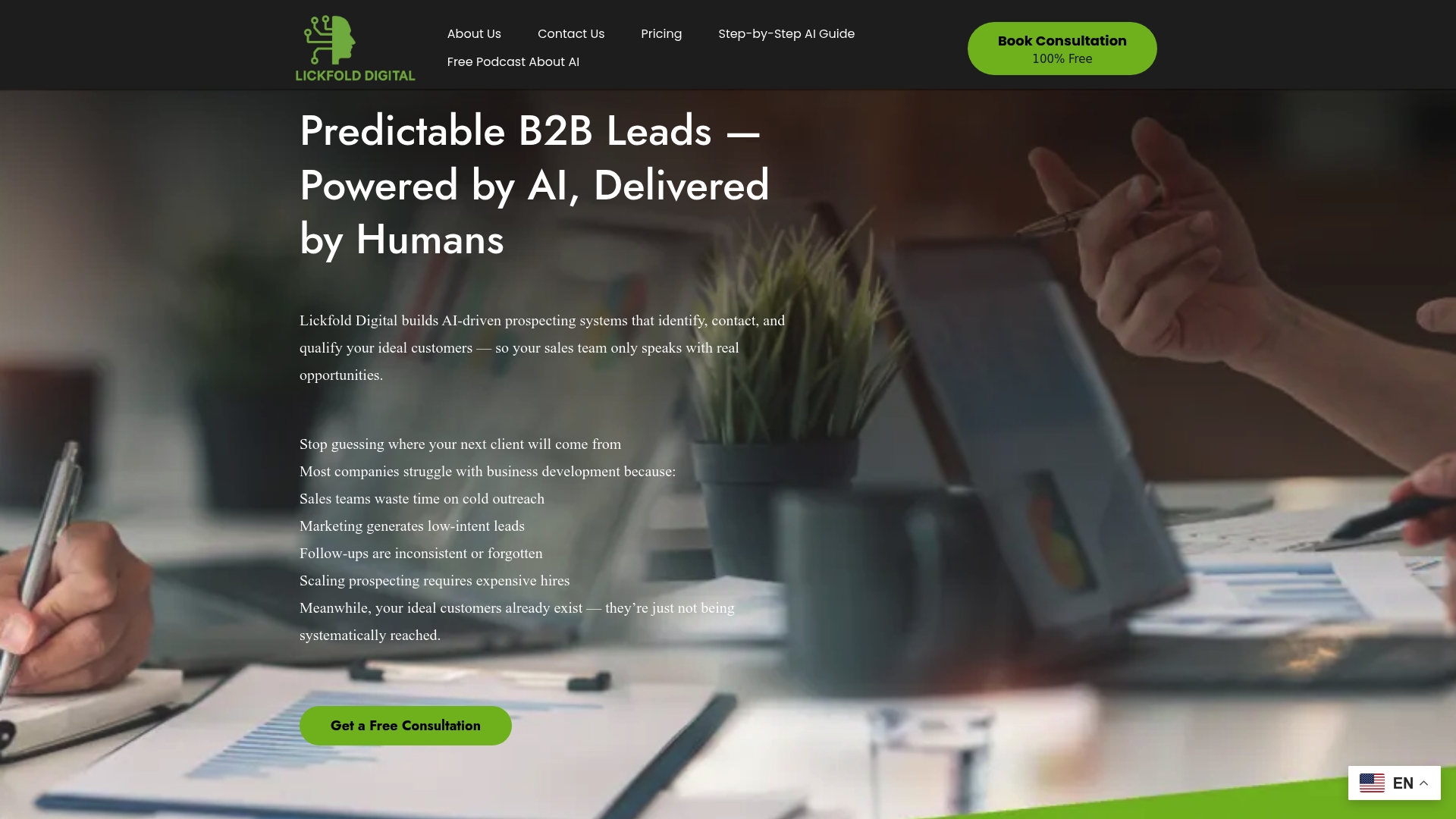
Lickfold deploys AI agents that identify decision-makers matching your ideal customer profile, execute personalized multi-touch outreach, and hand off warm, human-qualified leads to your sales team. The system runs continuously, maintaining email deliverability and reputation management so your outreach reaches inboxes, not spam folders. When your sales enablement platform receives a lead from Lickfold, that lead is already engaged and expecting a conversation. That combination of AI-driven prospecting and strong enablement content is where conversion rates move. Reach out to Lickfold to see how the system fits your current sales motion.
FAQ
What are B2B sales enablement tools?
B2B sales enablement tools are platforms that provide sales teams with content, coaching, and analytics to close deals more effectively. The best platforms combine AI-driven content generation, real-time coaching, and pipeline attribution in a single system.
How do I choose the right sales enablement platform?
Match platform complexity to your average deal size. Low ACV teams need automated, self-serve tools, while enterprise teams require account-based platforms with deep conversation intelligence and buyer engagement tracking.
Can sales enablement software reduce costs?
AI-powered platforms can reduce enablement tech spend by up to 80% by consolidating content management, coaching, analytics, and sequencing tools into one subscription.
How long does it take for reps to ramp on a new platform?
Integrated AI coaching compresses rep ramp time from quarters to weeks by simulating real sales scenarios and providing live call guidance from day one.
What is a digital sales room?
A digital sales room is a branded, collaborative workspace where buyers and sellers share documents, track milestones, and align on next steps. Combined with AI coaching, digital sales rooms accelerate deal closure in complex B2B sales cycles.