
B2B Sales Automation Software Comparison for Revenue Teams
B2B Sales Automation Software Comparison for Revenue Teams
TL;DR:
- Lickfold Digital offers a managed, AI-driven outbound pipeline optimized for lean B2B sales teams. Traditional stack-based platforms require extensive setup and internal RevOps, which managed services can bypass for quicker results. The best platform choice depends on team size, CRM, and capacity for infrastructure management.
For US B2B teams that want a managed, AI-driven outbound pipeline with fast time-to-value, Lickfold Digital is the recommended choice. For enterprise Salesforce shops that need deep forecasting and conversation intelligence, a CRM-native sales engagement platform like Outreach or Salesloft fits better. For startups and SMBs that need data plus outreach under one contract, Apollo.io or HubSpot CRM are the practical starting points.
TL;DR shortlist:
- Lickfold Digital — best for B2B service firms and lean sales teams that want a fully managed outbound pipeline with AI agents, deliverability infrastructure, and human reply qualification, without building RevOps from scratch
- HubSpot CRM — best for growing teams that want CRM plus outreach in a single platform with straightforward onboarding
- Salesforce (Sales Cloud / Einstein) — best for enterprise revenue teams anchored on Salesforce that need robust pipeline management and forecasting
- Apollo.io — best for startups and mid-market teams wanting contact data plus engagement in one affordable platform
- Outreach / Salesloft — best for mid-market to enterprise teams that prioritize structured cadences, rep coaching, and Salesforce integration
AI-native autonomous agents can reduce setup time from weeks to hours compared with traditional rule-based systems. That single variable separates the 2026 shortlist from the prior generation of sales engagement platforms.
Table of Contents
- How does this B2B sales automation software comparison stack up?
- How do you choose the right sales automation platform for your team?
- Short profiles of every platform buyers commonly evaluate
- How we evaluated these platforms
- What Lickfold Digital’s AI outbound approach looks like in practice
- Key Takeaways
- When does a managed service beat a self-serve platform?
- Lickfold Digital delivers a managed outbound pipeline, not just software
- Further reading and primary sources
How does this B2B sales automation software comparison stack up?
The table below covers the most decision-relevant dimensions for US revenue teams. Rows are ordered by buyer profile, starting with Lickfold Digital.
| Tool | Best for | Key automation features | AI capabilities | Starting price | Integrations | Onboarding time | Data quality | Support / managed | Scalability | Security & compliance |
|---|---|---|---|---|---|---|---|---|---|---|
| Lickfold Digital | Managed AI outbound, lean teams | Multi-touch sequences, email warm-up, reputation mgmt | Autonomous AI agents, human-in-the-loop qualification | Tiered subscription | CRM sync (bi-directional) | Days | Managed, curated prospecting | Fully managed | High | SOC-aligned infrastructure |
| HubSpot CRM | Growing SMB/mid-market teams | Sequences, workflows, deal automation | Breeze AI assistant | Free tier; paid from ~$15/seat/mo | Native: Gmail, Outlook, Slack, Salesforce | 1–3 days | Enrichment via integrations | Self-serve + support tiers | High | SOC 2, GDPR |
| Salesforce (Sales Cloud) | Enterprise CRM-anchored teams | Flows, cadences, CPQ, forecasting | Einstein AI (scoring, forecasting, generative) | ~$25/seat/mo (Starter) | AppExchange ecosystem | 2–4 weeks | Via ZoomInfo/Clearbit add-ons | Enterprise support tiers | Very high | SOC 2, ISO 27001 |
| Apollo.io | Startups, mid-market outbound | Sequences, dialer, enrichment | AI email writer, scoring | Free tier; paid from ~$49/mo | HubSpot, Salesforce, Zapier | Hours–1 day | large contact database (self-reported) | Self-serve | Medium–High | SOC 2 |
| Outreach | Enterprise cadence + forecasting | Cadences, mutual action plans, forecasting | Kaia AI assistant, deal health | Custom pricing | Salesforce-first | 2–4 weeks | Via ZoomInfo/Clearbit | Dedicated CSM | Very high | SOC 2, ISO 27001 |
| Salesloft | Mid-market to enterprise coaching | Cadences, dialer, coaching workflows | AI deal insights, conversation intelligence | Custom pricing | Salesforce, HubSpot, Gong | 2–3 weeks | Via integrations | Dedicated CSM | Very high | SOC 2, ISO 27001 |
| ZoomInfo | Enterprise data + intent | Contact enrichment, intent signals, workflows | AI-powered scoring, GTM Context Graph | Custom (enterprise) | Salesforce, HubSpot, Outreach | 1–2 weeks | Industry-leading verified coverage | Enterprise support | Very high | SOC 2, ISO 27001 |
| Gong | Conversation intelligence | Call recording, deal signals, coaching | AI deal risk, topic detection | Custom pricing | Salesforce, HubSpot, Zoom | 1–2 weeks | Conversation data only | Dedicated CSM | High | SOC 2, GDPR |
| Clari | Pipeline forecasting | Revenue forecasting, pipeline analytics | AI forecast models | Custom pricing | Salesforce, HubSpot | 1–2 weeks | Activity signals | Enterprise support | High | SOC 2 |
| Pipedrive | Small teams, visual pipelines | Pipeline automation, email sequences | AI sales assistant | From ~$14/seat/mo | hundreds of integrations | Hours–1 day | Via LeadBooster add-on | Self-serve + chat | Medium | SOC 2 |
| monday CRM | Flexible workflow teams | Automation recipes, board-based pipelines | AI assistant (beta) | from low per-seat cost | Zapier, Slack, HubSpot | Hours–1 day | Via integrations | Self-serve + support | Medium–High | SOC 2, ISO 27001 |
| DealHub / DealHub AI | CPQ and quoting teams | CPQ, quoting, contract workflows | AI-assisted pricing, deal guidance | Custom pricing | Salesforce, HubSpot | 1–2 weeks | N/A (quoting layer) | Dedicated support | High | SOC 2 |
| LinkedIn Sales Navigator | Social-selling, relationship-led | Lead lists, InMail, account alerts | AI-recommended leads | From ~$99/seat/mo | Salesforce, HubSpot, Outreach | Hours | LinkedIn graph | Self-serve | Medium–High | LinkedIn enterprise controls |
| Reply.io | SMB multi-channel outreach | Email + LinkedIn + call sequences | AI email assistant, Jason AI | From ~$49/mo | HubSpot, Salesforce, Zapier | Hours–1 day | Via integrations | Self-serve + chat | Medium | SOC 2 |
| ActiveCampaign | SMB email automation | Email automation, CRM, lead scoring | AI predictive sending | From ~$15/mo | hundreds of integrations | Hours–1 day | Via integrations | Self-serve + support | Medium | SOC 2, GDPR |
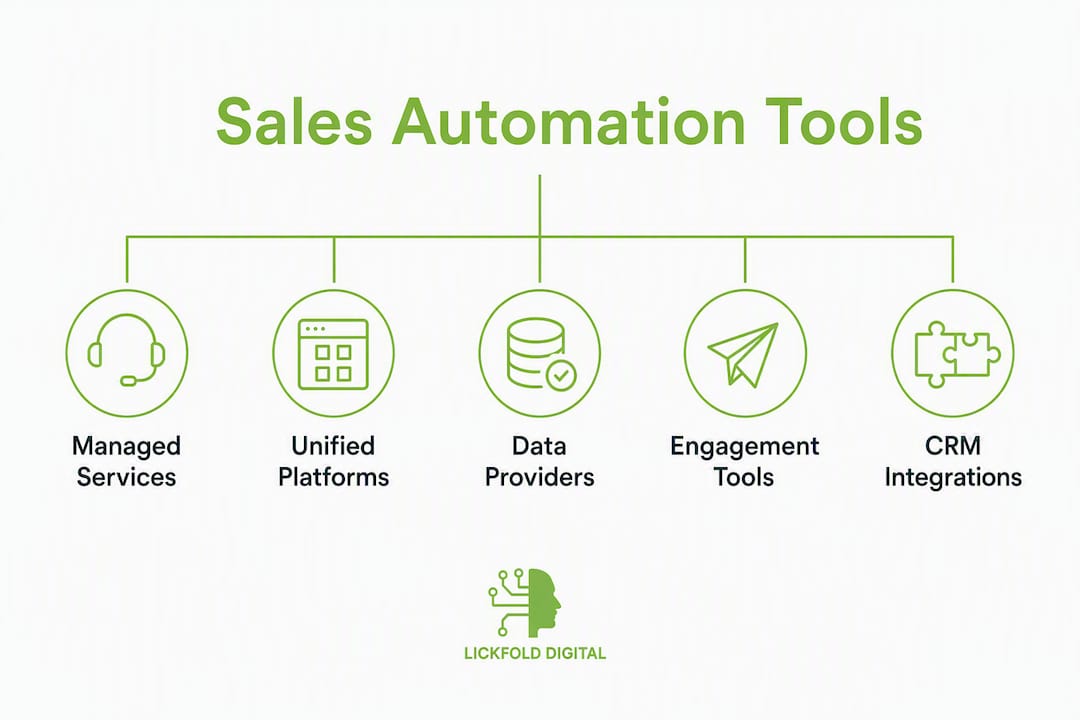
TCO snapshot: For a 25-rep team, a unified platform like HubSpot or Apollo typically costs significantly less annually than a best-of-breed stack that includes SEP, data provider, enrichment, and dialer components. Fragmented stacks often incur a multiple of the total cost of ownership compared with unified platforms. Managed services like Lickfold Digital replace much of that stack with a single subscription, which changes the cost model significantly for lean teams.
How to read this table: Rule vendors in or out first on AI depth and data quality, then on integration anchor (what CRM you already run), then on onboarding time relative to your POC window.
How do you choose the right sales automation platform for your team?
Pick by motion and scale first. A managed AI outbound service fits lean teams with no RevOps staff. A CRM-native sales engagement platform fits Salesforce-anchored enterprise teams. A bundled data-plus-engagement tool fits SMBs that need speed over customization.
Diagnostic checklist before you demo anything:
- Team size: under 10 reps, 10–50, or 50+?
- Sales motion: outbound-led, inbound-led, or hybrid?
- CRM anchor: Salesforce, HubSpot, or no CRM yet?
- RevOps capacity: dedicated ops team, part-time admin, or none?
- Deliverability needs: do you have warmed sending infrastructure, or do you need it managed?
- TAM geography: US-only, or do you need EMEA-compliant data (GDPR)?
Questions to ask vendors during demos:
- How does your AI agent hand off a qualified lead to a human rep, and what triggers that handoff?
- What is your data verification cadence, and what percentage of contacts are phone-verified?
- Can you show deliverability rates from a live customer account?
- What CRM objects does your sync write back, and is it bi-directional?
- What security certifications do you hold, and when was your last penetration test?
- What is the all-in annual cost at our rep count, including data, support, and add-ons?
Red flags to watch for:
- Data sold separately from the sequencing tool, requiring a second contract and integration
- AI described as “assistant” only, with no autonomous agent capability
- Setup time quoted as “4–6 weeks” with no dedicated onboarding engineer
- Pricing that scales by contact volume rather than seat, making costs unpredictable
- No clear SLA for data accuracy or deliverability
Decision path by team profile:
- 1–10 reps, no CRM, outbound-led → Lickfold Digital (managed) or Apollo.io (self-serve); avoid enterprise SEPs entirely
- 10–30 reps, HubSpot anchor → HubSpot Sales Hub or Apollo.io; HubSpot and Apollo often deliver similar outcomes at a fraction of the TCO for teams under 30–50 reps
- 30–75 reps, Salesforce anchor → Outreach or Salesloft; add ZoomInfo for data if budget allows
- 75+ reps, enterprise → Salesforce Sales Cloud + Einstein, Outreach or Salesloft, Gong, ZoomInfo; budget for 2–4 weeks onboarding per tool
- Any size, no RevOps, needs fast pipeline → Lickfold Digital managed service; skip the stack-building phase entirely
Short profiles of every platform buyers commonly evaluate
Lickfold Digital
Lickfold Digital runs a fully managed AI-driven outbound operation on your behalf. Dedicated AI agents handle prospect research, decision-maker mapping, and personalized multi-touch outreach. Critically, human specialists qualify every reply before a lead reaches your sales team, eliminating the noise problem that plagues self-serve sequencing tools. The infrastructure includes dedicated warm-up email accounts and ongoing reputation management, so deliverability is maintained rather than assumed.
Best for: B2B service firms, agencies, and sales-driven teams that want a predictable outbound pipeline without hiring a RevOps team or stitching together a stack. Pricing: tiered subscription (contact Lickfold for current plan details). Onboarding: days, not weeks. Pros: no tool sprawl, managed deliverability, human-in-the-loop qualification. Cons: less DIY control than self-serve platforms; not suited for purely inbound teams.
HubSpot CRM
HubSpot bundles CRM, email sequences, deal automation, and the Breeze AI assistant into one platform. The free tier is genuinely useful, and paid plans scale without requiring a separate data contract. Onboarding is fast, typically one to three days for a small team.

Pros: single platform reduces integration overhead; strong onboarding resources. Cons: advanced features require higher-tier plans that can get expensive at scale.
Salesforce (Sales Cloud / Einstein)
Salesforce remains the enterprise standard for pipeline management, forecasting, and CRM depth. Einstein adds AI-powered scoring, generative email drafts, and predictive forecasting. The AppExchange ecosystem means almost any tool integrates natively. Setup takes 2–4 weeks for complex configurations.
Pros: unmatched integration ecosystem; best-in-class forecasting. Cons: high TCO; requires dedicated admin or RevOps to maintain.
Apollo.io
Apollo combines a large contact database (self-reported) with built-in sequencing, a dialer, and an AI email writer. For teams under 30 reps, it often covers 80% of what a separate SEP and data provider would deliver at a fraction of the cost. The free tier lets teams validate the data quality before committing.

Pros: data plus engagement in one contract; competitive pricing. Cons: data freshness varies by segment; enterprise support is limited on lower tiers.
monday CRM
monday CRM sits on top of the monday.com Work OS, giving sales teams customizable boards, automation recipes, and pipeline views. It suits teams that run nonstandard sales processes or want project-style deal management. The AI assistant is still maturing.
Pros: highly flexible; fast setup. Cons: less purpose-built for outbound than dedicated SEPs.
Pipedrive
Pipedrive’s visual pipeline and drag-and-drop deal management make it the fastest CRM to set up for a small team. The AI sales assistant surfaces next-step suggestions. At roughly $14/seat/month on the Essential plan, it is one of the lowest-cost CRM options with automation included.
Pros: fast time-to-value; low per-seat cost. Cons: limited native data sourcing; scales less gracefully past 20–30 reps.
DealHub and DealHub AI
DealHub focuses on CPQ and quoting automation, sitting between the CRM and the contract. DealHub AI adds pricing guidance and deal-stage recommendations. For teams where proposal generation and approval workflows create closing friction, it removes a real bottleneck.
Pros: reduces quote-to-close time; strong Salesforce and HubSpot integration. Cons: not a prospecting or sequencing tool; requires a CRM anchor.
LinkedIn Sales Navigator
Sales Navigator gives reps access to LinkedIn’s relationship graph for lead discovery, InMail outreach, and account alerts. It is most valuable when your buyers are active on LinkedIn and relationship context matters. At roughly $99/seat/month, it is a supplementary tool, not a full outreach platform.
Pros: unmatched relationship context; integrates with most CRMs. Cons: InMail volume is capped; works best alongside a sequencing tool.
ListKit
ListKit focuses on fast B2B list building and export for outbound SDRs. Teams use it to generate targeted prospect lists quickly, then push those lists into their sequencing tool of choice. It is a data sourcing layer, not a full engagement platform.
Clari
Clari is a pipeline intelligence and forecasting platform built for revenue leaders, not individual reps. It ingests CRM activity, email, and calendar data to produce AI-driven forecast models. If forecast accuracy is your primary pain point, Clari addresses it directly.
Leadfeeder
Leadfeeder identifies companies visiting your website and converts those intent signals into outbound plays. It is most useful for teams with meaningful site traffic who want to prioritize accounts showing active interest. Without sufficient traffic, the signal volume is too low to drive a pipeline.
Gong
Gong records and analyzes sales calls, surfaces deal-risk signals, and generates coaching recommendations. It is the market leader in conversation intelligence. Most enterprise teams use it alongside a CRM and SEP rather than as a standalone tool.
Yesware
Yesware is a lightweight email tracking and outreach add-on for Gmail and Outlook. Individual sellers and small teams use it to run basic cadences without leaving their inbox. It is not a full SEP, but it is fast to deploy and low-cost.
Salesflare
Salesflare automates contact enrichment and data capture for small, relationship-driven teams. It pulls data from email, calendar, and LinkedIn to keep the CRM current without manual entry. A good fit for consultants and small agencies.
LeadFuze
LeadFuze generates targeted prospect lists on demand using firmographic and technographic filters. It is a list-building tool, similar in function to ListKit, and is typically used to feed a separate sequencing platform.
Autoklose
Autoklose pairs a contact database with email sequence automation at a price point accessible to cost-sensitive SMBs. The integrated model reduces the need for a separate data contract, though data coverage is narrower than ZoomInfo or Apollo.
Ringover
Ringover provides cloud telephony and call automation integrated with sales workflows. Teams that run high-volume outbound calling alongside email sequences use it to consolidate their dialer within their existing stack.
Kendo.ai
Kendo.ai is an AI-powered outreach assistant focused on personalized content generation at scale. It uses AI prompts to draft and vary outreach messages across channels, reducing the time reps spend writing cold emails.
DocuSign
DocuSign is the industry-standard eSignature and contract workflow platform. Most enterprise sales teams already have it. It integrates with Salesforce, HubSpot, and most CRMs to automate the contract-to-close step.
Fill
Fill handles proposal and document automation, with templating features that speed up proposal generation. It is typically used alongside a CPQ tool or CRM rather than as a standalone platform.
Proposify
Proposify offers proposal templates, client-facing analytics, and e-signature integrations. Agencies and service firms that send proposals frequently use it to track client engagement and identify when a prospect is reviewing a proposal.
Seismic
Seismic is an enterprise sales enablement platform that centralizes content libraries, personalizes materials at scale, and tracks content usage. It is built for large field and inside sales teams with complex content governance requirements.
Showpad
Showpad handles sales content management and distribution for field and inside sellers. It tracks which content reps share and how buyers engage with it, giving sales managers visibility into content-driven deal progression.
Calendly
Calendly automates meeting scheduling, reducing the back-and-forth that delays demo bookings. It integrates with most CRMs and calendar systems. Nearly every sales team uses it or a direct equivalent.
Drift
Drift runs conversational marketing playbooks on your website, qualifying inbound leads via chat and routing them to reps in real time. It is most effective when combined with an outbound motion, not as a standalone pipeline source.
Chili Piper
Chili Piper specializes in instant scheduling and routing for inbound leads, cutting the time between a form submission and a rep conversation. For high-inbound-volume teams, the speed improvement directly affects conversion rates.
People.ai
People.ai captures rep activity across email, calendar, and calls, then maps that activity to CRM records for attribution and productivity analysis. Revenue ops teams use it to understand which activities actually drive pipeline.
Better Proposals
Better Proposals focuses on fast proposal creation with client-facing analytics showing when a prospect opens, reads, or shares a proposal. Service firms that send frequent proposals use it to prioritize follow-up.
Kommunicate
Kommunicate provides chat automation with human escalation rules for lead qualification and customer support. Teams use it to handle initial qualification at scale before routing high-intent leads to a human rep.
Overloop (formerly Prospect)
Overloop combines list building and email sequencing in a single small-team toolset. It is a compact alternative to running a separate data tool and sequencing platform, suited for SMB outbound teams.
Skrapp
Skrapp finds and verifies email addresses from LinkedIn profiles, converting Sales Navigator lists into outreach-ready contacts. It is a point tool used to enrich lists before loading them into a sequencing platform.
Method CRM
Method CRM is a customizable CRM with deep QuickBooks integration, suited for SMB teams that need their sales pipeline and accounting data to stay in sync. It is a niche fit, not a general-purpose SEP.
ZoomInfo
ZoomInfo provides enterprise-grade B2B contact data, technographics, and intent signals. Its GTM Context Graph enriches account records with buying signals. Premium data coverage is a high-leverage investment because better data improves deliverability and reply rates directly. Pricing is custom and typically enterprise-level.
Outreach
Outreach is a full sales engagement platform with cadence automation, mutual action plans, conversation intelligence via Kaia, and forecasting. It is Salesforce-first and best suited to teams with a dedicated RevOps function to configure and maintain it.
Salesloft
Salesloft combines cadences, a dialer, coaching workflows, and conversation intelligence into a revenue orchestration platform. It competes directly with Outreach and is often preferred by teams that weight rep coaching over raw cadence volume.
Clearbit
Clearbit provides firmographic enrichment and intent data to improve lead routing and personalization. It is commonly used as a data layer that feeds into HubSpot or Salesforce rather than as a standalone tool.
Lusha
Lusha is a browser extension that surfaces email and phone data for individual reps directly from LinkedIn or company pages. It is fast and low-friction for individual lookups, though not suited for bulk list building.
LeanData
LeanData handles lead-to-account matching and routing, keeping CRM data clean as deal volume grows. It is a RevOps infrastructure tool rather than a front-line selling tool, most relevant for mid-market and enterprise teams.
Cognism
Cognism focuses on EMEA contact data with phone-verified mobile numbers and GDPR-compliant sourcing. For US teams selling into Europe, it fills a gap that US-centric data providers often leave.
Kluster
Kluster provides buyer-intent and ABM orchestration tools for account-based teams. It focuses on account-level intent signals and play activation rather than individual contact outreach.
Default
Default is an inbound lead routing and scheduling platform that connects form submissions, enrichment, and calendar booking into a single workflow. G2 reviewers note its clean interface and fast setup as standout qualities.
Attention
Attention is an AI sales coaching tool that analyzes calls in real time and surfaces next-step recommendations and CRM auto-fill suggestions during live conversations. It competes in the conversation intelligence space alongside Gong.
Pricing and onboarding reference:
| Tool | Starting price | Typical onboarding |
|---|---|---|
| Lickfold Digital | Tiered subscription | Days |
| HubSpot CRM | Free; paid ~$15/seat/mo | 1–3 days |
| Apollo.io | Free; paid ~$49/mo | Hours–1 day |
| Pipedrive | ~$14/seat/mo | Hours–1 day |
| monday CRM | low per-seat cost | Hours–1 day |
| Salesforce Sales Cloud | ~$25/seat/mo (Starter) | 2–4 weeks |
| Outreach | Custom | 2–4 weeks |
| Salesloft | Custom | 2–3 weeks |
| ZoomInfo | Custom | 1–2 weeks |
| LinkedIn Sales Navigator | ~$99/seat/mo | Hours |
| Reply.io | ~$49/mo | Hours–1 day |
| ActiveCampaign | ~$15/mo | Hours–1 day |
| Gong | Custom | 1–2 weeks |
| Clari | Custom | 1–2 weeks |
| DealHub | Custom | 1–2 weeks |
Pro Tip: Before signing any data contract, pull a sample of 200–300 contacts in your exact ICP segment and run a deliverability check. A 10-point drop in deliverability on cheap data will cost more in pipeline than the price difference between providers.
How we evaluated these platforms
Platforms were scored on seven dimensions: AI capability, data quality, integration fidelity, time-to-value, TCO, security and compliance, and support quality. The weightings below reflect what US B2B buyers consistently flag as decision drivers.
- AI capability (25%) — Does the platform offer autonomous agents, or only rule-based assistants? Can it operate across CRM, email, and calendar without manual triggers?
- Data quality (20%) — What is the verification cadence? Is phone-verified mobile data available? What is the documented deliverability rate?
- Integration fidelity (15%) — Does the CRM sync write back bi-directionally? Are native connectors available for the buyer’s existing stack, or is Zapier the only bridge?
- Time-to-value / onboarding (15%) — How long until a rep can run a live sequence? Enterprise SEPs commonly take 2–4 weeks; AI-native platforms can deliver meaningful automation in days.
- TCO (15%) — All-in annual cost at 25 and 50 reps, including data, support, and required add-ons.
- Security and compliance (10%) — SOC 2 Type II, ISO 27001, GDPR readiness for teams with EMEA exposure.
Data sources: vendor documentation, third-party practitioner analyses, G2 review data, and hands-on demo walkthroughs covering API connectivity, sample outreach deliverability, and CRM sync behavior.
Limitations: pricing changes frequently; always verify current tiers directly with vendors. Deliverability results vary by domain age, sending volume, and ICP segment. Readers should run a POC with their own data before committing to any platform.
What Lickfold Digital’s AI outbound approach looks like in practice
AI agents accelerate research and outreach, but success requires explicit human-in-the-loop handoffs at qualification points. That is the single most common failure mode in sales automation implementations: the AI runs sequences, but no one has designed the moment where a human takes over.
Lickfold Digital’s setup process addresses this directly. The implementation checklist looks like this:
- Define the ICP: firmographics, technographics, job titles, and buying triggers
- Stand up dedicated sending domains with warm-up infrastructure (typically 2–4 weeks of warm-up before live sends)
- Configure AI agents to research accounts, identify decision-makers, and draft personalized first-touch messages
- Set qualification criteria: what reply signals trigger human review versus automated follow-up?
- Human specialists review qualified replies and pass warm leads to the sales team with context notes
- Track KPIs weekly: reply rate, SQL rate, pipeline velocity, and cost per SQL
The KPIs matter more than the tool. A managed outbound program achieving a modest reply and SQL rate from cold outreach is performing well by industry standards. If reply rates drop significantly, the first place to check is data quality and sending domain reputation, not the messaging.
Statistic callout: AI-native agents reduce required setup time from weeks to hours versus traditional CRM-based automation, which changes the POC calculus for lean teams entirely.
On tool sprawl: the fastest way to inflate TCO is to add a data provider, a sequencing tool, an enrichment layer, and a dialer as separate contracts. Consolidate the data layer early. If your sequencing tool does not include verified contact data, you are already building a fragmented stack. Lickfold’s managed model bundles prospecting, outreach, deliverability, and qualification under one engagement, which is why it suits teams that want to skip the integration phase entirely.
Pro Tip: Set up bi-directional CRM sync before your first live sequence, not after. Contacts that bounce or unsubscribe need to be suppressed in your CRM immediately, or you will damage domain reputation and violate CAN-SPAM compliance simultaneously.
For teams exploring AI-driven sales workflows in more depth, the implementation patterns for CRM integration and outreach sequencing are worth reviewing before your first vendor demo.
Key Takeaways
The most effective B2B sales automation choice in 2026 comes down to three variables: your team’s RevOps capacity, your CRM anchor, and whether you need managed deliverability or can own it yourself.
| Point | Details |
|---|---|
| Match tool to motion | Managed AI outbound (Lickfold Digital) fits lean teams; CRM-native SEPs fit Salesforce enterprise teams. |
| TCO compounds fast | Best-of-breed stacks can run 3x–5x higher in total cost than a unified platform at the same rep count. |
| Data quality drives ROI | Premium verified data improves deliverability and reply rates; cheap data costs more in lost pipeline than it saves. |
| Onboarding time is a real variable | Enterprise SEPs take 2–4 weeks to configure; AI-native platforms deliver results in days. |
| Lickfold Digital for lean teams | For B2B teams that need a fast, managed outbound pipeline without RevOps overhead, Lickfold Digital is the recommended starting point. |
When does a managed service beat a self-serve platform?
The conventional wisdom in sales tech is that every team should own its stack. Buy the best SEP, the best data provider, the best enrichment tool, wire them together, and hire a RevOps manager to keep it running. That advice is correct for teams that already have the infrastructure and the people to maintain it.
For everyone else, it is a trap. A 10-person sales team that spends three months evaluating, procuring, and integrating a five-tool stack has not built a pipeline. It has built a project. The opportunity cost is real and rarely appears in any TCO calculation.
The honest trade-off is this: a managed service like Lickfold Digital costs more per lead than a self-serve tool at full utilization. But full utilization of a self-serve stack requires a RevOps function, clean data, warmed sending infrastructure, and someone accountable for deliverability. Most teams under 30 reps do not have all four. A managed engagement delivers the pipeline without requiring them.
Self-serve platforms win when internal RevOps exists, the CRM anchor is already established, and the team has the bandwidth to run A/B tests, monitor deliverability, and iterate on sequences. Salesforce-anchored enterprise teams with a dedicated ops function should absolutely run Outreach or Salesloft. The control and customization justify the complexity.
The mistake is assuming that “we can figure it out” is a free option. It is not. It has a cost measured in months and pipeline not generated.
Lickfold Digital delivers a managed outbound pipeline, not just software
Most of the platforms in this comparison require you to build and run the machine yourself. Lickfold Digital is the alternative for B2B teams that want the pipeline output without the infrastructure overhead.
Dedicated AI agents handle prospect research, decision-maker mapping, and personalized multi-touch outreach across your target accounts. Every reply is reviewed by a human specialist before it reaches your sales team, so your reps spend time on warm conversations, not inbox triage. The sending infrastructure, domain warm-up, and reputation management are handled as part of the engagement, not left to you to configure.
For B2B service firms, agencies, and sales-driven organizations that need a predictable outbound pipeline in weeks rather than months, Lickfold Digital fits where a traditional SaaS tool does not. There is no RevOps hire required, no multi-vendor contract to manage, and no six-week onboarding before the first lead arrives.
Reach out to Lickfold Digital to discuss your ICP, current pipeline targets, and what a managed outbound engagement looks like for your team size and market.
Further reading and primary sources
The claims and comparisons in this article draw on the following sources. Each is listed with its primary use in the evaluation.
- Best AI Sales Tools in 2026: CRM Automation, Lead Scoring, and Outreach Compared — AI agent time-to-value comparisons and autonomous agent capability benchmarks
- Best sales automation software (editorial) — Human-in-the-loop handoff design and failure-mode analysis
- Sales software tools — B2B (ZoomInfo) — TCO comparisons, data quality ROI, and stack consolidation analysis
- Outreach vs Salesloft vs Amplemarket 2026: Pricing + Decision — SMB vs. enterprise TCO bands and team-size-to-vendor mapping
- Best B2B Lead Generation Software: Platform Comparison Guide 2026 — Pricing range benchmarks ($49/month to $3,600+/month) and time-to-first-lead metrics
- Automate B2B prospecting 2026 (Lickfold Digital) — Lickfold Digital’s managed service capabilities and infrastructure details
- G2 reviews: Apollo.io — User-reported data quality and sequencing experience
- G2 reviews: ZoomInfo Sales — Enterprise data coverage and intent signal assessments
- G2 reviews: ListKit — List-building speed and export quality for outbound SDRs
- AI Agents Use Cases in Sales: 2026 B2B Guide (Lickfold Digital) — Real-world AI agent deployment patterns and human handoff design
- Growth automation and SEO pipeline (BabyLoveGrowth) — Cross-discipline context on AI-driven content and pipeline growth automation