
Seven Step Generative Engine Optimization Plan To Get AI Citations
Seven Step Generative Engine Optimization Plan To Get AI Citations
Generative engine optimization (GEO) is the practice of structuring content so AI systems like ChatGPT, Perplexity, and Google’s AI Overviews choose to cite or quote it directly. The single highest priority right now: rewrite your best pages into self-contained paragraphs that state a fact, back it with a source, and stand alone without surrounding context. Backlinko’s GEO framework and GEO-bench’s peer-reviewed testing both point the same direction: extractable, citation-backed chunks get pulled into AI answers far more often than generic prose.
TL;DR:
- Structuring content into self-contained, source-backed paragraphs increases the likelihood of AI citation and boosts visibility by approximately 30 to 40 percent.
- Prioritizing technical crawlability, schema, and mobile performance remains essential, while rewriting for clarity and source attribution directly influences AI recognition.
- Effective GEO requires active outreach, including third-party mentions and co-citations, which many teams neglect but are critical for building trust and external signals.
- Citation frequency in AI answers depends on how often your pages or brand are mentioned, quoted, or linked, not just on search rankings or traffic.
- A systematic, phased approach involving content restructuring, schema application, outreach, and tracking yields the best results and should focus on high-traffic, revenue-driving pages.
Table of Contents
- What Generative Engine Optimization Actually Means
- GEO vs SEO: What Changes and What Doesn’t
- Five Strategies That Move the Citation Needle
- The Technical Checklist AI Crawlers Actually Care About
- Tracking Whether Your Content Actually Gets Cited
- A Seven-Step Plan for This Quarter
- Why Lickfold Digital’s Model Fits GEO Execution
- The Bottom Line on Getting Cited by AI
- What the Conventional GEO Advice Gets Wrong
- Get Your Content Structured and Distributed for AI Visibility
- Sources
What Generative Engine Optimization Actually Means
GEO covers content structured specifically to earn citations, mentions, or direct quotes inside AI-generated answers rather than clicks on a search results page. You’ll see it called Answer Engine Optimization (AEO), AI Optimization (AIO), or LLM Optimization (LLMO) depending on who’s writing. There’s no formal industry standard splitting these terms apart, and as Wikipedia’s entry on the practice notes, practitioners largely use them interchangeably.
The mechanics matter more than the label; for an in-depth overview of AI search platforms and visibility opportunities, see Why Optimize for ChatGPT. Traditional search engines rank whole pages against a query and let the user click through. Generative engines work differently: they retrieve passages from dozens of sources, synthesize them into a single answer, and decide in real time which sentence deserves a citation. That shift changes what “ranking” even means.
A few consequences follow directly:
- Your page can rank on page one and still never get cited if the content isn’t structured to be pulled out cleanly.
- Multiple competitors can get cited in the same answer, so visibility isn’t winner take all the way top-10 rankings are.
- The unit of competition shrinks from the page down to the paragraph.
Marketers who treat GEO as a bolt-on tactic miss this. It’s a structural rethink of how information gets packaged.
GEO vs SEO: What Changes and What Doesn’t
The goal shifts from ranking position to citation frequency. A page sitting at position 4 for a competitive term can still be the most quoted source in an AI answer, while the position 1-page gets ignored entirely because its content isn’t written in extractable form. That’s the core AEO vs SEO distinction marketers need to internalize: SEO measures where you rank, GEO measures whether you get mentioned at all.
What survives the transition matters just as much as what changes. Google’s own developer guidance on generative AI features is blunt about this: crawlability, high-quality content, and structured data remain the foundation, not optional extras. GEO builds on SEO instead of replacing it.
Here’s what to keep versus what to reprioritize:
- Keep: technical crawlability, domain authority, backlink profiles, page speed.
- Reprioritize: paragraph-level clarity over keyword density, front-loaded facts over narrative buildup, cited statistics over unsupported claims.
- Reframe: turn a 400-word explainer paragraph into three self-contained answer blocks, each opening with the conclusion.
Five Strategies That Move the Citation Needle
These five levers show up repeatedly in practitioner testing and academic benchmarking. None of them work in isolation, but together they compound.
- Entity clarity. Use consistent naming for your brand, products, and authors across every page. Add author bios with credentials and organization schema so AI systems can confirm who’s behind the claim.
- Chunk-level extractability. Write one idea per paragraph, and open with the answer, not the setup. Search Engine Land’s GEO breakdown treats this as the single most reliable citation lever because generative engines extract and recombine blocks, not entire articles.
- Cite sources and add statistics. GEO-bench testing found that adding citations, quotations, and statistics to a page increased its visibility in generative engine responses by roughly 30 to 40% on some metrics. That’s not a marginal edge.
- Multi-platform presence. AI crawlers pull from Reddit threads, review sites, industry directories, and press coverage, not just your domain. If your brand only exists on your own website, you’re invisible to a huge share of retrieval.
- Reputation building. Earned mentions and co-citations in third-party content signal trustworthiness in a way self-published claims never will.
Pro Tip: Pick your five highest-traffic pages and rewrite just the opening paragraph of each section into a single, quotable sentence with a number or named source attached. That’s the fastest way to test lift without a full content overhaul.
The Technical Checklist AI Crawlers Actually Care About
None of the content work matters if the crawler can’t reach the page in the first place. Server-side rendering, clean sitemaps, correct robots directives, and canonical tags are the entry ticket, not a bonus. AI retrieval systems generally follow the same crawl paths as traditional search bots, so a page blocked from Googlebot is blocked from generative retrieval too.
Page speed and mobile rendering count as well. A page that times out or renders incorrectly on a slower connection doesn’t get parsed cleanly, and an unparsed page can’t be chunked.
On markup, Google’s guidance on optimizing for generative AI features recommends structured data as a core signal, not a nice-to-have. Prioritize:
- Organization and Author schema to establish who’s making the claim.
- FAQ schema on genuinely question-shaped content.
- Claim or Statistic markup on any page carrying a specific figure.
Chunking rules matter just as much as markup. Use descriptive headings every 100 to 150 words, keep one claim per paragraph, and label data points explicitly (“According to X, the rate is Y”) rather than burying them mid-sentence.
GEO-bench’s benchmark work found that citation-backed passages saw visibility gains of roughly 30 to 40% (https://seo.navines.com/learn/geo-research-findings/) over unsupported prose on the metrics it tested — a gap wide enough that skipping citations is effectively leaving visibility on the table.
Tracking Whether Your Content Actually Gets Cited
Citation frequency is the primary KPI: how often your brand or page gets named, quoted, or linked inside an AI-generated answer. Track it alongside AI share of voice (how you compare to competitors within the same answer set), sentiment of the mention, and referral traffic arriving from AI platforms in your analytics.
Start with what’s already available. Google Search Console’s AI-related reporting and Bing’s webmaster tools now surface some generative-feature data. Beyond that, most teams run manual or scripted prompt probes: asking ChatGPT, Perplexity, and Gemini the same set of target questions weekly and logging who gets cited.
A simple experiment structure works well here:
- Baseline: scrape current citation results for 15 to 20 target prompts before making changes.
- Change: rewrite one page’s chunk structure and add sourced statistics.
- Re-test: run the same prompts again after two to four weeks and compare citation lift.
Results vary by domain and query type. GEO-bench’s own evaluations found improvement magnitudes differ significantly across domains, so treat any single test as directional, not universal.
A Seven-Step Plan for This Quarter
You don’t need to touch every page at once. Sequence the work so early wins fund the later, harder steps.
- Audit your top 20 pages for extractability and technical readiness. Flag pages with long, unstructured paragraphs and missing schema.
- Rewrite priority pages with front-loaded facts, labeled statistics, and short quotable lines near the top of each section.
- Apply JSON-LD schema for Organization, Author, and Claim data on every page you touch in step 2.
- Earn mentions through outreach. Pitch industry publications, contribute data to roundups, and syndicate key findings, the same outreach discipline that drives B2B lead generation works just as well for earning citations.
- Instrument citation tracking using the prompt-probe method above, run weekly against your priority query set.
- Iterate based on results. Kill tactics that show no lift after 60 days; double down on what moves citation frequency.
- Extend to secondary pages once your top-tier content shows measurable gains.
Pro Tip: If your team is already stretched thin on content production, a managed service that handles both the content restructuring and the outreach side simultaneously will move faster than doing them sequentially in-house.
Backlinko’s own stepwise GEO methodology follows nearly this same sequence: technical readiness first, content restructuring second, citation building third, measurement last. The order isn’t arbitrary. Each step depends on the one before it.
Why Lickfold Digital’s Model Fits GEO Execution
GEO success depends on two things most internal teams struggle to sustain: consistent outreach that earns third-party mentions, and enough content velocity to keep testing what gets cited. Lickfold Digital’s AI agents run market research and decision-maker mapping continuously, which is the same groundwork earned mentions require, knowing who to pitch and why they’d care.

The delivery infrastructure matters here too. Warm-up email accounts and ongoing reputation management keep outreach campaigns landing in inboxes instead of spam folders, which directly affects whether a pitch for a co-citation ever gets read. For teams running a small pilot, internal effort can work. For sustained, multi-platform citation building, a managed system built for volume tends to outpace a stretched internal team.
The Bottom Line on Getting Cited by AI
GEO comes down to one habit: write for extraction, not persuasion. Restructure your highest-value pages into self-contained, sourced paragraphs first, then measure citation lift with prompt probes before expanding further. Prioritize the pages already driving revenue, and treat every rewrite as a testable change, not a one-time fix.
What the Conventional GEO Advice Gets Wrong
Most GEO content published so far treats it as a checklist problem: add schema, cite a stat, done. That undersells what’s actually happening. Generative engines are making a trust judgment every time they choose a source, and a single optimized paragraph surrounded by thin, unsupported content doesn’t fix that judgment. The whole page’s credibility gets evaluated, not just the chunk you rewrote.
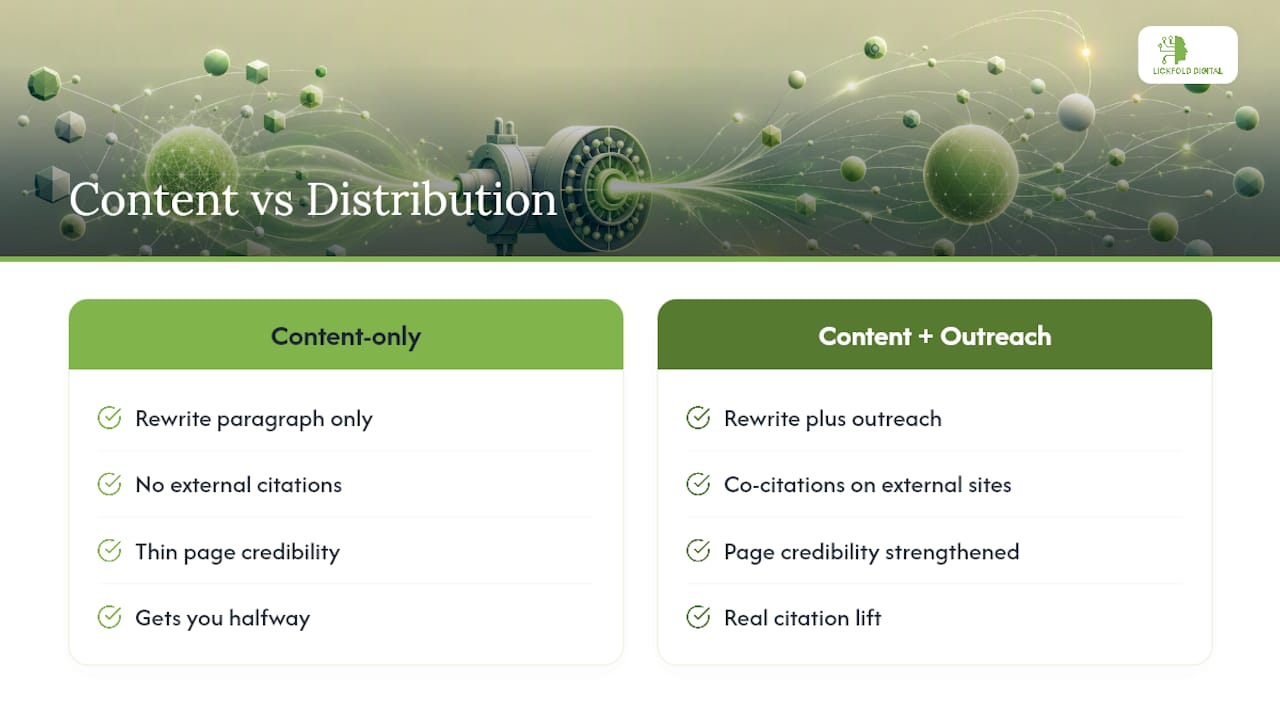
The bigger gap is that most teams treat GEO as a content-only exercise and skip the outreach half entirely. Citation-worthy content matters, but so does existing somewhere AI systems already trust, review sites, industry press, third-party roundups. A brand with zero external footprint can write the most extractable paragraph in its category and still lose to a mediocre one that’s been quoted in five other places already.
Prioritize distribution alongside rewriting. The teams seeing real citation lift right now are pairing structural content fixes with active outreach campaigns that build the co-citations generative engines seem to weight heavily. Content work alone gets you halfway there.
— Duarte
Get Your Content Structured and Distributed for AI Visibility
Lickfold Digital gives marketing teams the outreach engine GEO actually requires, without adding headcount. While the strategies above cover what to fix on your pages, earning the third-party mentions and co-citations that generative engines reward takes sustained, targeted outreach most internal teams can’t sustain month over month.

Lickfold Digital’s AI agents handle the market research, decision-maker targeting, and multi-touch outreach campaigns that turn a rewritten page into an actually cited one, backed by warm-up email infrastructure and reputation management so those pitches land instead of bouncing. Every reply gets human-qualified before it reaches your sales team, so outreach volume never comes at the cost of quality. If you’re already investing in content restructuring for GEO and need the distribution side to match, reach out to Lickfold Digital to see how the two fit together.
Sources
- Generative Engine Optimization (GEO) methods and GEO-bench
- Optimizing your website for generative AI features on Google Search